


APEC ties fuel regional integration: Business leaders


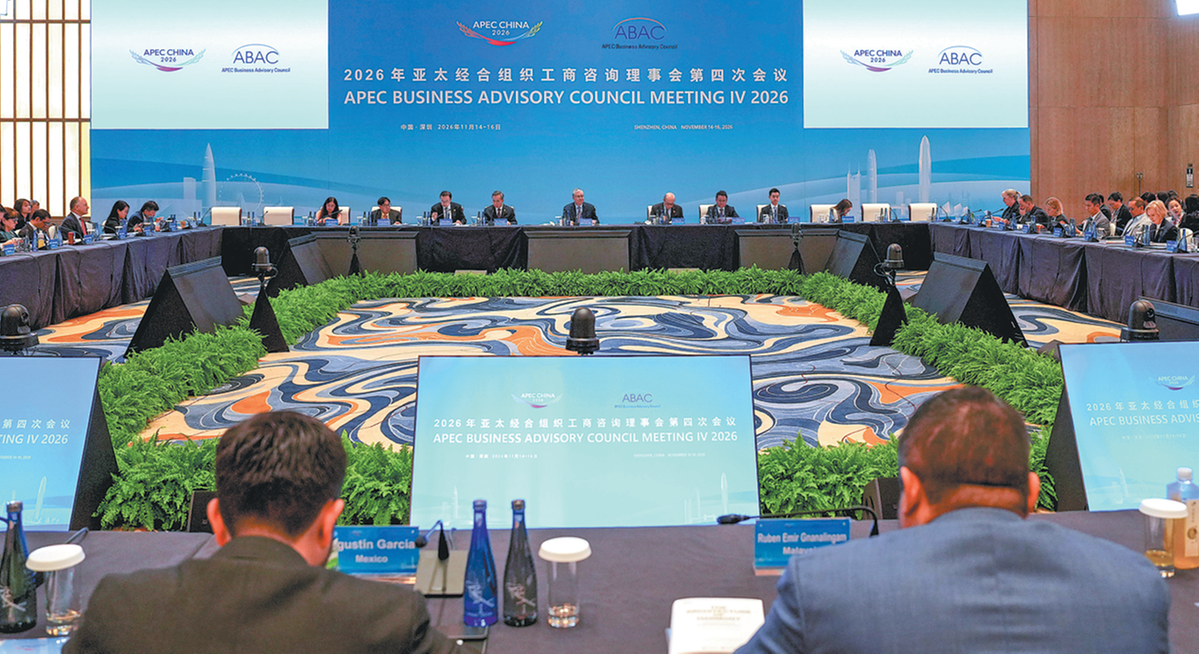
China's commitment to shared development and closer cooperation with other Asia-Pacific Economic Cooperation economies will accelerate regional economic integration, strengthen supply chain connectivity and inject fresh momentum into growth across the region, business leaders said on Monday.
Speaking at a news conference in Shenzhen, Guangdong province, Li Fanrong, 2026 chair of the APEC Business Advisory Council and chairman of State-owned Sinochem Holdings Corp, said deeper cooperation in trade, services, technology and investment would create more opportunities for regional businesses and enable APEC economies to better integrate their industrial and supply chain networks.
Anna Curzon, chair of ABAC's Regional Economic Integration Working Group, said businesses need practical steps to turn the Asia-Pacific's long-term integration vision into lower costs and smoother cross-border trade flows.
She also called for closer regulatory coordination among APEC economies, particularly in digital trade, saying greater interoperability would allow businesses to operate across markets without facing entirely different rule books.
Vivian Jiang, chair of Deloitte China, said China's role in Asia-Pacific economic integration has evolved from that of a manufacturing hub to a key driver of deeply interconnected regional supply chains. Beyond traditional goods trade, the country is increasingly extending its industrial capabilities, capital and technological expertise to other economies in the region.
"Trade volume is only part of the picture, as China's contribution to regional supply chain resilience is anchored in both trade agreements and local innovation hubs," said Jiang.
The implementation of the Regional Comprehensive Economic Partnership, coupled with greater cooperation in digital trade and other areas, is helping lower structural barriers and preserve market openness across Asia-Pacific economies amid global economic uncertainties, she added.
Businesses across the Asia-Pacific are turning closer economic ties into new investments, expanded production networks and growing cross-border trade.
United States-based logistics company FedEx Corp announced on Monday that it had opened a new cargo terminal at Guangzhou Baiyun International Airport in Guangzhou, Guangdong's provincial capital, an investment aimed at strengthening logistics connectivity between South China, other Asia-Pacific markets and the rest of the world.
Shaping global chains
"As a global hub for advanced manufacturing, innovation and cross-border commerce, the Guangdong-Hong Kong-Macao Greater Bay Area is helping shape the future of global supply chains," said Raj Subramaniam, president and CEO of FedEx Corp.
He said the company will continue investing in logistics infrastructure across the Greater Bay Area to support growing demand and create new opportunities for businesses.
At the same time, Chinese manufacturers are also capitalizing on growing trade opportunities across APEC economies.
Shenzhen Pilot Technology Co Ltd has been expanding exports of power banks and wireless chargers to Australia, New Zealand and other APEC economies, according to Shenzhen Customs.
Its exports exceeded 70 million yuan ($10.49 million) in the first 10 months of this year, up 27 percent year-on-year, with APEC economies accounting for the largest share.
"Driven by the global energy transition, demand for lithium battery products is rising, while APEC economies represent some of the world's major consumer electronics markets," said Li Kexiang, the company's general manager.
China's trade in high-tech products with other APEC economies surged 50.3 percent year-on-year to reach 6.66 trillion yuan in the first three quarters, exceeding the total for the whole of last year.
The country's imports of electronic components from other APEC economies increased 56 percent during the same period, according to data from the General Administration of Customs.
