


Bounthavy: CPC self-reform conducive to Lancang-Mekong cooperation


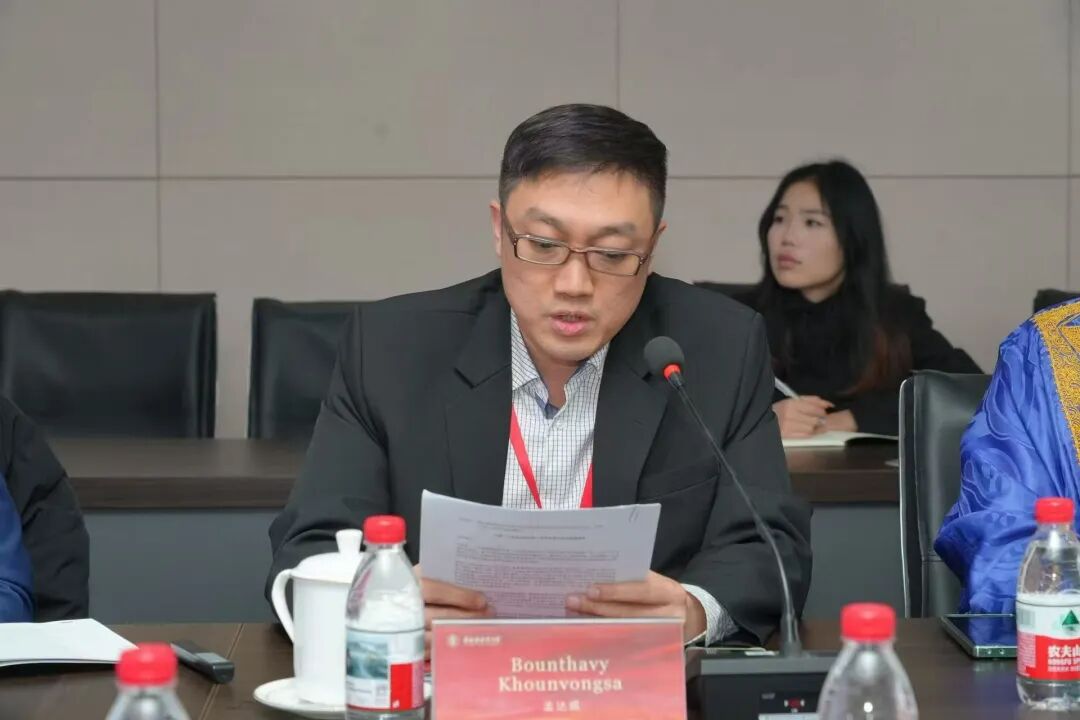
Bounthavy Khounvonsa, writer of the article
The Fifth Plenary Session of the 20th Central Committee of the Communist Party of China (CPC), with an eye on the overall landscape of Chinese modernization, made systematic arrangements for perseveringly advancing the full and rigorous self-governance of the Party. This provides a strong political guarantee for China to advance Chinese modernization and expand high-level opening up during the 15th Five-Year Plan period, and also offers positive expectations for Lancang-Mekong countries to deepen policy alignment and expand room for cooperation.
From the perspective of party governance and regional development, the CPC's governance capacity building with self-reform is the institutional foundation for Chinese modernization to maintain strategic continuity and governance stability. The open and developmental characteristics of Chinese modernization enable its achievements to spill over continuously, forming a multi-level, wide-ranging pattern of common interests with the Mekong countries.
Institutional Foundation Gives Rise to Opening-Up Dividends
The infrastructure connectivity is a prerequisite for regional economic integration, and it is the primary condition for "landlocked countries" to break through geographical constraints and participate in industrial division of labor. The infrastructure for cross-border connectivity has typical attributes of a regional public good, and its planning and implementation require stable policy support and strong execution capacity. The governance advantages formed by the CPC through continuous self-renewal and improvement of its governance model provide an institutional foundation for the implementation of cross-border infrastructure cooperation.
Laos is the only landlocked country in Southeast Asia. Lagging transport infrastructure has long constrained its economic development, and transforming from a "landlocked country" to a "land-linked country" is a strategic goal of national development. The land corridor with the China-Laos Railway at its backbone is a key to the Lancang-Mekong connectivity network. For Laos, the railway has greatly reduced cross-border logistics costs, shortened transport time, improved the market accessibility of local goods, and driven the coordinated development of agriculture, tourism, and logistics, transforming Laos from a geographically landlocked country to a regional transport hub. For the Lancang-Mekong region, the improvement of the land network has reduced the cost of cross-regional flow of production factors, providing hardware for value-chain integration and industrial transfer across regions.
Supporting measures such as highway upgrades, cross-border customs clearance facilitation, and coordinated inland waterway shipping have further amplified the comprehensive effect of connectivity. This cooperation is not a one-way output, but a strategic alignment of development needs. Laos urgently needs to break development bottlenecks and integrate into the regional economic system, while China needs to create room for cooperation with neighbors. The two goals are highly compatible. The Fifth Plenary Session of the 20th CPC Central Committee emphasized further deepening reform and opening up, and China will continue to unleash the dividends of high-level opening up.
Capacity Cultivation: From "Giving Fish" to "Teaching Fishing"
Improving people's livelihood is the core connotation of the right to development and an important goal of governance for all countries. China and the Mekong countries are all developing economies, facing similar challenges and demands in poverty reduction, agricultural development, and public service improvement, which constitute the realistic interest basis for cooperation in people's livelihood. China's accumulated experience and capacity in people's livelihood governance are essentially the practical outcome of the ruling party optimizing the governance system through self-renewal and continuously responding to people's livelihood demands.
The Lancang-Mekong cooperation in people's livelihood is not one-way aid, but experience sharing and local capacity cultivation oriented toward capacity building, with its common interests reflected in the joint improvement of development capacity. In poverty reduction, the governance mechanism formed by China through targeted poverty alleviation practices can be used by Laos, which is still in the critical stage of poverty reduction. Laos and China carried out experience exchange through grassroots cadre training and village-level development projects. This not only helps Laos improve its local poverty reduction system, but also provides a practical scenario for exploring the localized adaptation of China's experience in Laos.
Capacity building in agriculture and human resources is even more prominent. Agriculture is the pillar industry and foundation of people's livelihood in Laos. China promotes the localization of hybrid rice and cash crop through technology demonstration bases, expert dispatch, and local talent training, enhancing Laos' food security and farmers' income. Cooperation in education and medical care focuses on human capital accumulation, and thanks to scholarship programs, vocational and technical training, and medical assistance, countless professionals have been cultivated for Laos. In the long run, the improvement of people's livelihood and human resources in Laos will provide stronger support for regional industrial cooperation.
Jointly Building the Governance System for Lancang-Mekong Region
At present, the momentum of global economic recovery is insufficient, and the cross-regional spillover of challenges such as climate change and industrial chain restructuring continues to increase. No single country can independently cope with the systemic risks. Deepening regionally coordinated governance and jointly addressing challenges is an inevitable choice for Lancang-Mekong countries and a manifestation of the common interests between China and Mekong countries.
Since its launch, the Lancang-Mekong Cooperation mechanism has gradually formed a multi-level, wide-ranging framework for regional governance. The principle of extensive consultation, joint contribution, and shared benefits it upholds is in line with the development stage and realistic needs of regional countries, avoiding the inequality problems born by mechanisms dominated by external countries.
China is the largest economy in the region, and the improvement of governance capacity brought by the continuous self-renewal of the CPC, the ruling party of China, provides experience, technology, and resource support for regional public-affairs governance. The CPC’s self-reform is an important stabilizing force in the regional governance system.
In conclusion, the Chinese modernization is not a closed endogenous development process; its institutional advantages and governance capacity have significant spillover effects in the Lancang-Mekong region. The convergence of interests between China and Mekong countries runs through different aspects of development. The interest convergence runs from the supply of connectivity public goods, to the sharing of capacity building for people's livelihood, and to the coordinated governance of regional affairs.
The governance stability brought by the CPC's self-reform provides an important predictability guarantee for regional cooperation. Standing at a new start, the six countries will further open ground for Lancang-Mekong cooperation. Laos should further align its development strategy with China, enhance the compatibility between cooperation and Laos' development needs, and achieve its own development goals in the common development of the Lancang-Mekong region.
Writing by Bounthavy Khounvonsa (Laotian Specialist in Chinese Affairs); Trans-editing by Wang Shixue, Yang Chunmei and Liu Ziyu
