


Pseudo-Arunachal hydro project makes India caught in the middle


The Siang Upper Multipurpose Project (SUMP) was once again faced large-scale protests on September 30, 2026. Being advanced by Indian government, the hydropower project is located in China’s Zangnan region, hereafter referred to as the “pseudo-Arunachal Pradesh”. That day, as the territory’s so-called “Chief Minister” Pema Khandu visited the project sites, he was met with shop closures, road blockades, and protests.
On October 23, the situation in pseudo-Arunachal Pradesh escalated further. Local police used tear gas to disperse protesters, and the office of India’s National Hydroelectric Power Corporation in Pasighat was set on fire. New Delhi then deployed additional police forces. Pema Khandu again called for dialogue, attributing local concerns to “misinformation and misunderstandings” on the project.
To date, the massive project—with a planned installed capacity of about 11,200 MW and endowed with strategic significance by India—remains stuck at the stage of pre-feasibility study. The central and pseudo-Arunachal Pradesh governments have used administrative coordination, public relations campaigns, and even armed force, but they still failed to quell resistance from affected villages.
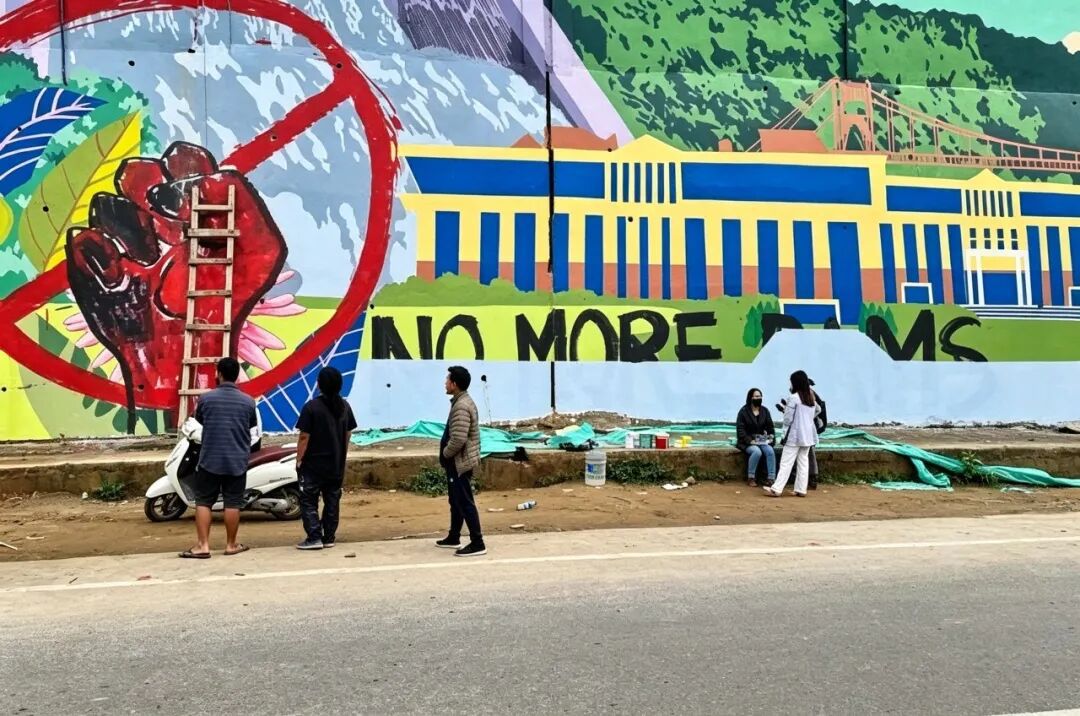
A poster against the Siang Upper Multipurpose Project (SUMP) is set up in pseudo-Arunachal Pradesh.
Interest Calculations of the “Central”, “Local” Authorities
For the pseudo-Arunachal Pradesh government, large hydropower projects mean investment from central government, electricity revenue, and fiscal resources. On October 6, Pema Khandu emphasized in a public speech that hydropower development can strengthen the economy through free electricity and equity returns, and he framed hydro projects as a path to expand autonomous fiscal capacity. The sheer scale of the SUMP makes it a key project for local authorities to attract investment and deliver on development promises.
In recent years, India has added a stronger strategic dimension to the project. As China advances the downstream Yarlung Tsangpo hydropower project, India has kept amplifying alleged risks of water cutoff and sudden dam releases, packaging the SUMP as a necessary measure to safeguard India’s “water security.” Pema Khandu even claimed that China might use its dam as a “water bomb.”
For Modi and the BJP, linking “local” hydropower development directly to competition with China helps mobilize domestic nationalist sentiment and provides a justification for demanding that the “locality” fall in line with a “strategic arrangement.” Putting concrete issues—land acquisition, displacement, environmental impact—into the grand narrative of rivalry with China makes it seem only natural that local residents should sacrifice for the so-called national interests.
The shifting stance of politicians illustrates this point vividly. The Indian Express disclosed that Ojing Tasing had once traveled to New Delhi as an anti-dam activist demanding cancellation of hydropower projects in the valley. Today he chairs the Empowered High-Level Committee coordinating the SUMP’s preliminary surveys, and now argues for building the dam by citing China’s engineering works.
But this rhetoric has also boxed the government in. Having repeatedly sold the SUMP as a necessary counter to Chinese projects, the central and pseudo-Arunachal governments must now prove they can actually deliver it. Prolonged stagnation exposes weak policy implementation; voluntarily scrapping it would not justify their own security narrative. Pushing the SUMP at all costs has thus become a requirement for preserving both policy credibility and a tough-on-China posture.
This political need has made the tussle between the “central” and “local” governments more visible: Opponents know full well that once pre-feasibility study is completed, the dam will be hard to stop. So they resisted at the stage of pre-feasibility studies.
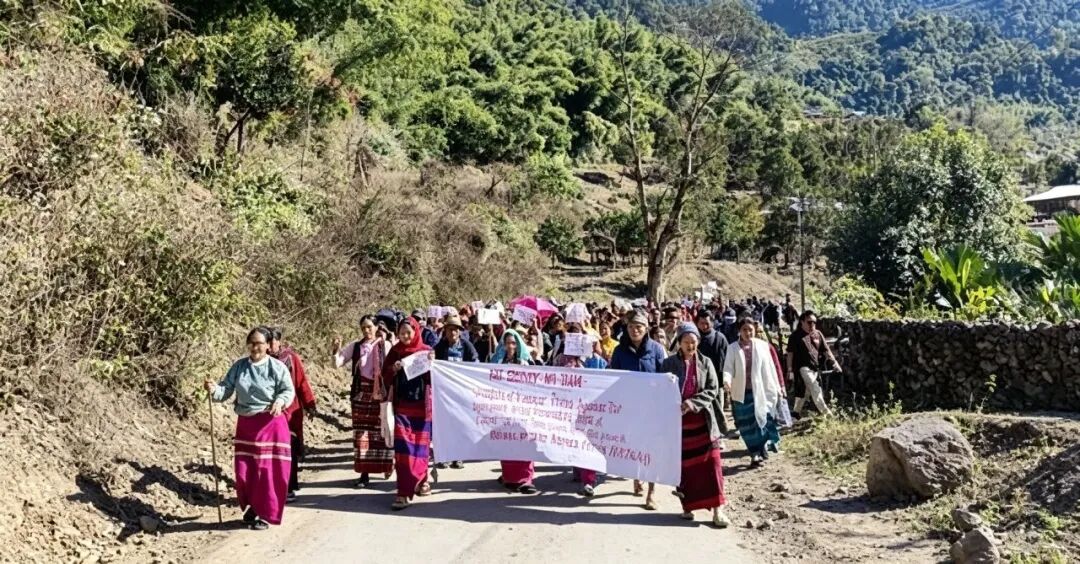
A protest against the Siang Upper Multipurpose Project (SUMP) is seen in pseudo-Arunachal Pradesh.
Resistance from Local Communities
For the local Adi people of the Lhoba ethnic group in pseudo-Arunachal, their ancestral land sustains livelihoods, clan ties, and historical memory alike. Riga village, for instance, is one of the oldest Adi settlements in the area. The riverside villages carry the memories of multiple clans, while farmland and orchards provide steady income for villagers. Opponents in the villages fear that even with resettlement and compensation, they could never regain equivalent farmland, resource-use rights, or community standing after relocation. One-off compensation simply cannot buy consent.
The resistance also rests on a long-built organizational base. The Siang Indigenous Farmers’ Forum (SIFF) has for years mobilized affected villages against large dams. In August 2025, SIFF convened the Adi traditional council—the General Bogum Bokang Kebang (GBBK)—in Geku to oppose the dam and the pre-feasibility studies. Clan networks, village institutions, and traditional deliberation have stitched together a durable, cross-village opposition.
More crucially, these villages can directly shape the on-site conditions the surveys require. The NHPC submitted an initial pre-feasibility report covering three alternative dam sites in December 2022, but the final site selection still needs supplementary drilling and geophysical investigation. On September 14, villagers on both banks of the proposed Uggeng dam site stopped drilling equipment from entering. By late October, the NHPC staff on the project admitted that field surveys could not move forward and the site could not be finalized. Drilling requires machinery access, personnel stay-over, and supply lines; repeated road blockades and entry refusals have left the geological data for site comparison incomplete. Local opposition has thereby acquired real power to stall the project.
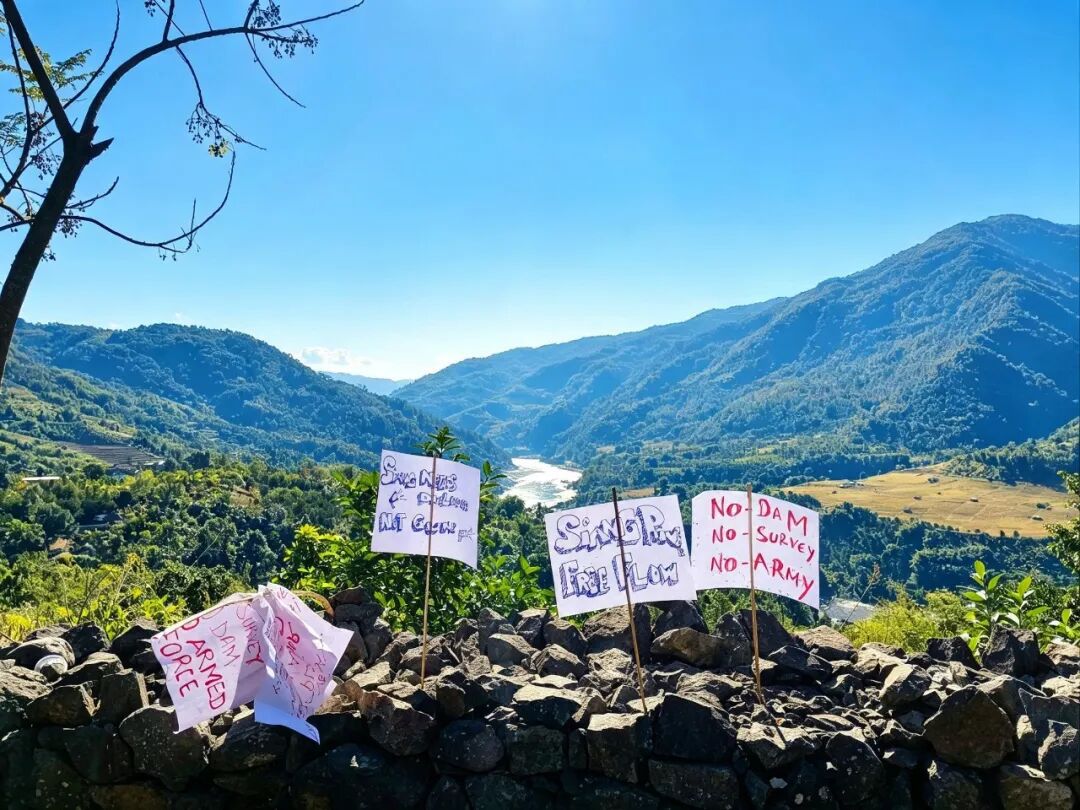
Posters against the Siang Upper Multipurpose Project (SUMP) are seen in pseudo-Arunachal Pradesh.
Soft and Hard Tools Both Fail to Calm Down Locals
Faced with grassroots resistance, the Indian central government tried to respond with a mix of hard coercion and soft persuasion, but it got the opposite result, piling up political costs against itself.
On the soft side, both public relations and financial pacification flopped. The NHPC pinned its hopes on a public-relations firm, extending the contract to November 2026 at a total cost of about ₹109 million, and the firm tried to flip the “negative narrative” via elders and media outlets. But the villagers’ demand is to halt surveys and cancel the project, making the two sides fundamentally incompatible. On money, the central government approved a ₹3.5 billion special development package, yet the signing procedure for pre-feasibility consent documents is widely disputed. Komkar villagers say they were induced to sign as “beneficiaries” of agriculture schemes. Whether signatories were truly informed goes directly to the credibility of the consent—so the funds didn’t buy away the doubt.
On the hard side, intervention by force has backfired immediately. The government promised to respect villagers’ wishes while deploying police to protect the survey work. To residents who already distrust the signature process, using coercion at the preliminary stage signals it’s impossible to refuse the authority at the dam-building stage. On October 10, the youth wing of the Siang Indigenous Farmers’ Forum made “withdraw police, drop cases, release detainees, compensate losses” a precondition for any dialogue; the subsequent tear-gas dispersal and the torching of the NHPC office pushed things further over the edge.
The hard approach also triggered a chain of political blowback. Former Chief Minister Gegong Apang demanded the project be scrapped outright, and the Congress party called for disclosure of the resettlement plan and an audit of the development funds. The money meant to win over villagers has now become an entry point for attacks from the opposition party. Arrests and reporting restrictions raised questions about due process and press freedom, and on October 14 the East Siang district court granted interim arrest protection to 13 applicants. The International Rivers organization also spoke out against the militarized deployment. New Delhi wanted the project to showcase its capacity to guard national security, but its treatment of affected residents handed fresh evidence to outside critics.
The Modi Government Gets Stuck in Hydro Project
To resume the preliminary surveys, the Indian government must first negotiate on machinery access and continuous work conditions with the villages around each candidate site. Keep relying on police, and it must sustain security spending and absorb clash risks. If the government switches to consultation, it has to handle land acquisition, resettlement for villagers, and dispute over arrests. Each of the issues touches collective decisions inside the villages and earlier government promises. And the project itself still faces a long procedural tail: Even after a site is chosen, a Detailed Project Report and further clearances are needed. The NHPC staff conceded the work after pre-feasibility studies alone will take years.
Through the remainder of Modi’s term, the government will keep invoking the China-security rationale to gain support for the SUMP. But the project will likely oscillate between resistance and renegotiation for a long time, with the prospect of actual construction growing dimmer. The more loudly New Delhi elevates the SUMP as a trophy in the contest with China, the more the prolonged deadlock will expose Modi’s inability to manage the conflicting “central” and “local” interests.
Writing Ye Weijie (Member of the South Asia Research Group and PhD Candidate at Yunnan University); Trans-editing by Wang Shixue and Han Chengyuan
