


Why is Modi's strongman aura fading away?


For India, 2026 is an eventful year. The US-Israel-Iran conflict has driven up commodity prices and dealt a heavy blow to India's economy. Large-scale domestic protests have damaged Prime Minister Narendra Modi's image and the BJP's grip on power. Yet, Modi has not projected the strongman image he once did. Instead, he has lapsed into a kind of political silence, allowing international media, domestic opposition parties, and public opinion to criticize him freely.
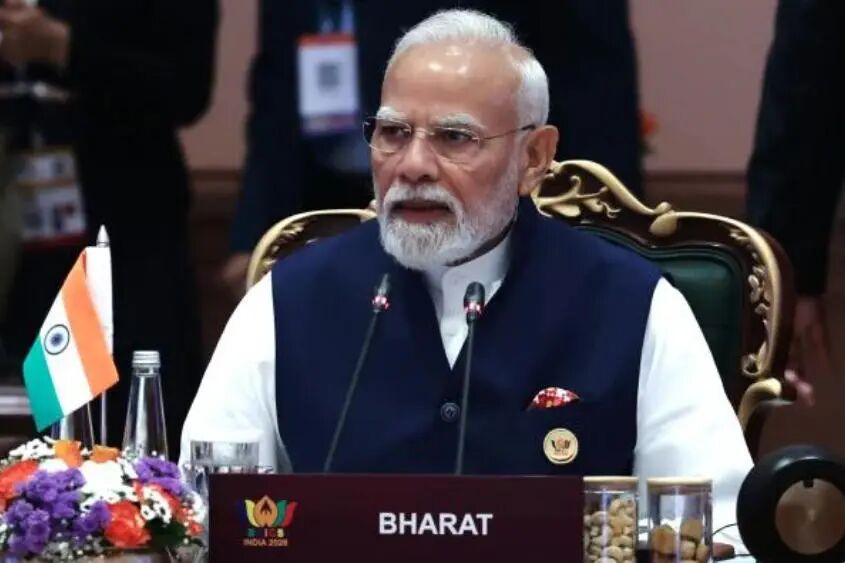
Prime Minister Narendra Modi
External Fractures in a Fading Aura
Modi has long presented himself as a tough leader. This tough image is rooted in the Indian domestic politics. However, Modi has not markedly enhanced India's national strength, and his political and diplomatic image was built on the premise of relative domestic stability and an international environment favorable to India. Once that premise is broken, it is bound to deal a fatal blow to his domestic and diplomatic image.
On the one hand, the defeat in the air battle with Pakistan in May 2025 exposed India's military weakness for all to see. Although India soon dispatched overseas publicity delegations to promote its military success in Operation Sindoor, everyone knew this was just another political performance for the domestic audience.
On the other hand, the US attitude toward India has undergone a dramatic shift. Shortly after the Russia-Ukraine war broke out, the US and the West kept pressuring India to take sides on what they called issues of major principle, demanding that India cut ties with Russia and stop importing Russian oil. However, the Modi government read the West's inherent weakness and believed that the West needed India to contain China's influence, so it had the confidence to take a tough stance.
But this approach did not work during the Trump era. Over the past year or so, the Trump administration has pressured Modi on tariffs, Russian oil, immigration, and India-Pakistan relations. The key reason for the US shift toward India is that Trump prioritizes concerns about American decline over the need to balance China, so India's strategic importance to the US has dropped sharply. Trump's shift caught Modi off guard, leaving him unsure how to respond.
More critically, Trump's unconventional behavior and disparaging remarks about Modi have put Modi in an extremely awkward position internationally. For example, when discussing US-India arms sales and tariff negotiations in January, Trump imitated Modi's tone and accent on the spot, saying: "Prime Minister Modi came to me and said, 'Sir, may I see you?'" When discussing the Russian oil issue, Trump demanded that India sharply cut its oil imports from Russia and said: "Prime Minister Modi is a very nice person. He knows I'm not happy. Making me happy is very important."
Observers in India and abroad generally believe that this was Modi's pragmatic and calm diplomatic strategy toward the US when under pressure from Trump, and the low profile was adopted to avoid further provoking the vindictive Trump. But the meekness of Modi's tone, the submissiveness of his attitude, and the speed of his turnaround stood in stark contrast to the tough-guy image he has always promoted.
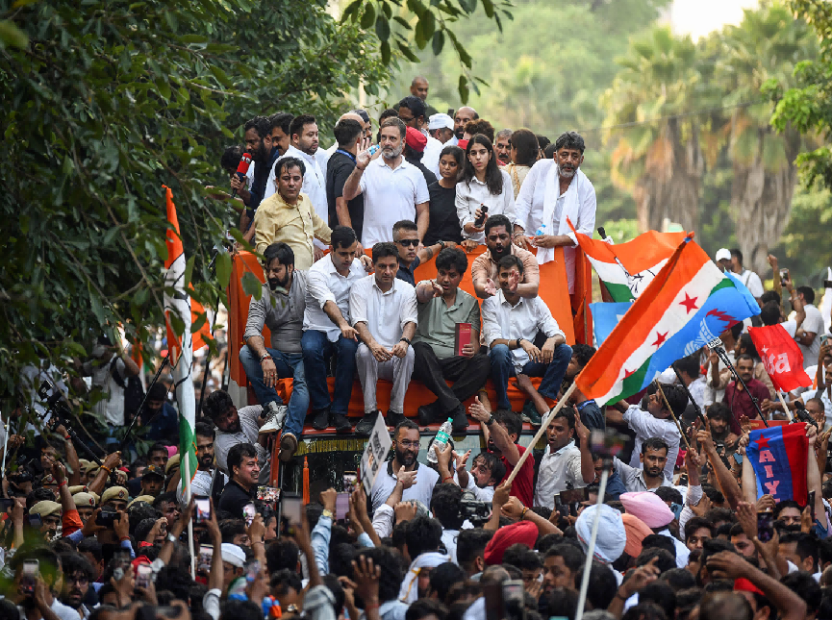
A protest in India
Governance Failure in Domestic Protests
Modi's strongman image has not only collapsed internationally but has also begun to crumble domestically.
First, two large-scale protests broke out in India in less than four months.
In the recent protests against the illegality of the SIR process, Modi's biggest problem is that his authority as head of government, and the final decision-making power that embodies that authority, is facing a major challenge. Even if Gyanesh Kumar, the central figure, is not Modi's confidant, Modi absolutely cannot concede to the protesters' demands and dismiss a specific official, or he will be seen as weak, causing the government's authority to be swept away and making governance unsustainable.
However, as the top decision-maker, Modi is often forced into a corner. After all, the BJP's more than a decade in power has accumulated too many political, economic, and social ills and loopholes, many of which even carry fatal risks. If Modi and the BJP focused their main energy on fixing these loopholes, they would be entangled by opposition parties and lose more votes. Therefore, the BJP's playbook over the past decade or so has been to use new issues to cover up old controversies. In other words, when it comes to innovation in setting political agendas, Modi can only move forward, because retreating carries enormous and unknown political risks.
If Modi dismisses important officials out of fear of protests, it means he has already stepped onto the fast track of retreat. Modi's dismissal of Education Minister Dharmendra Pradhan during the NEET protests in June-July 2026 has in fact set a precedent. If Modi cannot withstand the current wave of SIR protests, it will mean the Modi government is heading into an even bigger crisis.
Second, Modi's ability to set political agendas is weakening.
One of the most important abilities for a politician is to set political agendas. Well-set agendas can effectively accomplish political mobilization. Over the past 12 years, it is precisely by constantly refreshing political agendas, especially economic issues, that Modi has been able to win domestic social support amid constant risks and challenges.
In this process, Modi seems to have fallen into a certain dilemma. A political agenda or initiative should revolve around some abstract concept and should avoid concrete matters. Take the difference between "Modi will lead the Indian people toward a better life" and "India will become a developed country by 2047" as an example. The former is abstract enough and less attractive, but it has enough room for political interpretation and is hard to falsify, while the latter is concrete enough and highly attractive, but its test standards are very clear, and once falsified, people will easily lose their confidence and trust in the government.
Nevertheless, Modi has no choice but to rely on repeatedly setting economic agendas and placing them at the core as much as possible—because Indians desperately need to build economic confidence. The result is that concrete economic indicators increasingly replace political goals that should be abstract, so that when these economic indicators repeatedly fall short, the political room for maneuver available to the Modi government shrinks sharply. On the surface, Modi still has many supporters, but their stickiness has clearly declined.
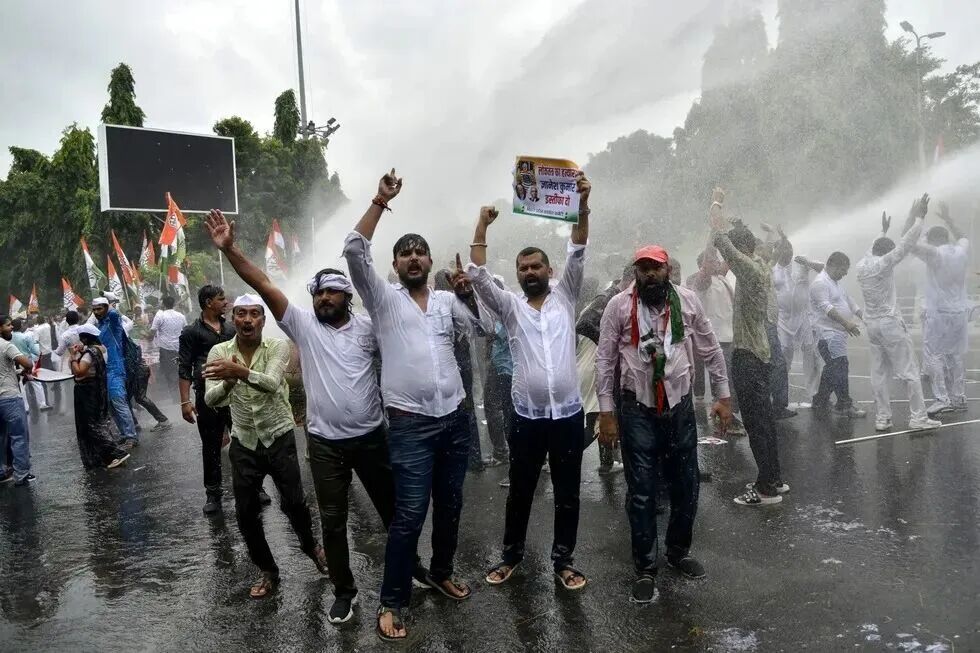
A protest in India
Finally, Modi's governance capacity appears weak and cannot sustain a strongman image.
For a long time, Modi's strongman image has been highly bound up and fused with the political agendas and initiatives he touts. Whenever Modi rolls out a new agenda, he is always full of grand rhetoric, shows firm determination, and has the BJP tirelessly promote these agendas and initiatives, such as "Digital India," "Self-Reliant India," "a $5 trillion economy by 2025," "a Developed India 2047". Whenever Indian people hear Modi's new initiative, they will reflexively think of Modi's tough image. But these two protest incidents brought that tough image to an abrupt halt.
Judging from the causes, course, and response measures of the two Jantar Mantar protests, Modi's most prominent feature is "incompetence," while the BJP's most prominent characteristic is "rigidity."
In its initial stage, the NEET protest was not uncommon in India, but it quickly fermented into a large-scale protest. This shows that the Modi government's traditional response procedures and governance capacity have already sounded a failure warning. From the outbreak of the NEET protest to the founding of the "Cockroach People's Party" and then to the Jantar Mantar protest, only a little over a month passed. Compared with other large-scale protests, the time span of the protests is short enough; but for the Modi government's response, this month is long enough.
Writing by Bai Guangcan (Member of the South Asian Studies Group on WeChat); Trans-editing by Wang Shixue and Liu Ziyu
