


ICCOS helps get rid of online scams in Lancang-Mekong region


The 2026 International Conference on Combating Online Scams (ICCOS) was held in Phnom Penh, Cambodia, from September 23 to 24.
The event was attended by Cambodian Prime Minister Hun Manet, together with some 300 representatives from nearly 30 countries and international organizations.
This conference can be seen as a landmark event: the governance logic for cross-border online fraud in the Lancang-Mekong region is undergoing a fundamental shift.
Online scam has never been a problem of a single country. The chronic problem can only be solved through regional coordination, pragmatic action, and fusing security into development.
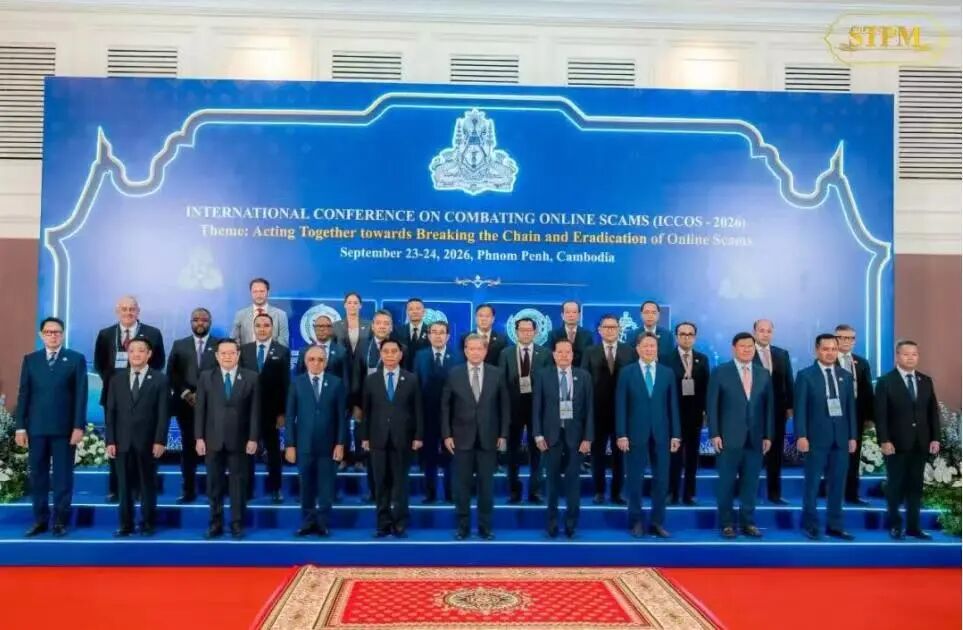
Attendees at the 2026 International Conference on Combating Online Scams (ICCOS)
From Single-Country Effort to Lancang-Mekong Action
For a long time, the international observers have generally seen online scams as a problem of Cambodia alone, and they have even labeled the country "a hub of online scams." This view is one-sided. The online fraud is a typical form of transnational crime, and the criminal chain is spread across multiple countries.
Because of the national borders, criminal gangs can move personnel, funds, and servers back and forth, and it is very difficult to completely cut off criminal networks at the root through law enforcement action by a single country. This also means that regional cooperation is indispensable for combating such crimes.
A key signal sent by this conference is that countries in the Lancang-Mekong region are accelerating the formation of a common understanding. Despite previous differences between Cambodia and Thailand, the Thai official responsible for anti-scam affairs still participated in the dialogue. This shows that in the face of a common security threat, countries can set aside contradictions and seek cooperative solutions.
The conference adopted the Phnom Penh Declaration, and the document specifies 11 commitments that include blocking criminal chains, using technological innovation, strengthening legal policies and regulatory frameworks, enhancing capacity and resilience, improving victim protection, implementing the principle of "not punishing victims," and preventing fraud and human trafficking.
The deeper significance of these commitments lies in the fact that the scopes of Lancang-Mekong cooperation are expanding, and non-traditional security governance is becoming an increasingly important area of cooperation. Countries are increasingly recognizing that combating online scams is not the responsibility of any single country, but a security issue faced jointly by the entire river basin. It is necessary to establish a collaborative governance mechanism that is long-term and stable.
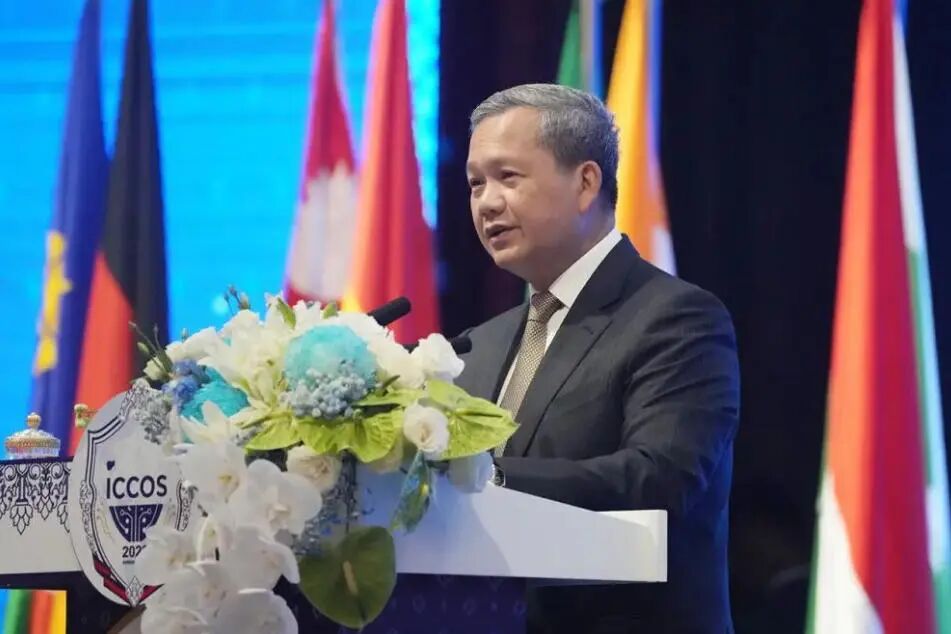
Cambodian Prime Minister Hun Manet speaks at the 2026 ICCOS.
Cambodia-China Cooperation Makes an Example for Regional Anti-Scam
Regional consensus on fighting online scams cannot remain to be declarations in document; ultimately, it needs to be implemented through pragmatic joint action between countries. Cambodia-China collaboration in the anti-scam field is a typical case in point.
China has been seriously affected by online scams, so it has zero tolerance for the crimes. Cambodia has inspected hundreds of involved sites and dismantled 86 major fraud gangs. By bringing hundreds of cases into judicial proceedings, the country has frozen hundreds of millions of dollars involved in the cases.
Among these, the most landmark achievement comes from the efficient law enforcement collaboration between Cambodia and China. The two sides captured the top leaders of telecom fraud who had long been entrenched in Cambodia, including Chen Zhi, founder of Cambodia's Prince Group, and Li Xiong, former chairman of Huione Group, among others.
The value of the Cambodia-China actions goes far beyond the solving of individual cases. They prove that national borders are not a "safe haven" for transnational criminal gangs, and that the cooperation model of "intelligence sharing, joint arrest and suspect transfer" has been proven feasible. For other Lancang-Mekong countries, the practical experience is worth learning, and it helps combat similar cross-border crimes in the region.

A coastal city of Cambodia
Anti-Scam Efforts Are Reshaping Cambodia
Combating online fraud is not only a security governance task. The conference has improved the international image of Cambodia and development prospect in the Lancang-Mekong region.
In the past, overseas public opinions amplified Cambodia's telecom fraud problem, portraying the entire country as a "dangerous place" through one-sided narratives. This labeling-style dissemination hit the confidence of foreign investors and tourists, affecting the Cambodian opening-up. Cambodia's initiative to host this international conference is itself a practical action to respond to external prejudice.
As scam parks are cleared, criminals are brought to justice, and regional security cooperation mechanisms continue to improve, the international community's perception of Cambodia is gradually changing.
Security is the foundation for investment, tourism and people-to-people exchanges under the Belt and Road Initiative and the Lancang-Mekong Cooperation. If the Cambodian anti-scam efforts continue, external trust in Cambodia will rebound. As more investors and tourists from various countries, including China, come to Cambodia, more international flights will be operated.
However, online fraud gangs iterate quickly, so governance cannot be achieved overnight. The consensus formed at this conference is a new starting point, not the end. The international anti-scam effort needs to be advanced over the long term, for differences in national legal systems will not disappear soon. It also takes time to track cross-border funds, protect the victims, and build governance mechanisms.
Writing by Soy Sopheap (President of the Cambodian DAP Media Center); Trans-editing by Wang Shixue, Shen Yan and Liu Ziyu
