


Is the UK about to split into four?


Scottish First Minister John Swinney, Welsh First Minister Rhun ap Iorwerth, and Northern Ireland First Minister Michelle O'Neill met in Cardiff on September 14, and they signed a memorandum of understanding with the presence of Mary Lou McDonald, president of the Sinn Féin party popular in Irland. The memorandum calls on the United Kingdom (UK) government led by Prime Minister Andy Burnham to prepare for a constitutional change. The three sides pledged to strengthen cooperation on the economy, energy, and relations with Europe, and they will support the peoples of the three regions in deciding their own future.
This is the first time that the first ministers of all three devolved regions of the UK are from parties that advocate leaving the United Kingdom. The three parties declared that the era of Westminster is coming to an end. However, between a joint statement in consensus and a change in the UK national map, there still lie the gaps of public opinion, legal procedures, and political realities. To understand this summit now as meaning the UK is about to split is clearly going too far.
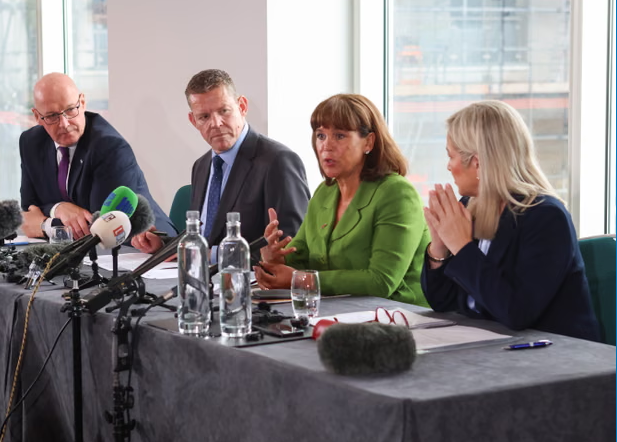
Left to right: John Swinney, Rhun ap Iorweth, Mary Lou McDonald and Michelle O'Neill
Three different paths to governing
To begin with, it is necessary to distinguish the identities of the several people at the meeting. The Independent Television noted that they attended this trilateral meeting in their capacity as leaders of their respective parties. The Cardiff Agreement separately signed that day by the Scottish and Welsh governments is an intergovernmental cooperation document, but this agreement only concerns matters such as child poverty, the cost of living, and public policy, and explicitly is not legally binding. Moreover, neither the memorandum among the three parties nor the agreement between the two regions contains any wording about launching a referendum, let alone a timetable for the three regions to leave the UK simultaneously.
The three parties are also not moving in step. Swinney and the Scottish National Party are seeking another referendum before the end of the current Scottish Parliament term in 2031, Sinn Féin hopes for a vote on Irish unification by 2030 at the latest, and Plaid Cymru has explicitly ruled out an independence referendum during the current parliamentary term ending in 2030. For now, the memorandum demands that London transfer the authority to decide whether to hold a referendum. But fighting for this power and deciding to use it are different things.
The latest change that made this gathering possible came from Wales. In May this year, Plaid Cymru won 43 seats in the Welsh Parliament, which was expanded to 96 seats, while Labour was left with only 9 seats, ending the history of Labour's continuous dominance in the Welsh government since the devolved body was established in 1999. Reform UK took 34 seats and became the largest opposition party. However, the government formed by ap Iorwerth is only a minority government, and legislation and budgets still require support from other parties.
The 2016 UK referendum on leaving the EU indeed further amplified disputes over London's decision-making in different parts of the United Kingdom. At the time, most voters in Scotland and Northern Ireland supported remaining in the EU, while Wales supported leaving. Therefore, the three parties' shared advocacy this time for stronger European ties only reflects the similarity of their party positions, and it is far from enough to infer from this that the societies of the three regions have already formed similar identities as independent nations.
Three sets of devolution arrangements within the UK
As a United Kingdom mainly composed of four political divisions, the UK's devolution has no one-size-fits-all blueprint. The three regions are all parts of the United Kingdom, each with an elected parliament and government, but none has the status of a sovereign state, and their powers come from different laws. The UK Parliament in Westminster still retains ultimate legislative authority, and matters such as foreign affairs and defense are handled by London. The differences among Scotland, Wales, and Northern Ireland today stem both from the history of how each entered the United Kingdom and from arrangements formed through successive negotiations afterward.
Scotland was once an independent kingdom. In 1707 it merged its parliament with England's, yet it long preserved institutions such as its own legal system. A 1997 referendum approved a devolution plan, and in 1999 the Scottish Parliament resumed operation, with matters such as education, health care, and justice handed over to the elected devolved body. Several subsequent rounds of devolution further expanded the tax and some welfare powers. It already has considerable room in day-to-day governance, and the current controversy centers on whether these powers can be extended to national status.
Wales started from an even lower status. Historically it was only a principality conquered by England, and in the 16th century it was incorporated into England's legal and administrative system. Its 1997 devolution referendum passed only by a narrow margin. The Welsh Parliament established in 1999 initially mainly handled administrative and secondary legislative matters, and only after subsequent reforms, especially the 2011 referendum, did it obtain fuller primary legislative powers. It can manage health care, education, and housing, and also has some tax powers, but policing and justice remain in the hands of the UK government, and England and Wales still belong to the same jurisdiction.
Northern Ireland's devolution is tightly linked to peace arrangements. After the partition of Ireland in 1921, the six counties in the north remained in the UK and once had their own parliament. Amid escalating conflict in 1972, direct rule from London was imposed. The 1998 Belfast Agreement laid the foundation for restoring devolution, with government power shared between nationalists and unionists to ensure both sides' participation. Although the first minister and deputy first minister differ in title, they jointly head the government, and usually there is no superior-subordinate relationship. Policing and justice powers in Northern Ireland were not devolved until 2010.
How much is Burnham willing to give up?
The three parties chose this moment to join forces because they have their eye on the new prime minister's political experience and the promises he made after taking office. Andy Burnham served for a long time as mayor of Greater Manchester and has consistently criticized the excessive concentration of power in London. After taking office, he also promised to deepen devolution. A Financial Times report pointed out that nationalists in the three regions are borrowing Burnham's own rhetoric to advance their demands. If the “localities” like London, Manchester and Birmingham should have more decision-making power, the political divisions of Scotland, Wales and Northern Ireland should seek further devolution of power.
Burnham has already tasted the trouble caused by his vague wording. On September 9, he said in the House of Commons that Scotland could hold a vote if a clear consensus in favor of another referendum is formed; but the next day, in a letter to Swinney, he reiterated that independence and a referendum were not under consideration. Swinney seized on the first sentence and declared that Burnham might become the last prime minister of the United Kingdom. The UK government once again stressed that priority should be given to the cost of living for families and employment. This exchange shows that Burnham is willing to discuss devolution, but he cannot accept a reform led by nationalists.
The direct pressure the Cardiff summit puts on Burnham is to make him explain how far his devolution promises can actually be implemented. If he is willing to compromise on specific powers, finances and intergovernmental talks, there is still room to advance devolution reform; if his response remains to be lip service for a long time, the three parties will continue to blame London for governance difficulties. This three-party summit certainly has not put the UK on a countdown to breakup, but the gathering has made it hard for Burnham to avoid a question: In the United Kingdom he advocates rebuilding, how much can the three regions decide for themselves?
Source: China News Weekly; Trans-editing by Wang Shixue
