


Xiangshan Forum sheds light on Asian peace, security governance


The 13th Beijing Xiangshan Forum was held from September 15 to 17. Under the theme "Build Consensus on Stability, Advance Security Governance Together", this year's forum brought together about 2,000 officials, experts, scholars and observers from over 100 countries, regions and international organizations.
In the keynote speeches at the forum, Singapore's Minister for Public Service and Minister for Defence Chan Chun Sing and Vietnam's Deputy Prime Minister and Minister of National Defence Phan Van Giang both mentioned Asian security, and they occasionally interspersed their speeches with Chinese idioms and sayings, impressing the Chinese participants and giving rise to different interpretations.
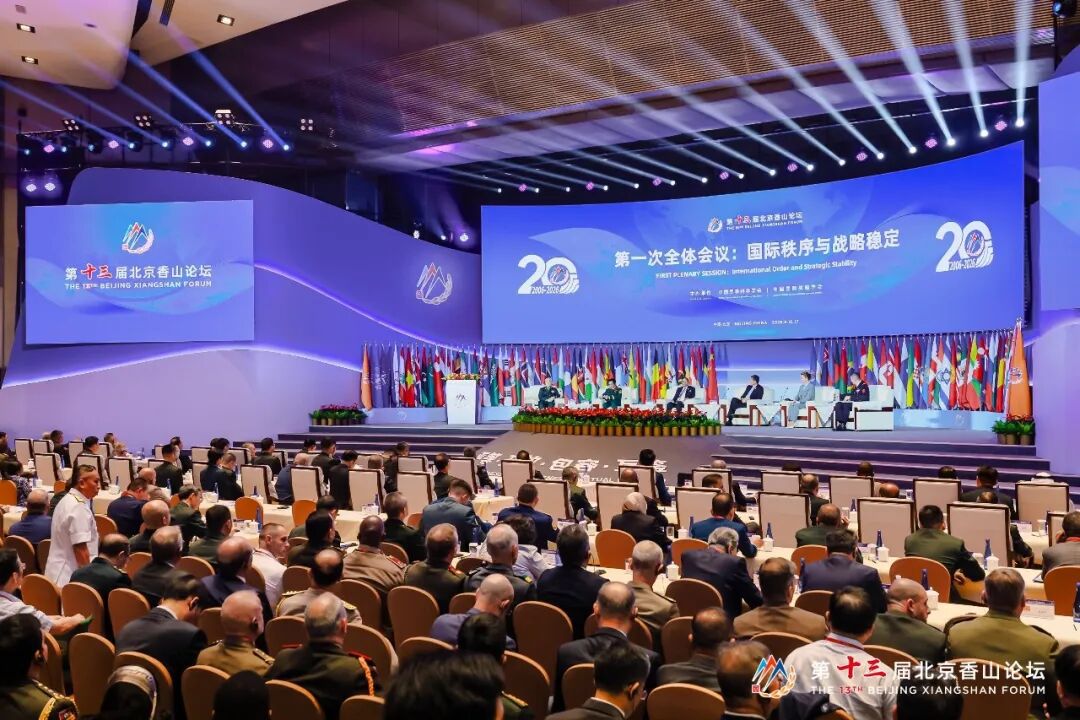
The 13th Beijing Xiangshan Forum goes on from September 15 to 17.
Asian peace has never mattered so much
The Beijing Xiangshan Forum has become a world-class brand of security dialogue. This year it has just passed its 20-year journey. From the first session, when there were only more than 20 representatives from just over ten countries, to the 13th session, when representatives from more than 100 countries and regions participate, it has become a large-scale security forum that attracts worldwide attention, with ever greater appeal. As a participant, witness, and firsthand observer of many previous forums, the author personally feels that peace and stability in the Asian region have never been so highly concerned about and valued as they are this year. The reasons are as follows.
First, the intensified of global conflicts carry the risk of spillover. Statistics show that the number of armed conflicts in 2025 hit a new high since the end of World War II. The U.S.-Israel-Iran conflict has further intensified regional tensions, and severe fluctuations in the international energy market have in turn impacted the global economy, causing historic changes in some countries. Against such a background, whether the Asian region can become a last pure land is undoubtedly a matter of deep concern for many countries.
Second, the overlap of risks in maritime corridor security and the application of emerging technologies such as AI and others has also made Asian countries more anxious, especially some small and weak countries in Southeast Asia. They worry that they will be drawn into the security game among major powers over maritime corridors, they fear being marginalized in the development of emerging technologies, and they worry about becoming victims of emerging technologies in the security sphere. As Vladimir Norov, chairman of the Central Asian Association for Artificial Intelligence, emphasized that no country can handle the risks in the field of artificial intelligence alone, and the path of global cooperation must be taken.
Third, the U.S. National Security Strategy and the National Defense Strategy issued during Trump's second term imply the emergence of a strategic signal of "delegating authority to allies" in his strategic adjustment. This has made regional countries feel even greater risks. For example, the reckless behavior of Philippine military and police at sea beyond their capabilities, and the absurd provocations against major powers by Philippine Defense Secretary Gilbert Teodoro, are constantly intensifying regional tensions.
And on the very next day after the forum closed, the Philippines once again staged a maritime "collision" and provoked China on September 18, a date of special significance to the Chinese people. This once again stirred up the maritime tension. Meanwhile, Japanese militarism is visibly reviving. As Chinese Minister of National Defense Dong Jun emphasized in his opening address, high vigilance must be maintained against all latent variants of hegemonism, militarism, and historical revisionism. The latter two refer to Japan.
On the first day of the Xiangshan Forum, a dialogue on a constructive strategic stability relationship between China and the United States was arranged. Professor Wu Xinbo, a scholar of American studies at Fudan University, former Chinese Ambassador to the United States Cui Tiankai, and Feng Dewei, a researcher at the U.S. Center for Naval Analyses, participated in the discussion. The dialogue venue was crowded with scholars and media representatives from various countries, with the topics focusing on security and stability in the Asia-Pacific. The underlying logic is that the evolution of major-power relations will inevitably bring changes to the region.
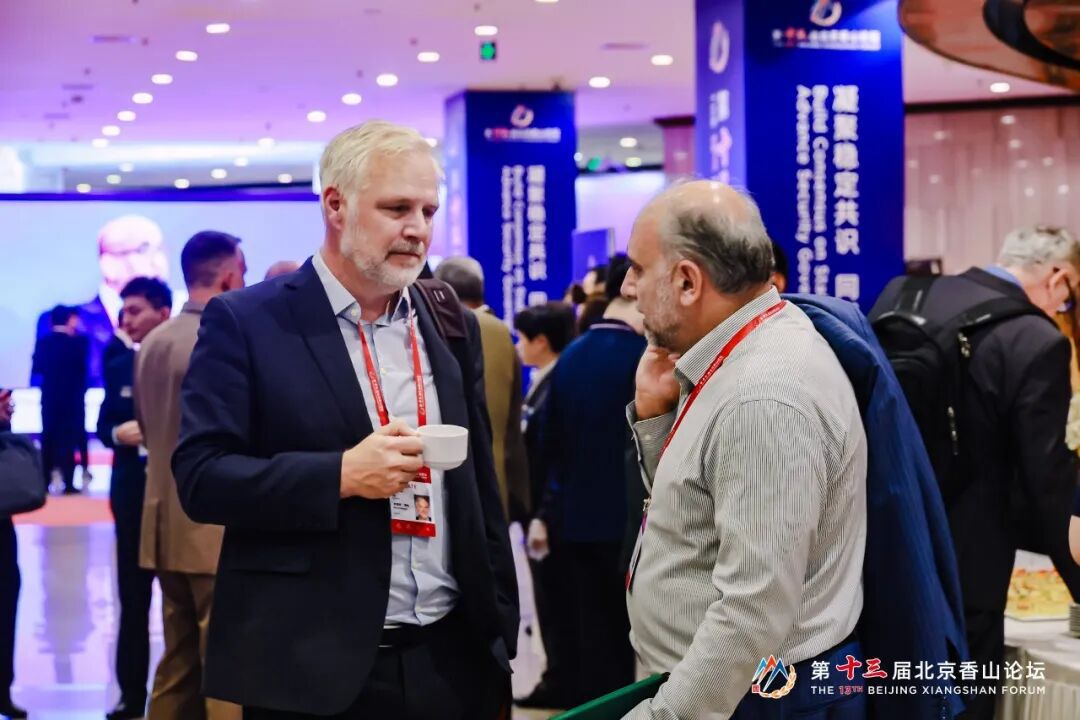
Attendees chat at the 13th Beijing Xiangshan Forum.
Asian security concept: Asian countries' own answer
Security is not an exclusive discourse of the West, but a common topic for all humanity. The Xiangshan Forum's setting of the dialogue theme "Build Consensus on Stability, Advance Security Governance Together" helps all parties in the world express their views and demands on an equal footing, whether they are major countries or small ones.
The current evolution of the world order is showing a trend of diversification and multilateralization. Against such a background, the voice of developing countries in the security field will undoubtedly grow stronger, and the world needs even more to hear their voices, because they can better represent most countries in the world, instead of a small number of Western countries. In advancing the Asian security concept, countries in the Asian region bear the responsibility. Former Japanese Prime Minister Yukio Hatoyama said at the forum: "We want dialogue, not confrontation; cooperation, not division. This is the path Asia should take."
On May 21, 2014, Chinese President Xi Jinping proposed some ideas on regional security at the Shanghai Summit of the Conference on Interaction and Confidence-Building Measures in Asia, and the points were later summarized as the "Asian security concept." The concept stresses on common, comprehensive, cooperative, and sustainable security, aiming to embark on a path of Asian security featuring joint construction, shared benefits, and win-win outcomes. Based on this concept, a series of security cooperation mechanisms have been built, such as the ASEAN Regional Forum, the ASEAN Defence Ministers' Meeting Plus, the Shanghai Cooperation Organization, the Conference on Interaction and Confidence-Building Measures in Asia, and Lancang-Mekong Cooperation. The Asian security concept advances an inclusive, universal, equal, and mutually trusting security framework, rather than an exclusive security mechanism.
The concept of common, comprehensive, cooperative and sustainable security advocates respecting and safeguarding the security of every country, resolving contradictions through development, eliminating the soil of insecurity, and achieving the ultimate goal of universal security. Asia's development experience over the past decades has proven that achieving development through cooperation rather than confrontation is feasible and effective.
At present, the total economic volume of the BRICS countries, mostly Asian countries, accounts for about 40% of the world total, far exceeding the percentage of about 29% of the G7 countries. The contributions of these countries to global security governance are rewriting the development course of world history.
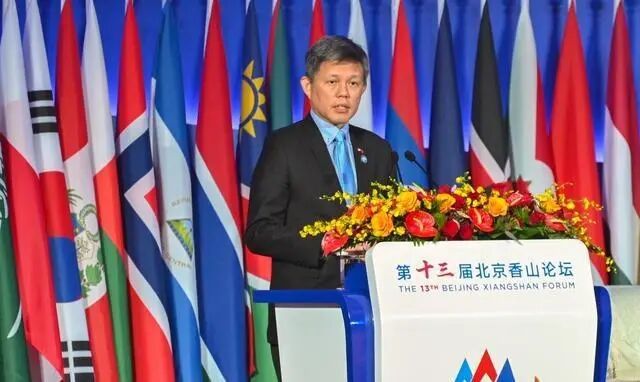
Singapore's Minister for Defence Chan Chun Sing delivered a speech at the opening of Xiangshan forum.
Asians standing together through thick and thin
At the Central Conference on Work Related to Foreign Affairs with Neighboring Countries in April 2025, the Communist Party of China Central Committee proposed the Asian security model based on "shared safety, seeking common ground while reserving differences, and engaging in dialogue and consultation." This model completely abandons traditional zero-sum game thinking and provides a new perspective and new choice for regional peace and stability. What it requires is the joint efforts of all parties, standing together through thick and thin, to jointly build a community with a shared future of their own.
At the opening of Xiangshan forum, Singapore's Minister for Public Service and Minister for Defence Chan Chun Sing, delivered his speech mostly in English, but he switched to Chinese at least three times and quoted classic Chinese sayings to expound Singapore's diplomatic and security views. Afterward his speech was questioned by netizens, especially Chinese self-media authors, who believed that there was more to his words.
Chan Chun Sing quoted from Mencius: "He who subdues others by force does not win their hearts; he who subdues others by virtue wins their heartfelt and sincere submission." The words emphasized that strength may force others into temporary compliance, but only trust and moral inspiration can truly win people's hearts. Netizens pointed out that this quotation from Mencius was obviously meant to remind and even criticize China: who should "subdue others by virtue" in the region.
He also emphasized in Chinese: "When major countries take on more responsibility, small countries have fewer worries." This means that small and medium-sized countries expect for a stable international order and the responsibility of major powers. Social media authors pointed out that these remarks would be more practically meaningful if said to the United States. Today, the US refuses to assume its responsibilities as a major power, withdrawing from multiple international organizations, and it also openly interferes in the internal affairs of other countries, violating the international law.
Finally, Chan Chun Sing used Chinese as his conclusion: "Lips and teeth depend on each other, cooperation is beyond doubt; subduing others by virtue, cooperation is boundless." Chinese net users see this as yet another “reminder” to China, the forum host.
Perhaps this is precisely the charm of the Xiangshan Forum. The forum emphasizes inclusiveness and equality. Regardless of the size, all participating countries have the opportunity for equal exchange, unlike the Shangri-La Dialogue that has been turned into a ground for choosing sides based on ideology. For example, Philippine scholars were also invited to the Xiangshan Forum to speak freely and express different views, although there are difficulties in China-Philippines relations.
Even more worthy of appreciation is the speech by Vietnam's Deputy Prime Minister and Minister of National Defence Phan Van Giang. The four suggestions he put forward in his keynote speech were very pragmatic and highly praised by the participants: abiding by international law, safeguarding the international order, adhering to multilateralism, and advancing peace and equality. In particular, he used the Chinese colloquial saying "standing together through thick and thin."
Asians need to make tireless joint efforts to promote regional peace and safeguard regional security. Only in this way can the Asian region have lasting peace and stability—this may be precisely the most important inspiration of this year's Xiangshan Forum.
Writing by Cheng Hanping (Executive Dean of the Institute for Regional and Country Studies at Zhejiang University of Technology); Trans-editing by Wang Shixue and Han Chengyuan
