


BRICS leaders voice concern over Middle East, condemn unilateral sanctions at India summit


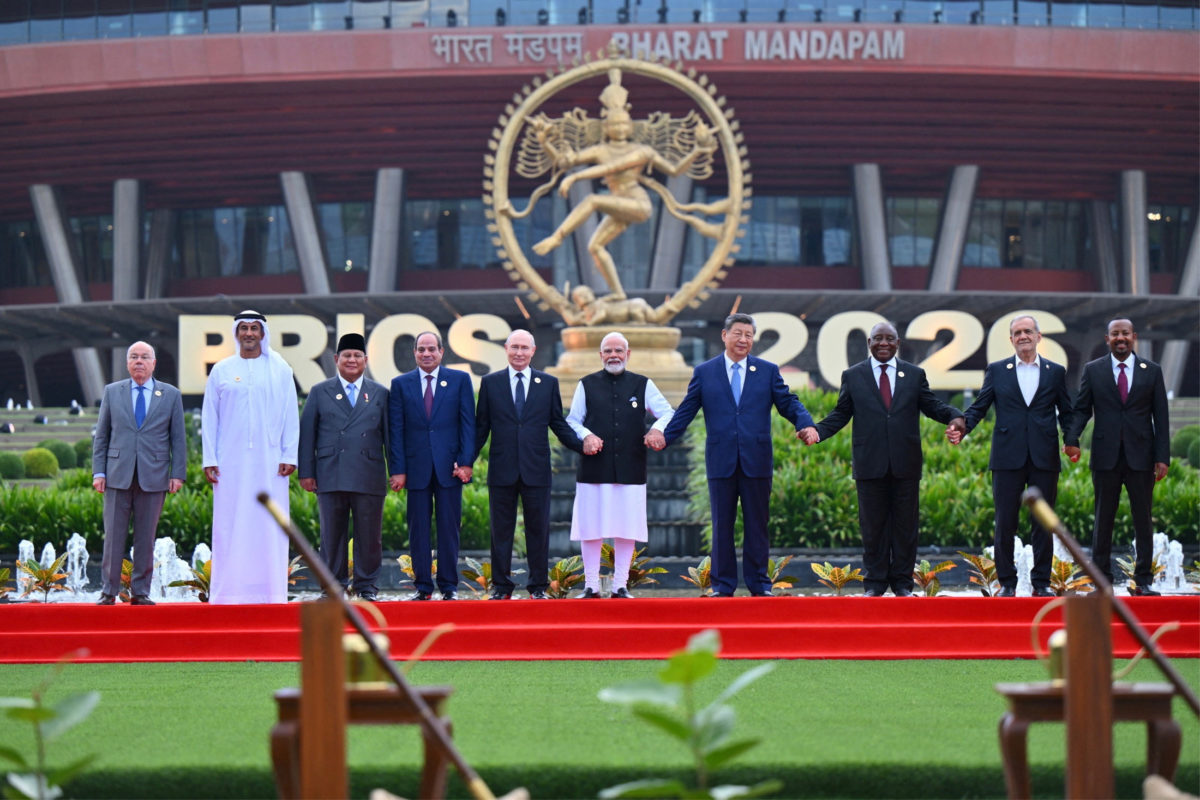
Brazil's Foreign Minister Mauro Vieira, Minister of State of the United Arab Emirates (UAE) Saeed bin Mubarak Al Hajeri, Russia's President Vladimir Putin, China's President Xi Jinping, India's Prime Minister Narendra Modi, Indonesia's President Prabowo Subianto, Egyptian President Abdel Fattah el-Sisi, South Africa's President Cyril Ramaphosa and Ethiopia's Prime Minister Abiy Ahmed India's pose for a family photo during the BRICS Summit in New Delhi, India, September 12, 2026. | Photo Credit: PRESS INFORMATION BUREAU
The BRICS group of emerging economies on Saturday expressed concern over rising tensions in the Middle East and condemned the use of sanctions not authorized by the U.N., as the leaders met in New Delhi to strengthen their position in global affairs seen as dominated by the West.
The meeting, which included Iranian President Masoud Pezeshkian, voiced concern over "deliberate attacks" on civilian infrastructure and peaceful nuclear facilities under the U.N. atomic energy agency's safeguards, saying nuclear safety and security must be protected during armed conflicts. The statement was seen as indirect criticism of U.S. and Israeli strikes on Iranian nuclear facilities.
The leaders also took aim at unilateral sanctions not authorized by the U.N. Security Council. They did not name any countries, but Russia, one of the founding members of BRICS, has faced Western sanctions following its full-scale invasion of Ukraine in 2022.
"We call for the elimination of such unlawful measures, which undermine international law and the principles and purposes of the U.N. Charter," the joint statement said.
Wars in Ukraine and the Middle East challenge BRICS unity
BRICS was founded in 2006 by Brazil, Russia, India and China, with South Africa joining in 2010. It has since expanded to 11 members, representing about half the world's population and a significant share of global economic output. The group has increasingly called for greater representation for developing countries in global institutions.
It has sought to raise its profile by promoting alternatives to Western-dominated financial institutions and positioning itself as the voice of developing nations and emerging economies.
India is hosting this year's summit, attended by Russian President Vladimir Putin, Chinese President Xi Jinping, Pezeshkian and counterparts from the other eight BRICS members.
Concerns have grown that the Iran war, triggered by U.S.-Israeli strikes on Feb. 28, may expand as fighting escalated between Saudi Arabia and Yemen's Houthi rebels. Wars in Ukraine and the Middle East, along with rising U.S.-China tensions, are also testing the bloc's ability to find common ground among countries with competing geopolitical interests.
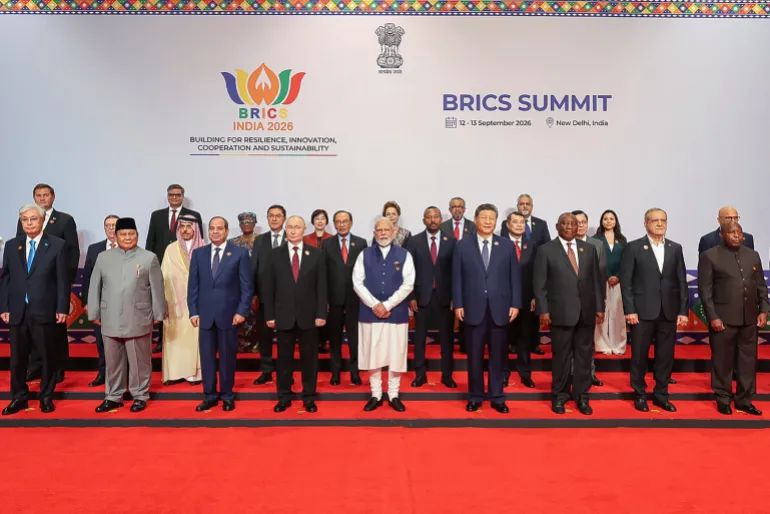
Leaders of participating countries gather for a family photo during the 18th BRICS Summit in New Delhi on September 13, 2026 [Handout/Indian Press Information Bureau (PIB) via AFP]
Modi stresses BRICS is not a counter to West
In his address, Modi sought to ease concerns that BRICS was intended to counter Western-led alliances.
"BRICS is not against anyone," he said, adding that the bloc had reached a "coming of age" moment in which the Global South must evolve into a "rule-shaper" in global governance.
"It is time for us to translate our unity and consensus in BRICS into concrete outcomes," he said.
Modi also proposed a BRICS seafarers' network to strengthen the safety and welfare of maritime workers, particularly as disruptions to maritime trade from the war in Iran have heightened risks for mariners.
India balances strategic partnerships
For India, the summit highlights its effort to maintain strategic ties with Russia and Iran while deepening relations with the U.S. and Europe. New Delhi has sought to balance its longstanding partnerships with Moscow and Tehran with efforts to expand economic, defense and technology ties with Washington and other Western nations.
India has maintained close ties with both Moscow and Tehran despite the war in Ukraine and tensions between Iran and the U.S., while calling for dialogue and diplomacy to resolve conflicts. Modi met Putin and Pezeshkian separately in New Delhi on Friday ahead of the summit.
India is also hoping the forum will help ease its longstanding strained ties with China. Modi and Xi held talks later Saturday, a meeting that helped consolidate a diplomatic thaw between the two countries after border tensions escalated in 2020.
