


Herders key figures in plateau wildlife conservation


Locals play central role in aiding monitoring and research efforts in Qinghai
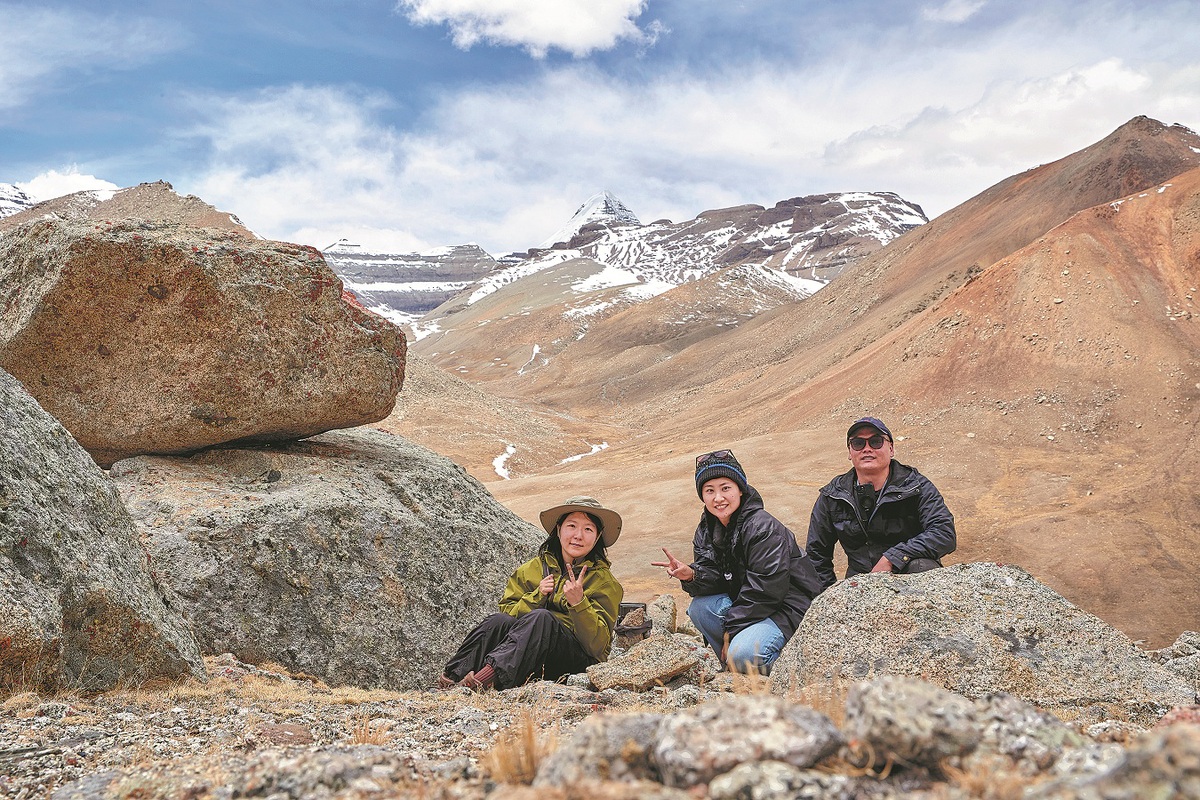
Li Xueyang (middle) and two of her colleagues during a field survey in Ngari prefecture, Xizang autonomous region.
When a herder from the Lancang River source area of Three-River-Source National Park called to report that a snow leopard had killed one of his yaks, Li Xueyang expected tension.
Instead, when she and her colleagues reached the site in Angsai township, Zadoi county, Qinghai province, they found the snow leopard still feeding nearby. The yak owner stood watching calmly, having already reported the loss for compensation from his insurer.
"What I saw was not hostility toward the snow leopard, but a kind of closeness," Li said.
For Li, the scene captured a central truth about conservation on the Qinghai-Tibet Plateau: protecting wildlife is not only about research, cameras and patrols.
It also depends on whether people living alongside wild animals can bear the cost of coexistence and share in its benefits.
Li has worked on wildlife research and community conservation in the plateau region since 2017. After receiving her doctoral degree from Peking University in 2023, she chose to remain in the source area of the Lancang River, much of it at altitudes above 4,000 meters.
"The place matched my imagination of the wilderness," Li said. On her first mountain trip, she saw pikas, marmots and blue sheep at close range. "The animals looked at us, and we looked back at them."
Li is part of a team from Peking University and the Shanshui Conservation Center that has worked in Angsai for more than a decade.
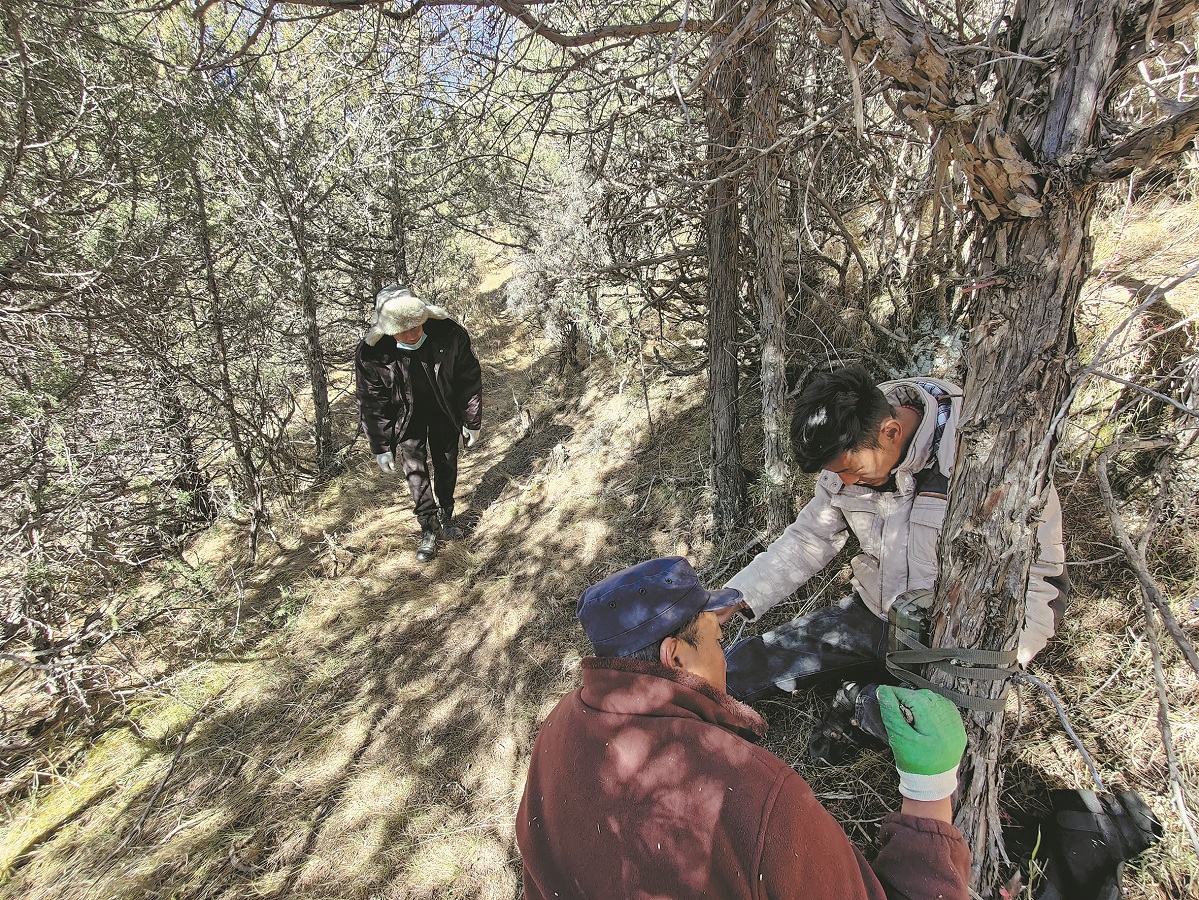
Members of Li Xueyang's team set up an infrared camera in Zadoi county, Qinghai province.
With support from the national park administration and local governments, team members train herders and ecological rangers to deploy infrared cameras and monitor wildlife.
The work is built around local knowledge. Herders know where snow leopards appear, which slopes animals use and where tracks or droppings are likely to be found.
"They are local scientists," Li said. "We bring modern methods and work with them to produce monitoring results."
The team divided the area into 72 grids and works with 93 herders and rangers to maintain 98 infrared cameras. The network has accumulated about 9 terabytes of data and over 1,900 snow leopard images.
Since three snow leopards were first recorded in 2015, the team has identified 142 individuals, with about 20 to 30 regularly detected in the valleys on an annual basis.
It has also recorded 17 leopards, including a female believed to be at least 12 years old that has given birth three times and raised five cubs.
Blue sheep density in Angsai is about four per square kilometer, providing sufficient prey for large carnivores and indicating a relatively intact food chain, Li said.
Technology has accelerated the work. An online database allows volunteers to identify animals remotely, while artificial intelligence filters empty frames, cutting manual screening by about 40 to 50 percent. But rain, snow and thick fur can blur a snow leopard's markings.
"AI can help sort similar images, but final identification still depends on experienced volunteers and researchers," Li said.
However, technology cannot replace the people who know the land.
Herders, Li said, taught her to recognize snow leopard scrapes and animal droppings, and guided researchers collecting fecal samples for genetic studies.
"Without local herders and rangers, we could not have maintained 11 years of continuous monitoring," she said.
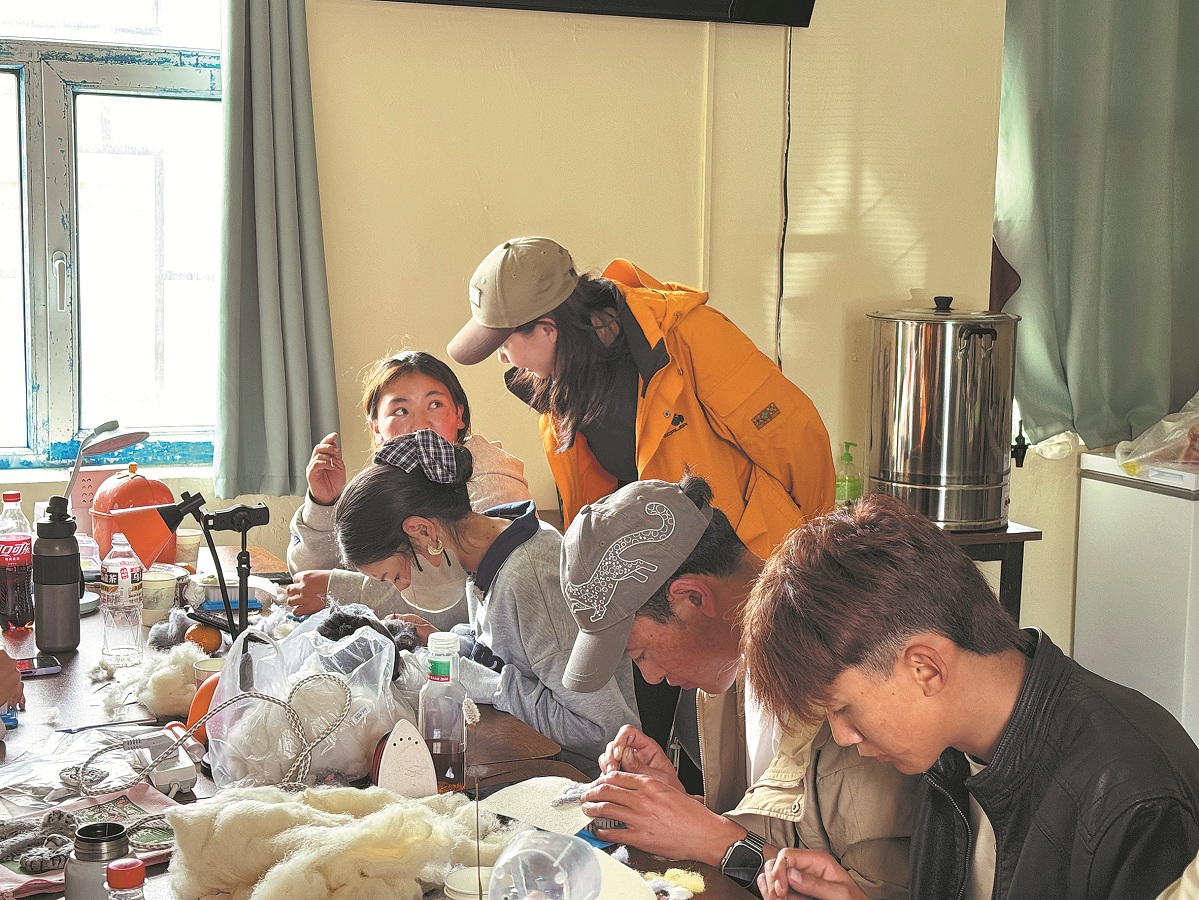
Liu Fanjing (standing) talks with a herder at the handicraft cooperative she helped establish in 2025 in Yushu, Qinghai province.
Community partnerships
The same partnership shaped a nature experience program launched in Angsai in 2018.
It trained 22 herding households to host visitors and guide wildlife observation under strict rules. Prior to its suspension due to policy adjustments, the program recorded over 750 visits.
The community allocated 45 percent of revenue to host families, 45 percent to a village collective fund and 10 percent to an animal protection fund. The program generated 2.5 million yuan ($370,664) for the local economy, with participating households earning on average nearly 70,000 yuan over its duration.
In line with the program, visitors could not feed or chase animals, approach dens too closely or casually use drones. Snow leopard sightings exceeded 50 percent without baiting or staged encounters. "People need secure livelihoods before they have the energy to protect nature," Li said.
For Liu Fanjing, a 29-year-old conservation worker who joined Shanshui's Yushu station in October, that principle is tested through daily, often unglamorous work.
After completing her master's degree in environmental sciences from Xi'an Jiaotong-Liverpool University in July 2025, Liu was drawn to the Three-River-Source region by its combination of wildlife science, community participation and practical conservation. She now works across several project sites, engaging with communities, exploring alternative livelihoods, reducing human-wildlife conflict and assisting with camera monitoring.
Front-line conservation rarely follows a fixed routine. On one winter trip, the team's vehicle became trapped in deep snow in an area with no cellphone signal.
On another night, Liu woke at a field station to dogs barking and the sound of heavy breathing outside. Bear tracks were found beside the wall the next morning.
The encounter gave her a practical understanding of coexistence. Food and kitchen waste must be removed, so bears do not develop a habit of searching human settlements for meals. Protecting wildlife, she said, also requires people to change their behavior and minimize opportunities for conflict.
Much of her work involves helping households install electric fences, wire barriers or reinforced doors and windows.
Because homes, livestock practices and bear activity differ, no single measure suits every family. Installation is followed by visits to check whether bears have returned and whether equipment is maintained. "The point is not simply to tell herders that something works," Liu said. "It is to observe and adjust it with them, so the measure fits each household."
The deeper challenge is unequal cost. The ecological value of wildlife protection is shared by society, Liu said, while livestock losses are carried mainly by individual families.
Many residents understand that snow leopards and bears hunt to survive, but tolerance does not erase the financial loss.
Insurance, compensation and protective equipment can reduce immediate damage. Long-term coexistence also requires ways for communities to earn an income from protecting the landscape.
Liu is helping a community run a handicraft cooperative established in December 2025. Its 15 members, about half of whom are women, make products inspired by local plants and animals. The cooperative has earned more than 20,000 yuan.
The sum is modest and cannot replace herding income, Liu said. But it gives residents another skill, additional earnings and a way to introduce their homeland through products they create themselves.
She sees similar promise in nature experiences, but cautions that Sanjiangyuan is not an ordinary tourism destination. Visitors must keep their distance from wildlife and respect ecological boundaries. Short-term revenue cannot come at the expense of fragile habitats.
Liu applies the same caution to wildlife data. More camera images do not necessarily prove that animal populations are growing, because changes in camera numbers, locations and coverage can affect results. Reliable conclusions require long-term monitoring with consistent methods.
Still, individual images can reveal why the work matters. While reviewing footage with a local monitor, Liu once watched one snow leopard cub appear, then another. Finally, the mother emerged with three cubs.
Other rewards are subdued: a cooperative member earning money from a product she made, a community guide completing a visit, or a herder beginning to trust a conservation team after months of conversation. Li's research shows what becomes possible when scientific methods meet knowledge accumulated and passed down over generations. Liu's work shows what it takes to sustain that partnership through fences, follow-up visits, shared income and patient negotiation.
The team's work points toward a measure of conservation broader than the number of animals recorded on camera. Success means that people can remain on their land, preserve their culture and build secure lives, while wildlife retains safe, connected habitats.
In the region, coexistence is not an abstract ideal. It is a pact that is renewed daily — whenever a herder reports a lost yak without demanding retaliation, a ranger climbs a mountain to check a camera, or a family chooses to make room for the wild animals beyond its door. The future of this landscape will depend on keeping that promise.
