


Africa-China-Middle East: A triangle to build


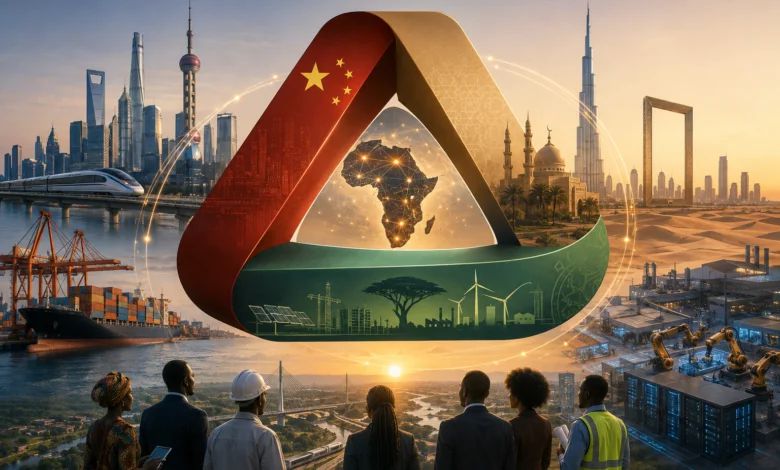
The Africa-China-Middle East triangle
In this article, JX Paulin puts forward a conviction: the next chapter in relations between Africa, China and the Middle East will not be written at summits, but in factories, cities, ports and businesses. To turn this triangle into a true economic powerhouse, Africa must learn, adapt and above all execute.
JX Paulin
In 1994, when I arrived in China, nothing yet suggested the economic and technological giant it would become. Yet there I learned a conviction that has never left me: with boldness, hard work and the ability to learn faster than others, what seems improbable can be turned into reality.
I worked there, built businesses, invested my time, my energy and my own money. I experienced successes, failures and, above all, learned one thing: boldness is worth nothing without execution.
Since then, I have worked and invested across the African continent, travelled to nineteen countries and met entrepreneurs, investors and public officials. I now live and work in the United Arab Emirates.
Three spaces, three trajectories, one shared lesson: countries that move forward do not copy. They learn, adapt and execute, with determination.
I am neither an academic nor a politician, and I do not claim to have all the answers. I speak simply as an entrepreneur. And when you have put your own capital on the table, you quickly learn to distinguish slogans from an environment that is genuinely conducive to business, and above all to recognise what works.
China: learn, adapt, execute
The Chinese lesson is not that Africa should become China. It lies elsewhere: China observed, absorbed, adapted, and then built its own path. It also understood that an industrial power is built first and foremost on skills.
According to the US National Science Foundation, China awarded approximately 2 million first university degrees in science and engineering in 2020 and 53,400 doctorates in these disciplines in 2022, the highest volume in the world that year (National Science Board/National Science Foundation, Science and Engineering Indicators 2024 and 2026).
Statistical definitions may vary, but the scale tells us what matters: you cannot decree a technology-driven economy. You have to train for it.
Looking at the colossal advances in Chinese AI and robotics, I smile when I think of those who told me, not so long ago: “China is only good at copying.”
The China–Africa relationship is opening a new window of opportunity today, and it is up to us to seize it. Bilateral trade reached $348 billion in 2025 and, since May 2026, China has applied zero tariffs to the 53 African countries with which it maintains diplomatic relations (State Council of the People’s Republic of China, 1 May 2026).
The question, therefore, is no longer simply: “How do we access the Chinese market?” It becomes: “What have we put in place to sell more processed, standardised and competitive products there?”
The UAE: resources as a starting point, not an end in themselves
The UAE taught me a second lesson: a natural resource is not a strategy. It is starting capital.
They had oil. They could have been satisfied with that. Instead, they chose to use that wealth to build cities, ports, airports, free zones, a financial centre, digital infrastructure and services.
In the first half of 2025, non-oil activities accounted for 77.5% of the UAE’s real GDP (Federal Competitiveness and Statistics Centre, December 2025).
This result is also a story of leadership, foresight and coherence. A free zone only works when the port, customs, land, energy, financing and administrative speed all work together.
A factory does not set up where there is a promise. It sets up where it can produce on Monday morning and ship on Friday without constraints.
Africas: different, yes. Fragmented, no.
After travelling across nineteen African countries, I remain wary of those who speak of an “Africa strategy” as though the continent were homogeneous.
There are many Africas, just as there are several European realities. In business, the differences between Lomé and Nairobi are no smaller than those between Paris and Berlin.
But recognising our differences must not become an excuse for cultivating our fragmentation.
Today, intra-African trade accounts for approximately 14% of the continent’s total trade, compared with around 50% in Asia and 60% in the European Union (World Bank, June 2026).
A Nigerian entrepreneur should be able to buy a raw material from a Congolese supplier, process it with a local partner and sell it in Nairobi without having to reinvent the rules, payments, certifications and logistics at every border. And above all, without spending three months on it!
That, in my view, is the promise of the AfCFTA: not to erase our differences, but to give them market scale and dynamism.
Four priorities for moving into action
After all these years on the ground, if a public decision-maker asked me tomorrow: “Very well, but where do we start, concretely?”, my answer would come down to four priorities.
Not four slogans. Four areas where we can act now.
Energy first.
Nearly 600 million people in sub-Saharan Africa still lacked access to electricity in 2024 (International Energy Agency, Financing Electricity Access in Africa, 2025).
Without reliable and affordable energy, there is no competitive industry, no cold chain, no data centres, and no AI at scale.
Then cities.
Africa’s urban population could reach approximately 1.4 billion by 2050, while more than half of its future urban footprint has yet to be built (UN-Habitat, State of African Cities Report 2026).
This is an immense constraint, but also a historic opportunity: much of tomorrow’s African city can still be designed, financed and built.
Urban development is not about concrete for concrete’s sake. Housing drives construction, materials, finance and maintenance. Transport brings workers closer to jobs. Water, electricity and fibre increase productivity. Well-designed neighbourhoods create commerce, services and new activities.
A poorly planned city can trap residents and businesses for decades in congestion, high costs and informality. A well-designed city becomes a platform for growth.
Building functional, connected and liveable cities is therefore not a consequence of development: it is one of its engines.
Then skills.
AI is a tremendous opportunity, but it does not eliminate the need for engineers; it requires more of them.
Engineers, technicians, developers, energy specialists and data experts: training them is economic policy.
We must stop thinking that our greatest wealth lies beneath our feet. Our most important wealth is already walking our streets!
Finally, entrepreneurs.
They do not need another seminar on resilience. They need electricity, predictable rules, fast payments, financing and a larger market.
The role of the state is not to do everything. It is to make things possible.
Some will say that these priorities are easier to articulate than to implement. Perhaps. But other countries, sometimes with far fewer resources, have already done it.
Difficulty is not an excuse. It is a reason to act.
The triangle to build
I am Franco-Togolese and proud of my heritage. I believe neither in rejecting Europe nor in replacing an old dependency with a new one.
Africa existed long before colonisation; it will exist long after this dark chapter has fully turned. But we must also know how to turn the page without throwing away the book.
I believe Africa does not have to choose between Beijing, Abu Dhabi, Paris or Washington. It must choose its interests, learn from each and build its own capabilities.
China can bring industrial depth, technology and know-how. The Middle East can bring capital, logistics and that culture of speed. The Africas, for their part, bring their entrepreneurs, resources, markets and knowledge of the ground that no external partner can replace.
But a triangle only has value if flows move in all three directions.
With the opening of the Chinese market and the growth of Gulf–Africa corridors, every country should now identify ten exportable products, address certification, packaging, cold-chain and distribution issues, while going out and securing contracts.
That too is boldness: starting without being truly ready.
Less talk. More purchase orders.
Throughout my life as an entrepreneur, I have moved forward with one simple idea: who dares wins — those who dare, win.
But those who dare without preparing often lose before they have even begun.
I have seen too many African delegations enter negotiations with vague objectives, facing Chinese counterparts who already knew their GDP, their regions, their resources, their needs and their potential.
At that point, the balance of power had already been established.
A good deal is negotiated with data, alternatives, red lines and a thorough understanding of one’s own value.
We already have the speeches, the summits, the grand declarations and the memorandums.
The next step is more difficult, and infinitely more interesting: turning China–Middle East–Africa relations into projects that work, country by country, and then connecting them to create scale.
Less talk. More purchase orders.
That is the triangle I would like to see emerge: not three regions looking at one another, but three regions building, investing, producing and trading together.
A triangle of shared interests, but also shared responsibilities.
And for that, we will need vision, preparation, pragmatism — and, of course, boldness.
Who dares wins.
