


Xi highlights green path to development


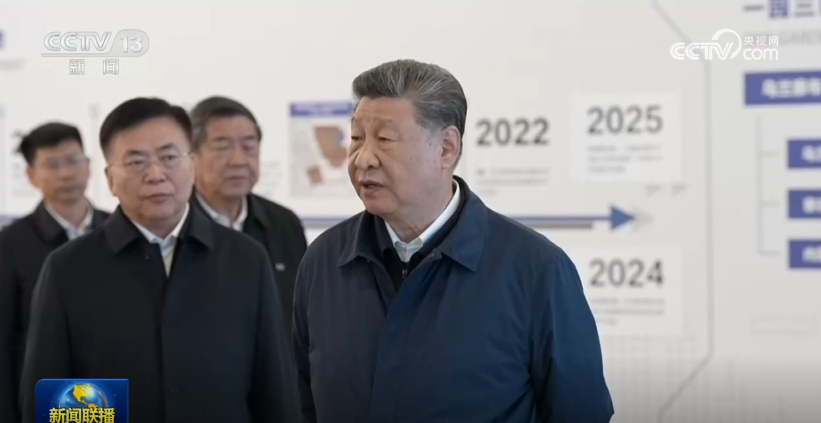
President Xi Jinping, who is also general secretary of the Communist Party of China Central Committee and chairman of the Central Military Commission, has an inspection tour in Ulaanqab, Inner Mongolia autonomous region.
A first-time visitor looking across the Huangqihai Lake in northern China might find it hard to imagine its dry, exposed lake bed just 20 years ago.
When President Xi Jinping visited the lakeside on Friday in Ulaanqab, a city in the Inner Mongolia autonomous region, the water stretched across more than 85 square kilometers. Fish had been detected again in May last year — a sign that the lake's ability to purify itself and sustain aquatic life was gradually recovering.
Looking through binoculars at birds on the mudflats, Xi said: "There are quite a few birds. The aquatic ecosystem here has recovered well."
The Huangqihai Lake nature reserve was the first stop on a fact-finding trip that also took Xi to the Qahar High-Tech Industrial Development Zone, where the city is expanding its green computing power industry. During the visit, Xi, who is also general secretary of the Communist Party of China Central Committee, stressed the need to coordinate high-quality development with high-level environmental protection.
Fed by 11 rivers, Huangqihai is an inland lake that came close to drying up following decades of drought and other pressures. In recent years, local authorities have dredged waterways feeding the lake, reduced agricultural pollution, restored vegetation and strengthened protection of the reserve.
Xi asked whether production activities were still taking place around the lake. Local officials told him that activity in the core area was controlled to reduce human disturbance.
He called for giving priority to natural restoration, supplemented by human intervention, in repairing degraded wetland ecosystems.
Ban Xiuping, Party secretary of Qahar Right Wing Front Banner, where the lake is located, said local residents have a deep attachment to Huangqihai. Its recovery has helped stabilize agricultural incomes and improve people's living environment, she said.
"I think General Secretary Xi's commitment to ecological restoration and conservation is rooted in his deep concern for the people," she said.
For Ban, the next milestone would be the return of more fish species. Crucian carp have already been detected, and she hopes common carp and grass carp will follow.
Friday's visit was Xi's fourth fact-finding trip to Inner Mongolia since 2012, following trips in 2014, 2019 and 2023. He has repeatedly called for protecting the region's lakes and pursuing the integrated conservation and restoration of mountains, rivers, forests, farmland, lakes, grasslands and deserts. In 2023, he inspected Ulansuhai Nur in Bayannuur and urged sustained efforts to protect it.
At Huangqihai, Xi called for sustained efforts to control sand and address overgrazing. He described the region's ecological protection as a national strategy benefiting both Inner Mongolia and the country as a whole.
Wu Guoqing, deputy director of Inner Mongolia's forestry and grassland bureau, said the department's work in recent years has included controlling desertification, addressing overgrazing and tackling the destruction of forests and grasslands.
According to figures released by the regional forestry and grassland bureau in June, Inner Mongolia's forest coverage has reached 21.98 percent, up 1.19 percentage points from 2021, while grassland vegetation coverage stood at 46.48 percent, its highest level this century.
As Ulaanqab works to restore the Huangqihai Lake, it is also developing its computing power industry. Just 240 kilometers from Beijing in a straight line, Ulaanqab offers abundant renewable energy, a climate that allows natural cooling for nearly 10 months a year, and direct fiber-optic links to the capital.
At the development zone, Xi learned about Inner Mongolia's progress in building a hub for the "East Data, West Computing" project, a national initiative linking computing power demand in eastern China with resources in western regions. He was also briefed on the development of the city's green computing power industry.
Urlug, deputy director of the zone's economic development and investment promotion bureau, said the city's computing power industry has grown in stages.
Huawei's arrival in 2013 brought Ulaanqab its first data center. For roughly a decade, the industry focused on storage and general-purpose computing.
From 2023 to around the turn of 2026, the city moved into a second phase focused on intelligent computing — the processing capacity used for artificial intelligence — with upgrades to chips, technology and supporting facilities, Urlug said.
The third phase, in his description, is closer coordination between computing power and electricity supply. "We are drawing on Ulaanqab's abundant renewable energy resources to develop a green intelligent computing power industry," he said.
During the trip, Xi commended the industry's progress and called for extending industrial chains, deepening the integration of the digital and real economies, and translating computing power strengths into development gains.
He also examined models of power and cooling systems and asked detailed questions about electricity and water efficiency.
Liu Junping, deputy director of the zone's administrative committee, said Xi's attention to water conservation left a strong impression.
"In developing computing capacity, we need to plan ahead," Liu said. "Ulaanqab is a water-scarce place. While saving energy, we must also save water."
Xi called for efficient, green and safe development, stressing coordination between computing power, electricity supply and water use. He urged those working in the sector to ensure the sound construction and operation of computing centers, actively promote the green computing power industry, and make greater contributions to building Digital China and developing new quality productive forces.
His discussions with officials and industry representatives included a warning about the way new industries expand.
"What worries me most is disorderly development — everyone rushing in at once and then dispersing all at once, which further dampens enthusiasm," Xi said. He also warned against blind competition and development that disregards local conditions.
Urlug said: "Computing power is an emerging industry. We need to get involved early and plan ahead so it develops in an orderly way."
The industry is also bringing talented people to Ulaanqab. Zan Deng, manager of the Inner Mongolia Huawang Data Center of Jiangsu Yangdian Science & Technology Co, moved to the city in 2024 to work on the project.
More than 70 percent of the company's staff members there have been recruited from elsewhere, she said, with employees settling in the city.
Zan was among the industry representatives whom Xi spoke with during the visit. Xi encouraged those present to pursue ambitious goals with patience and determination, describing them as a contingent advancing high-level scientific and technological self-reliance on a new "Long March".
"As someone working in this industry, I feel deeply honored and proud to be part of this journey," Zan said.
