


After China: What does Vietnam expect in hosting APEC 2027?


The 33rd Asia-Pacific Economic Cooperation (APEC) Economic Leaders' Meeting was held in south China’s Shenzhen in November 2026, when Vietnam became the host of APEC 2027. This is Vietnam's third time hosting the APEC Economic Leaders' Meeting, following the 2006 Hanoi summit and the APEC 2017 in Da Nang.
Having been an APEC member for nearly three decades, Vietnam has undergone a notable shift in its mindset toward this multilateral platform. In the early years, it hoped to use APEC to open up external markets, learn rules on international trade, and pave the way for WTO accession. Today, the APEC is no longer merely a trade and economic tool; it has become a comprehensive diplomatic lever for Vietnam to serve its domestic modernization, navigate relations among major Asia-Pacific powers, and strive for the discourse power internationally. Vietnam's expectations for APEC have long moved beyond simply "doing the economic math", and by now the expectations have extended to deeper considerations, such as economic security protection, domestic industrial transformation, and even middle-power expansion in strategic space.
A logo of APEC 2027 in Vietnam
The Evolution of the APEC "Training Ground"
As the Vietnamese reform and opening-up advanced into the 1990s, Vietnam was eager to join APEC, driven both by practical pressures and by opportunities to ride the tide.
On the one hand, traditional markets and foreign aid shrank sharply after the end of the Cold War, and the Vietnamese economy urgently needed new sources of capital and export outlets. On the other hand, with the normalization of U.S.-Vietnam relations and Vietnam's accession to ASEAN in 1995, Vietnam entered a critical period to break out of isolation and integrate into the Asia-Pacific industrial chains.
At that time, the APEC was more like a "training ground" for Vietnam. Through this multilateral platform, the country was able to familiarize itself with the Asia-Pacific trade and economic rules, attract regional capital, and open up export channels. But as it enters a new phase of hosting APEC for the third time in 2027, Vietnam's expectations for APEC have risen markedly in three dimensions.
First, Vietnam wants to use the multilateral mechanism to hedge against external uncertainty.
Global supply chains are currently undergoing continuous adjustment, and unilateralism is on the rise. Vietnam is highly dependent on exports and foreign investment, and especially does not want to be drawn into bloc confrontation or encounter high-threshold rule-based exclusion, so it particularly values APEC's non-binding cooperation model of consensus-building and voluntary participation. This mechanism can both safeguard the open trade landscape of the Asia-Pacific and preserve ample policy flexibility for Vietnam. In Vietnam's view, upholding APEC as an important cooperation pillar is building a multilateral buffer for economic security.
Second, Vietnam expects APEC to force domestic industrial transformation and break through the development dilemma of middle-income countries.
The APEC members have long contributed about 81% of Vietnam's foreign direct investment, making them Vietnam's most important source of foreign capital. However, the dividends of the processing and assembly model reliant on cheap labor are fading. Vietnam's top leadership has realized that staying at the lower end of industrial chains for the long term makes sustained growth difficult. Therefore, Vietnam has set forth the APEC 2027 theme as "jointly ushering in a new era of self-reliance, innovation, and shared prosperity," listing economic resilience, productivity improvement, and trade and investment expansion as its key considerations. Vietnam hopes to use the opportunities in APEC's rule-based dialogues and technical cooperation to advance its "dual transition" in digitalization and green energy and to push local industries to the upstream of industrial chains.
Third, the country hopes to practice its "bamboo diplomacy" on the APEC multilateral stage, maintaining a dynamic balance in major-power competition.
The impact of major-power competition is rising in the Asia-Pacific region. Avoiding being forced to take sides and maintaining a steady balance among various forces has always been the primary pursuit of Vietnam's diplomacy. The APEC focuses on pragmatic trade and economic cooperation and downplays ideological color, which precisely provides Vietnam with excellent room to maneuver. Vietnam can conduct high-level interactions with all parties under the same multilateral framework without having to publicly take sides.
Beyond specific agenda items, hosting the APEC for the third time is a rare opportunity for Vietnam to reshape its international positioning through multilateral diplomacy. After more than 40 years of reform and opening-up, Vietnam generally regards the present years as a critical stage of national development. By hosting APEC 2027, Vietnam hopes to show global capital the image of a politically stable country and to convey its identity as a responsible regional middle power.
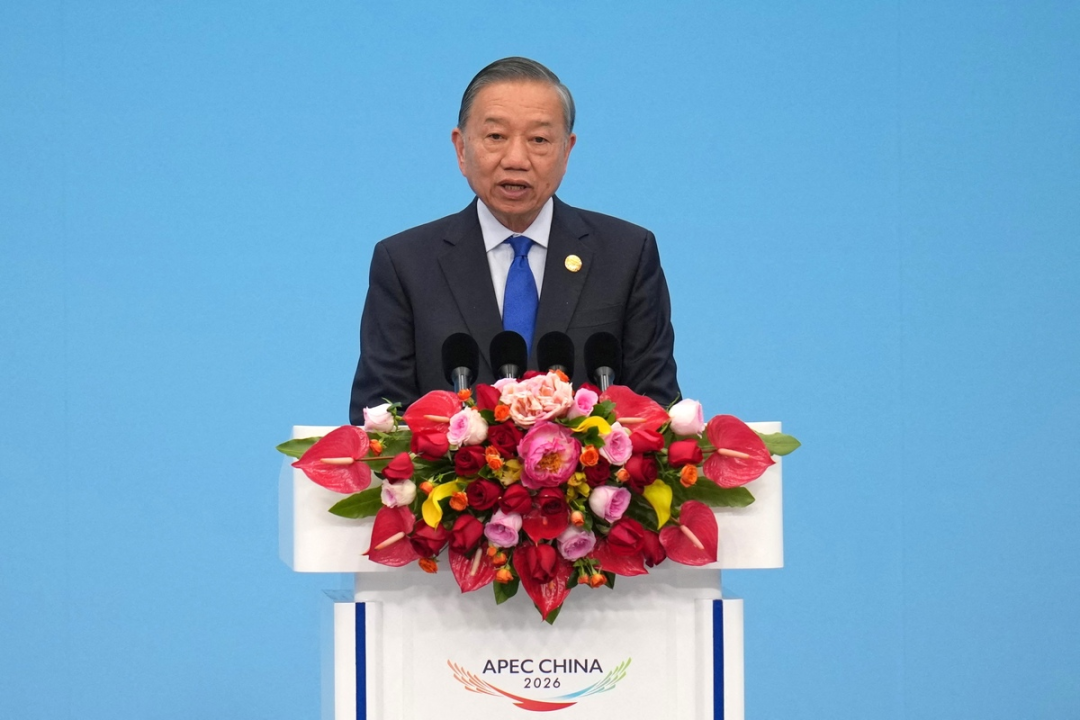
Vietnamese leader To Lam speaks at APEC 2026 in Shenzhen.
Vietnamese Efforts to Be a Good Host
Since Vietnam regards the APEC 2027 in Phu Quoc as a major event, it naturally dare not be negligent in implementation. Centering on the goal of "Being a Good Host," Hanoi is advancing domestic coordination, agenda design and diplomatic communication, fusing national mobilization capacity into diplomatic soft power.
In domestic coordination, Vietnam has established a 2027 APEC National Committee led by senior officials, incorporating the Ministry of Foreign Affairs, the Ministry of Industry and Trade, the Ministry of Finance, and local governments into a unified coordination system. During the preparation, Vietnam's National Assembly has emphasized frugality in hosting the event. Regarding supporting infrastructure projects such as the Phu Quoc airport expansion, lawmakers have called for improving project supervision and ensuring transparent use of funds. Vietnam is also using the opportunity as APEC host to improve its own governance capacity.
In agenda design, Vietnam has maintained the pragmatic posture of a developing economy, and has not rolled out radical geopolitical proposals. It has clearly stated that, on the one hand, it will fully carry forward the consensus already formed at the 2026 Shenzhen APEC Summit and continue to advance existing agendas such as the Free Trade Area of the Asia-Pacific, trade digitalization, and supply chain connectivity. On the other hand, Vietnam has chosen to break through from less resistant technical issues. For example, it has finalized in advance the four major topics of the 2027 APEC Finance Ministers' Meeting: macroeconomic policy coordination, sustainable finance, digital financial inclusion, and capital market development. In doing so, Vietnam has embedded its own development demands into the Asia-Pacific multilateral cooperation agenda in a gradual manner.
In diplomatic communication, Vietnam is good at using multilateralism to drive bilateralism. When completing the host handover in Shenzhen, Vietnam's senior leadership has been busy conducting bilateral head-of-state meetings. They made contacts with the science and technology industrialists in the Guangdong-Hong Kong-Macao Greater Bay Area for cooperation, while linking the APEC connectivity issues with the ASEAN Community and the Lancang-Mekong cooperation. At the same time, Vietnam has also begun to attach importance to international public diplomacy. A vice foreign minister is specifically coordinating external publicity work, and a high-standard international media center will be built on Phu Quoc Island. By actively getting engaged with international media, Vietnam hopes to tell the story of its cooperative development to the outside world.
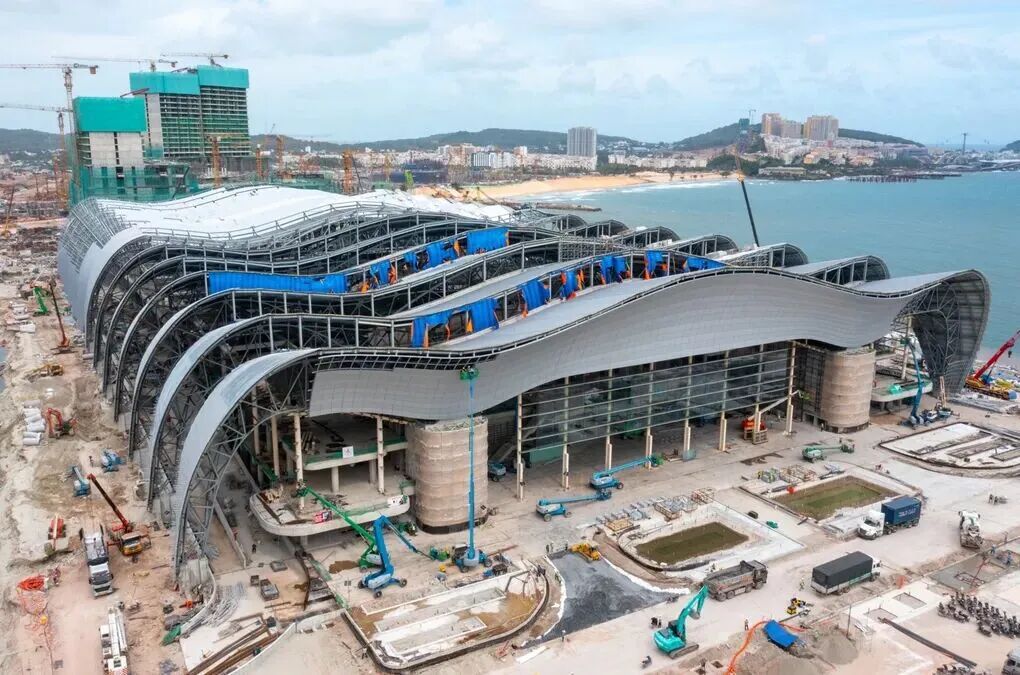
A facility is under construction for the APEC 2027 in Phu Quoc.
Three Unavoidable Hurdles
Although Vietnam has high expectations for APEC 2027, it still confronts three practical contradictions, which will also be a touchstone for testing Vietnam's diplomatic and governance capabilities.
First, there is a gap between the ideal of multilateral cooperation and the real disagreements among major Asia-Pacific powers. Vietnam hopes to serve as a communication bridge among Asia-Pacific parties and bridge the difference among diverse economies. But at present, contradictions such as supply chain "de-risking," high-tech export controls, and green trade barriers objectively exist. As a medium-sized economy, Vietnam does not have many chips to reconcile major-power differences. Whether the Phu Quoc Summit can ultimately produce substantive results remains to be seen.
Second, the infrastructure to hosting the event on an island faces fiscal pressure and ecological constraints. Holding the APEC meeting on Phu Quoc Island can showcase Vietnam's marine economy and eco-tourism to the outside world. But upgrading world-class reception, security, and transportation facilities on an island in a short period requires substantial investment and will also bring pressure on land development. Vietnam must both push forward project implementation and fulfill the National Assembly's requirement for funding transparency, while safeguarding the bottom line of island ecological protection. This is a big test for both central and local governance.
Finally, there is a disconnect between the external reform declarations and the real capabilities of local industries. Vietnam talks extensively on APEC platforms about innovation and green transformation, but objectively speaking, its manufacturing sector still relies heavily on foreign investment, and local enterprises have obvious shortcomings in technology R&D, green certification, and digital governance. If domestic reform and the cultivation of local enterprises cannot keep pace with the multilateral agenda, a large part of the institutional dividends brought by APEC may be captured by multinational corporations and will be difficult to truly transform into endogenous growth momentum for the national economy.
Concluding Remarks
Over the past three decades, Vietnam has continuously used the APEC multilateral platform to serve its own development, making it a typical case of an emerging economy flexibly using international mechanisms to pursue its own interests. It has neither completely attached itself to multilateral mechanisms due to limited national strength nor fallen into diplomatic passivity in geopolitical crevices.
Relying on its pragmatic judgment, Vietnam has instead made APEC a strategic pivot serving domestic dual transition and the "bamboo diplomacy." However, being a host does not mean that everything will go smoothly. The 2027 APEC meeting in Phu Quoc will be a major test of the quality of Vietnam's governance, and the outside world will also use it to see how much substantive contribution a medium-sized economy can make to shaping the Asia-Pacific order.
Writing by Lei Bowen and Peng Yuting (doctoral students at the School of Global and Area Studies, University of Chinese Academy of Social Sciences); Trans-editing by Wang Shixue and Liu Ziyu
