


Gulf investment: Libya and Algeria emerge as strategic frontiers


From oil exploration to food security, Gulf capital is accelerating its presence in North Africa. Libya is attracting new projects in hydrocarbons, while Algeria is drawing investors with the size of its market and its industrial and agricultural potential. Two different trajectories, but a shared logic: securing strategic assets and establishing a long-term presence in key markets.
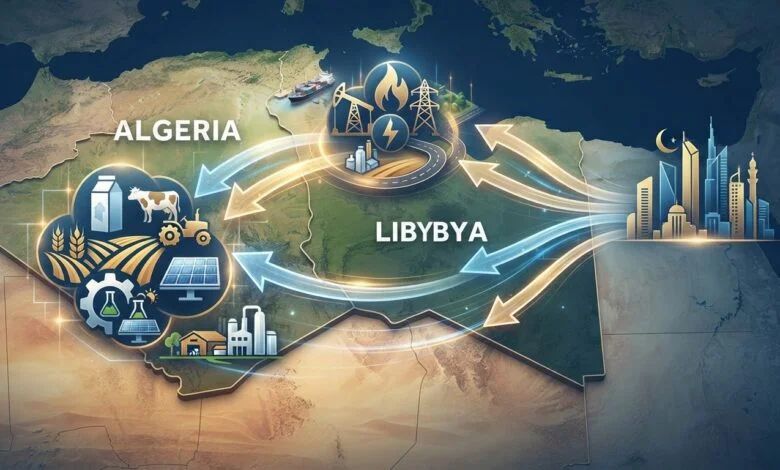
The trend is particularly visible in Libya, where Gulf groups are gradually returning to a high-potential energy market. On 5 July 2026, Qatari group UCC Holding, through its subsidiary Urbacon Energy Libya, signed an Exploration and Production Sharing Agreement with Libya’s National Oil Corporation and the Libyan Investment Authority for Area 47 in the Ghadames Basin. According to UCC Holding, the development programme is expected to raise production to approximately 80,000 barrels of oil per day, backed by an estimated US$1 billion investment.
The deal is significant on two levels. First, it confirms Qatari investors’ interest in Libya’s upstream oil sector. It also illustrates a broader strategy of securing energy assets that could gain in value as Libya’s production and infrastructure recover. UCC Holding says the agreement is part of its strategy to expand across the energy value chain, including upstream energy, power generation and strategic infrastructure.
Qatar is not alone. Oman is also seeking to deepen its energy presence in Libya. On 2 June 2026, OQ Exploration and Production signed a memorandum of understanding in Tripoli with the Libyan Investment Authority. The Omani Ministry of Foreign Affairs said the agreement opens new opportunities for investment partnerships in oil and gas exploration and production and establishes a framework for exploring joint investment opportunities. The MoU was signed by OQ Exploration and Production Chairman Ashraf bin Hamad Al Maamari and Libyan Investment Authority Chairman and CEO Ali Mahmoud Hassan, in the presence of Libyan Prime Minister Abdul Hamid Dbeibeh.
The Libyan strategy is therefore primarily energy-driven. It is based on the bet that a country with substantial resources and a strategic geographical position can become an increasingly attractive destination for capital — provided political stability, infrastructure security and the investment environment improve sufficiently to support long-term commitments.
Algeria Moves into a Different League
In Algeria, Gulf investment follows a different trajectory, increasingly focused on building local value chains. The most striking example is Qatari group Baladna, whose Algerian dairy project is valued at US$3.5 billion.
On 30 April 2026, Baladna announced more than US$635 million in second-phase contracts and the launch of a 109-flight operation to transport 30,000 Holstein cows from nine US states. The programme ultimately envisages a herd of 270,000 animals across 117,000 hectares. According to the company, once operational, the project is expected to supply up to 50% of Algeria’s powdered milk demand and generate more than 15,000 jobs locally.
The ambition goes well beyond livestock farming. The project is designed to build an integrated value chain combining agricultural production, dairy farming, processing and supply to the Algerian market. “Our investment in Algeria is designed to build a long-term, sustainable dairy ecosystem that supports local production, job creation, and supply stability,” said Marek Warzywoda, Group CEO of Baladna, in the company’s official announcement.
The approach also aligns with Algeria’s stated economic priorities: strengthening food security while developing higher-value domestic production. The Algerian Investment Promotion Agency, AAPI, has highlighted the country’s efforts to attract investment in areas including mining resources, strategic agriculture, food security and the pharmaceutical industry.
Saudi interest provides another signal. On 24 June, the AAPI received a delegation of Saudi businesspeople led by Ali Ben Abdelaziz Al Harish, Vice-President of the Algerian-Saudi Business Council, on the sidelines of the Algiers International Fair. According to the AAPI, discussions covered investment opportunities in agriculture, industry, energy and renewable energy, mining and tourism, as well as financing mechanisms, profit repatriation and the legal guarantees available to foreign investors.
Three days later, on 27 June, AAPI Director General Omar Rekkache announced that 353 foreign investment projects had been registered with the agency. He said several projects had already reached significant implementation levels and highlighted Algeria’s drive to attract higher-value investments, particularly those contributing to import substitution, food security, strategic agriculture, mining and the pharmaceutical industry.
Two Markets, One Strategic Logic
The comparison between Libya and Algeria reveals two distinct Gulf investment models. In Libya, capital is primarily seeking access to energy resources and future markets linked to infrastructure development. In Algeria, investment is increasingly geared towards industrial production, supply-chain security and access to a large domestic market.
For Gulf investors, this diversification also reflects the transformation of their own economies. Major Qatari, Omani and Saudi groups are increasingly deploying capital beyond hydrocarbons, while continuing to treat energy as a strategic sector.
The key question, therefore, is no longer simply how much money is being announced, but what these investments will actually produce. In both Libya and Algeria, the challenge for governments is to turn foreign capital into production, jobs, infrastructure and technology transfer.
The trend could mark a new phase in Gulf–North Africa economic relations. Following major energy projects, investors are increasingly targeting food security, industrial value chains and strategic infrastructure. Competition is no longer only about access to existing resources, but about securing an early position in the sectors likely to shape North African economies in the years ahead.
