


Transport services in China stepped up for holiday return


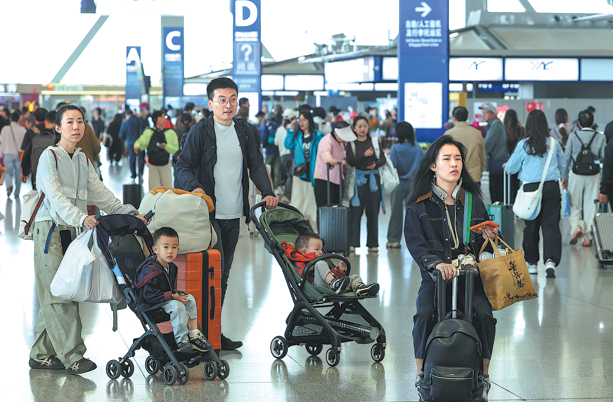
China stepped up transport services on Wednesday as the National Day holiday drew to a close, with the railways expecting 24.15 million passenger trips during the peak of the return rush.
China State Railway Group, the national railway operator, planned to operate 2,449 additional passenger trains. The railways carried 21.61 million passenger trips on Tuesday, marking the third consecutive day that daily passenger trips exceeded 20 million.
The holiday had already set a record for daily railway passenger trips, with 25.20 million trips recorded on Oct 1, according to the company.
The Ministry of Transport estimated 2.14 billion cross-regional trips from Oct 1 to 7, averaging 306 million a day, up 0.7 percent from the daily average during last year's eight-day Mid-Autumn Festival and National Day holiday. Wednesday alone was expected to see 293.75 million trips. The railways were expected to handle 152.36 million passenger trips over the seven days, with the daily average up 13.1 percent year-on-year.
Railway bureaus across the country have added services and strengthened connections with local transportation networks to facilitate passengers' return journeys.

Tourists get through the Kunming Changshui International Airport in Yunnan province on Wednesday, Octorber 7, as the National Day holiday comes to an end. Photo/Yunnan Daily
The Chengdu railway bureau scheduled 154 nighttime bullet train services and arranged for Chengdu East Railway Station to remain open overnight.
The Shanghai railway bureau planned to run 557 additional trains and couple train sets on 427 services to increase seat capacity.
At Guangzhou South Railway Station, seven passages allow passengers to transfer to the metro without undergoing another security check. Railway stations in Shanghai are also coordinating with metro and bus operators to facilitate journeys.
On expressways, authorities and power companies have deployed mobile charging facilities at busy service areas and directed drivers to alternative charging sites to ease queues.
Despite a 35 percent year-on-year increase in new energy vehicle traffic, the daily number of service areas experiencing exceptionally heavy charging demand fell 17 percent, the ministry said.
China's integrated transport network spans more than 6 million kilometers, including more than 50,000 km of high-speed railways, 199,000 km of expressways and 270 commercial airports.
The expanding transport network is giving travelers more options for sightseeing and family visits, including trips to destinations associated with China's revolutionary history.
A direct high-speed railway service linking Ruijin in Jiangxi province with Yan'an in Shaanxi province via Yudu in Jiangxi began operating on Sept 6. The service connects several destinations popular for "red tourism", or visits to sites associated with China's revolutionary history.
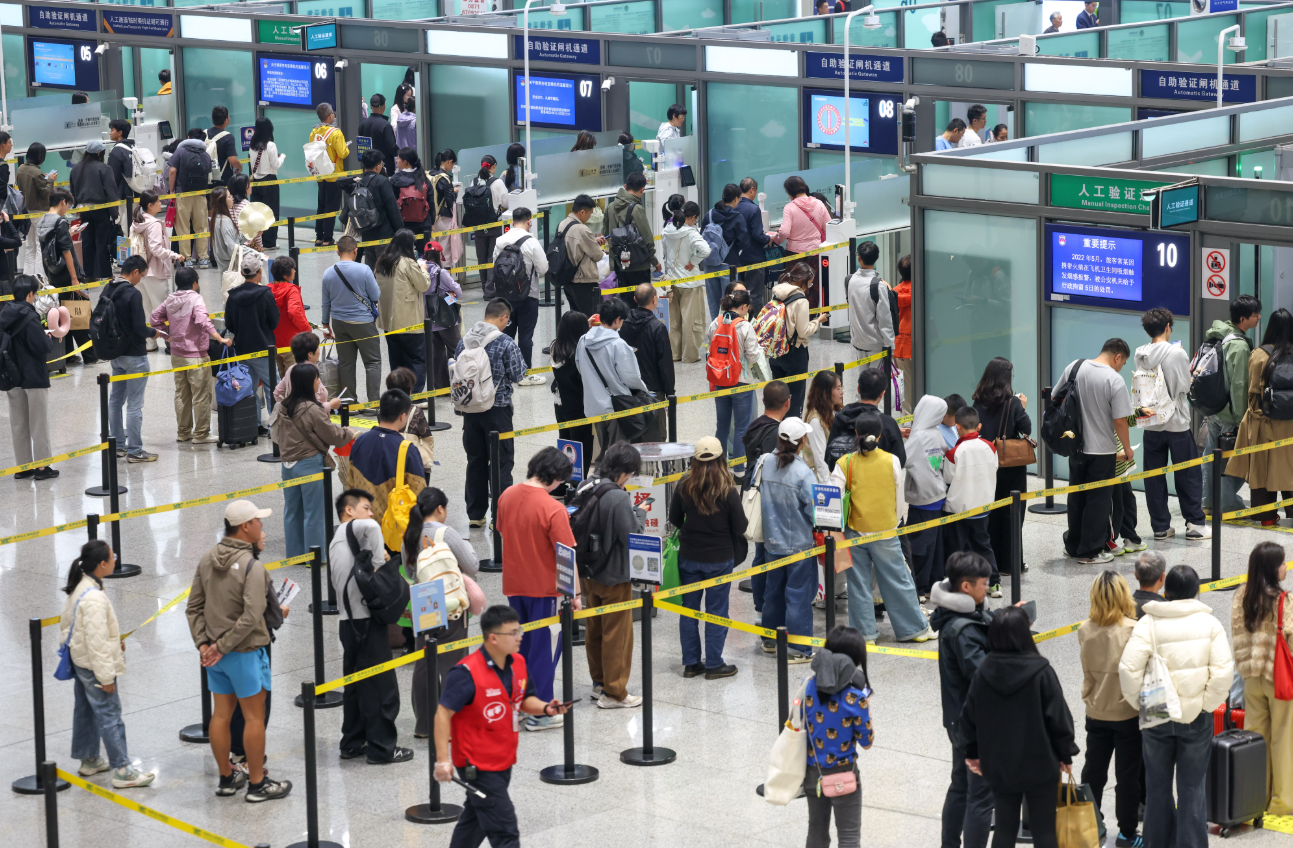
Tourists get through the Kunming Changshui International Airport in Yunnan province on Wednesday, Octorber 7, as the National Day holiday comes to an end. Photo/Yunnan Daily
According to China Railway Nanchang Group, Yudu station recorded 65,513 passenger departures during the Mid-Autumn Festival and National Day holiday period through Oct 6, up 57.04 percent year-on-year. Ruijin station handled 69,292 departures, up 52.48 percent.
Liu Jinsong traveled with his child from Nanchang to Ganzhou and then to Ruijin. They watched the flag-raising ceremony at Nanchang's Bayi Square before exploring the revolutionary heritage of southern Jiangxi.
"High-speed trains make traveling with a child so convenient. They save time and effort, and the service is thoughtful and attentive," Liu said. "My child also learned a lot along the way."
Zhang Jumei traveled with her two children to visit relatives in Yan'an on the Ruijin-Yan'an service.
"The children couldn't get enough of playing with their cousins," she said. The two families agreed to meet again in Ruijin for Spring Festival.
Aviation authorities had also anticipated a possible holiday record. At a news conference in late September, the Civil Aviation Administration of China forecast 31.19 million passenger trips from Sept 25 to Oct 7, covering the Mid-Autumn Festival and National Day holiday.
The daily average was forecast at 2.4 million trips, up 3.6 percent year-on-year, with the peak potentially exceeding 2.6 million.
The Ministry of Transport estimated that airlines would carry 16.95 million passenger trips from Oct 1 to 7, averaging 2.42 million a day and remaining broadly unchanged year-on-year. Air passenger traffic on Wednesday was expected to reach 2.51 million trips, up 2.4 percent year-on-year.
China Eastern Airlines identified Oct 6 and 7 as the main return peak and planned to deploy larger wide-body aircraft on more than 270 flights between Sept 24 and Oct 8.
A traveler surnamed Jiang said that flying from Luzhou in Sichuan province to Tianjin previously took 10 hours, including connections or stops. Lucky Air resumed the route linking the two cities for the holiday.
"Now it takes three hours," she said.
