


India is concerned over tunnel-boring machines


The Chinese Ministry of Commerce and General Administration of Customs announced October 19 that new export controls (hereinafter referred to as the "new regulations") would be imposed on full-face tunnel boring machines or shield tunneling machines, as well as on the cutting tools and cutterheads, screw conveyors, segment erectors, main drive systems and other components. The export controls would also apply to walking excavators, plateau-type wet shotcrete machines, and other items. The Chinese side stated that the items involved in these controls have clear dual attributes of the military-civilian use, and export applications that meet the regulations will be approved.
The new regulations do not target any specific country, but India reacted strongly, particularly out of concern that the Indian subway, high-speed rail, border infrastructure, and other projects could be affected. India is advancing multiple tunnel construction projects and has a large demand for professional equipment such as the tunneling machines and related components. How will the new regulations affect India? Can Indian domestic manufacturing serve as an alternative supply?
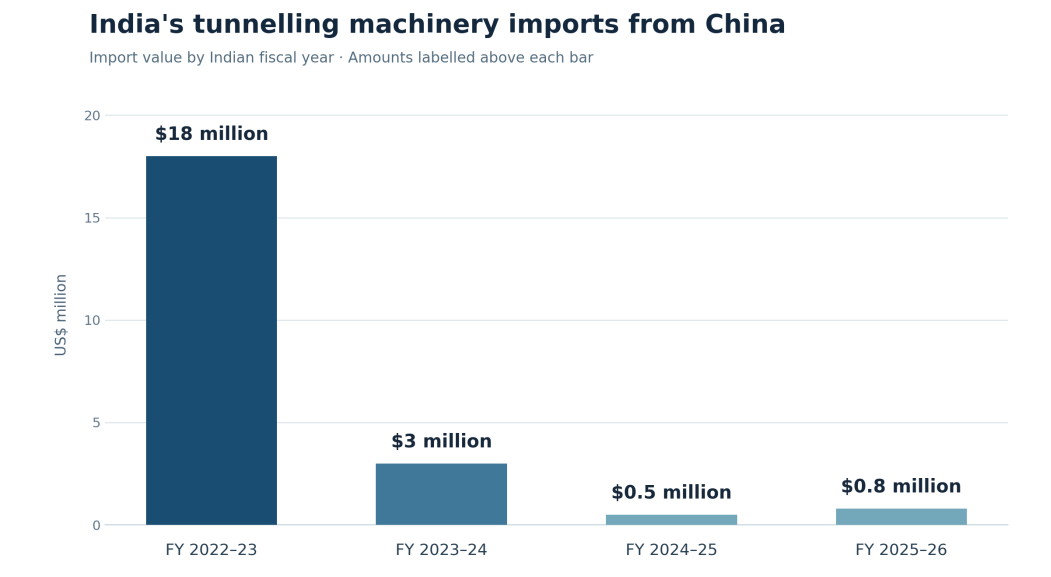
The Indian imports of tunnel boring machines from China in FY2022-2026. Data/Reuters
How Does the Indian External Dependence Manifest?
India's concern about the new regulations is first reflected in the demand for professional equipment in its tunnel projects. However, equipment procurement is only the first step. The supply of components and key technologies during construction, as well as the actual production stages through which the equipment passes, are equally related to whether projects can proceed smoothly.
First, as Indian tunnel projects increase, the professional equipment still needs to be supplied externally. The Mumbai-Ahmedabad high-speed rail is India's first high-speed line under construction, but the equipment undertaking the main underground tunneling for this project still comes from foreign suppliers. The project plans to build 21 kilometers of underground tunnels, of which 16 kilometers will be constructed using shield tunneling machines, and the two machines undertaking this task are both supplied by Germany's Herrenknecht AG.
This situation is not limited to high-speed rail. Chennai Metro Rail Limited (CMRL) of India stated that the Phase II tunnel project of the Chennai Metro uses 23 shield tunneling machines, including both newly imported equipment and equipment remanufactured in India.
As India's urban subway expansion and large highway tunnels, regional rapid transit systems, and high-speed rail projects advance, demand for shield tunneling machines and related equipment may further grow. The U.S.-based Robbins Company estimates that in the next 10 to 15 years, the number of shield tunneling machines required for India's subway projects could reach 100-120 units.
As demand expands, India not only needs a sufficient number of shield tunneling machines, but must also ensure that the models procured meet project requirements. For tunnel projects requiring long-term excavation, "how to procure" is only the beginning; "how to use" during construction is equally important on whether the equipment can continue operating.
Second, delivery of the complete machine is not the end point; components and technical services are key. In tunnel engineering, components of the shield tunneling machine need regular inspection and replacement as appropriate, and equipment operation also requires technical support such as overhaul and commissioning. Therefore, the supply does not end when the shield tunneling machine is delivered.
The new regulations cover not only complete shield tunneling machines, but also specially designed cutting tools and cutterheads, main drive systems, and other components, as well as related remanufacturing technologies. The head of the Indian subsidiary of German tunnel boring machine manufacturer Herrenknecht once explained that the company adjusts equipment configurations according to project geological conditions, and some key components must be imported from Europe.
Therefore, the degree of India's dependence on external equipment depends not only on the number of complete shield tunneling machines imported, but also on whether it can continuously obtain specialized components, refurbishment technology, and on-site services required for equipment commissioning and maintenance.
Third, procuring European brands may still involve Chinese production stages. Procuring European brands does not mean that the production and delivery of the equipment are unrelated to China. Since 2024, India has repeatedly faced equipment customs clearance delays and has expressed concerns to the Chinese side. In September 2025, German Ambassador to India Philipp Ackermann disclosed that at least three Herrenknecht tunnel boring machines produced in Chinese factories and planned for shipment to India had been detained by Chinese customs, but they were subsequently released one after another.
Although Indian industry insiders believe that nearly half of local tunnel boring machines are produced in Germany and that direct dependence on Chinese enterprises should not be exaggerated, it is worth noting that assessing supply risk requires looking not only at suppliers but also at the actual place of production and supply pathways of the equipment.
According to the Chinese new regulations, controlled items of Chinese origin, even if transferred through a third country, must obtain a license if ultimately provided to sensitive destinations specified in the announcement. Therefore, European companies have increased supply options, but this does not mean they can bypass China's production stages and corresponding requirements on export control.
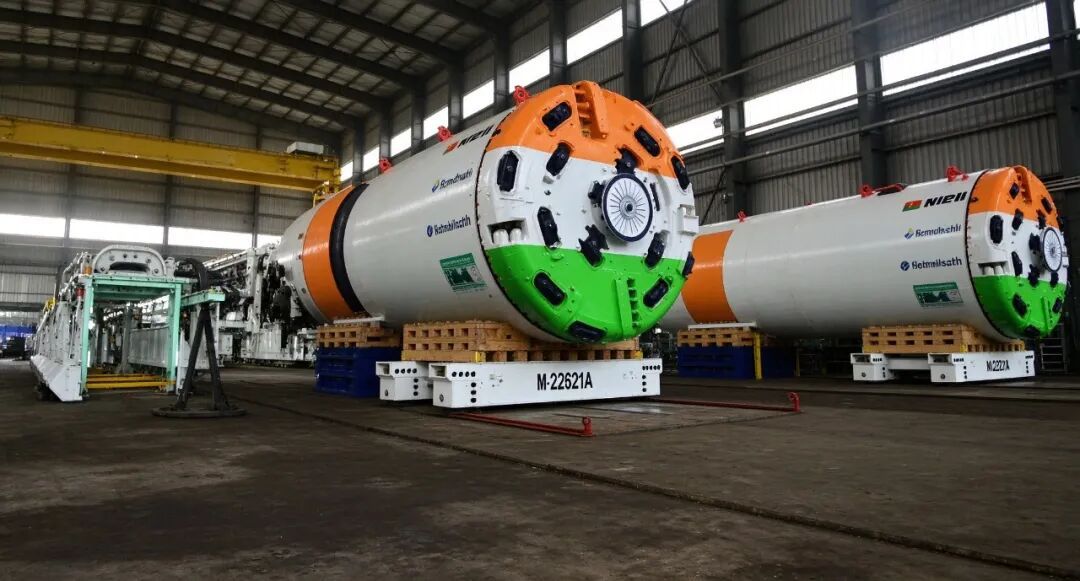
Two tunnel boring machines
Can Indian Manufacturing Form Alternative Capacity?
The difficulty of eliminating potential risks by replacing suppliers has prompted India to begin assessing the impact of the new regulations on imports of professional tunnel excavation equipment and key projects, and to promptly explore domestic manufacturing of shield tunneling machines. India had previously included tunnel boring equipment within the scope of manufacturing support.
In the FY2026-27 budget, India has proposed supporting domestic manufacturing of tunnel boring equipment and launched an incentive plan of about US$1.2 billion over seven years. At the same time, India is also pushing foreign companies to accelerate manufacturing in India, and Germany's Herrenknecht is expanding its Chennai plant.
Indian Railway Minister Ashwini Vaishnaw said that the country can already manufacture shield tunneling machines with diameters of 8 meters and 15 meters, and is preparing to produce models with diameters exceeding 16 meters. U.S.-headquartered tunnel boring machine manufacturer Robbins also stated that the localization rate of two machines it manufactured for the Bhopal and Patna urban metro projects in India reached about 80% to 85%. The equipment used in the Chennai Metro Phase II project also includes shield tunneling machines remanufactured in India.
This means that India already has a certain foundation in manufacturing shield tunneling machines, refurbishing old machines, and providing project services. If continuous orders can be formed, Indian domestic enterprises will have the opportunity to repeatedly produce and improve existing types of machines. Procurement of shield tunneling machines for related projects in India may have more local options.
However, there is still a gap between producing a shield tunneling machine of a certain diameter and delivering the machines required for each project on time. Equipment diameter is only one indicator; specific conditions such as geology and construction routes all affect the selection of machine models. Even if India can already produce shield tunneling machines with a diameter of 15 meters, it may not necessarily be able to replace the 13.6-meter-diameter equipment used in the Mumbai-Ahmedabad high-speed rail.
In addition, moving from being able to manufacture the equipment to forming stable industrial capacity still requires long-term accumulation. In 2025, India's state-owned Bharat Earth Movers Limited (BEML) sought technology partners for manufacturing domestic shield tunneling machines. The scope of cooperation it listed included not only design and manufacturing, installation and testing, commissioning and maintenance, but also personnel training, long-term component supply, and maintenance. This shows that the capabilities India hopes to build go far beyond a complete machine production line.
However, as long as key services and technical personnel remain dependent on external partners for a long time, India will need a certain amount of time to transform external resources into domestic capabilities. For a country that both needs to expand infrastructure and wants to reduce external dependence, India can make policies to change the direction of procurement, but it cannot save the time required for industrial development.
More critically, it’s uncertain whether domestic enterprises can continuously deliver engineering-tested models of the machine within a limited time. This also determines that in the short term, India's domestic manufacturing plans will find it difficult to eliminate India's concerns about the Chinese new regulations.
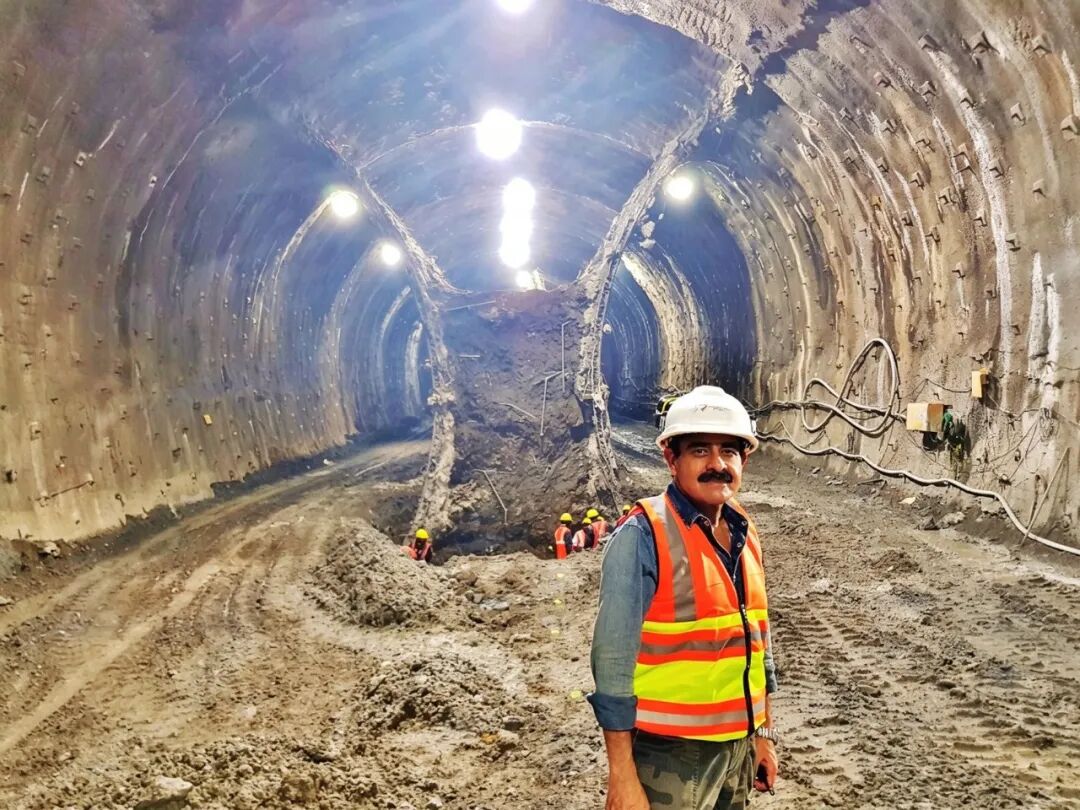
An Indian tunnel is under construction.
Cooperation with China Cannot Avoid Security Concerns
India's expansion of domestic manufacturing of shield tunneling machines can increase the selectivity of equipment for projects, but in the short term it will be difficult to meet all project needs, which also makes India's concerns extend beyond equipment procurement itself.
On the one hand, India imposes restrictions on China in economic matters everywhere based on security considerations; on the other hand, its infrastructure construction still relies on equipment manufactured by countries including China and on technologies provided by them. When India uses the imported equipment for border projects, China's security concerns are also involved, making the contradiction between India's security precautions and development needs more prominent.
India is building tunnels in border areas, evidently not only to shorten people's travel time. When introducing the Sela Tunnel in the Tawang direction, the Indian side explicitly stated that it can provide all-weather passage conditions and enhance the army's combat readiness. When discussing the Shinkun La Tunnel in the Ladakh region, India emphasized that the project will facilitate the rapid passage of troops and equipment while also promoting local development. These projects have both civilian and military value and cannot be equated with ordinary commercial construction.
India previously also imposed government approval on investment from land-border countries including China, and set registration and security review thresholds for their enterprises' participation in public procurement. Restrictions also extend to the field of shield tunneling machines: BEML's 2025 technical cooperation inquiry document requires technology providers from countries sharing a land border with India to complete registration first, and stipulates that shield tunneling machine assemblies may not be procured from these countries.
Therefore, India can review economic activities involving its own security, and should also understand why China reviews dual-use equipment that may be used in sensitive areas. India cannot, on the one hand, restrict Chinese enterprises from entering its market on the grounds of "national security," and on the other hand, categorize China's security review based on the final use of equipment as "economic coercion."
Writing by Shan Minmin (member of the South Asian Studies Group on WeChat and master student at the School of Asian and African Studies, Shanghai International Studies University); Trans-editing by Wang Shixue and Zu Hongbing
