


U.S.-India trade talk fails because of irreconcilable differences


During the U.S. Trade Representative's visit to New Delhi last month, the United States and India failed to reach a consensus on an interim trade agreement. The reason behind the failure lies in irreconcilable differences over key interests, particularly India's increasingly tough stance in the negotiations.
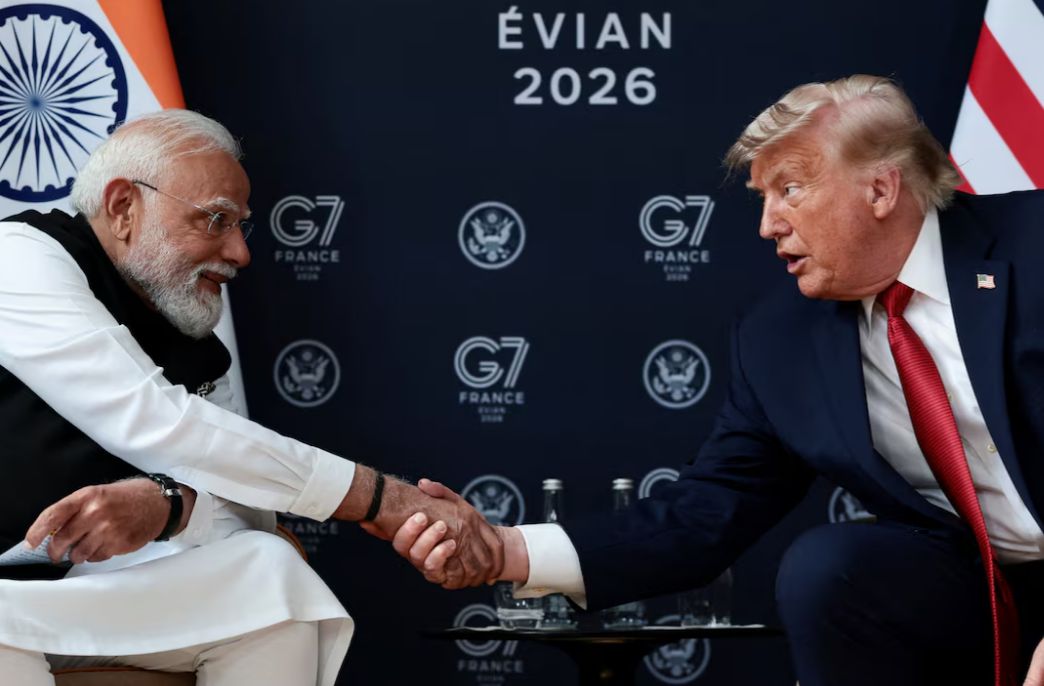
U.S. President Donald Trump shakes hands with Indian Prime Minister Narendra Modi as they attend a bilateral meeting during the G7 Summit in Evian-les-Bains, France, June 17, 2026. Photo/REUTERS
India explicitly demanded that any trade agreement with the U.S. must grant it tariff treatment superior to that of competitors like China, along with U.S. guarantees against future tariff hikes. On sensitive issues such as agriculture—which India regards as a "red line"—New Delhi refused to make concessions, fearing that market opening would harm the interests of hundreds of millions of farmers and undermine its political base.
India's recent economic performance has been robust, with merchandise exports growing by approximately 15% year-on-year in the second quarter. At the same time, India is actively expanding cooperation with other economies—its free trade agreement with the UK is set to take effect soon, and negotiations with the EU are progressing. These developments have given India more leverage to avoid rushing into a deal.
A previous provisional framework agreed upon by the U.S. and India lost its appeal after the U.S. Supreme Court ruled that certain U.S. tariff measures were unlawful. With growing policy uncertainty on the U.S. side, India is more inclined to adopt a wait-and-see approach rather than hastily accepting a potentially unfavorable agreement.
This breakdown marks a clear signal that bilateral ties are shifting from a "strategic partnership" toward a more "transactional relationship," reflecting the concentrated eruption of underlying tensions. It can be said that the failure of the trade talk is a concentrated manifestation of underlying fissures in U.S.-India relations, particularly in the economic and trade domain.
U.S.-India relations were once hailed by Washington as a "defining partnership for the 21st century," but they are now increasingly viewed as a transactional relationship based on calculated interests. In U.S. strategic circles, there is a perception that India has fallen short of American expectations on key strategic issues—such as the Russia-Ukraine conflict and balancing China—leading to a reassessment of its strategic value.
Trust in the United States is declining within India's domestic discourse. The U.S. has continued to exert pressure on issues like tariffs and energy procurement, and has even explicitly stated that it "will not allow India to develop into a strong competitor." This has triggered a strong sense of "betrayal" among India's strategic community, prompting introspection about the risks of over-reliance on the U.S.
