


What underpins the Chinese-language craze in Laos?


Thongloun Sisoulith, General Secretary of the Lao People's Revolutionary Party Central Committee and President of Laos, is paying a state visit to China from June 2 to June 6. Thanks to Sino-Lao economic integration, industry-education collaboration, and people-to-people bonds, the enthusiasm for Lao young people to learn and use the Chinese language is growing.
Railway makes Chinese a necessity for employment
Language skills, as an important form of human capital, can significantly enhance a worker's employability and income, thereby promoting regional economic development. The opening and operation of the China-Laos Railway provide an observable case study for this theory.
In December 2021, the China-Laos Railway officially began operations. This landmark "Belt and Road" project has not only fundamentally transformed Laos's centuries-old predicament of being a "landlocked country" but has also created an urgent demand for bilingual talent, making Chinese language skills a "hard currency" in the eyes of Lao youth.
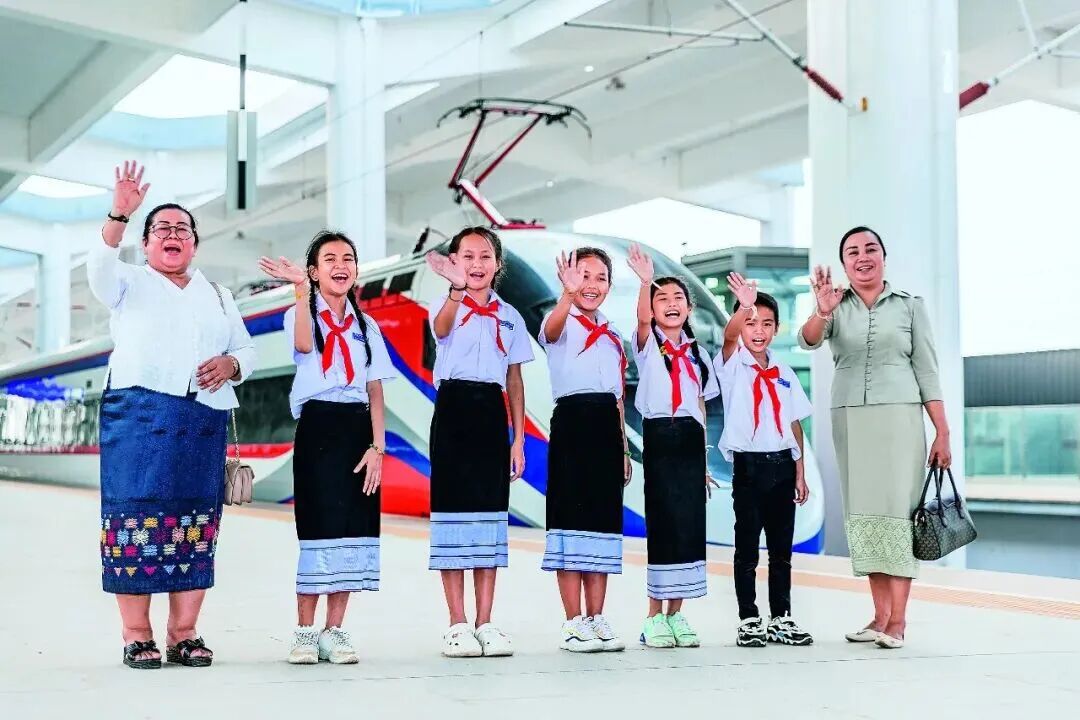
Lao pupils and teachers wave at a station of the China-Laos Railway.
To meet the railway's demand for bilingual personnel, the Laos-China Railway Co., Ltd. partnered with the Confucius Institute at Souphanouvong University to launch a "Chinese plus railway" training program, enabling Lao employees to learn railway-specific Chinese terminology and operational skills in their work.
To date, the proportion of Lao employees proficient in Chinese on the China-Laos Railway has jumped to 61% from 5% in the initial stages of operation. The share of Lao employees at the Vientiane Operations Center is expected to reach 80% by the end of 2026.
Power cooperation highlights the language’s role
In cross-border cooperation, language is not just a communication tool but also affects the efficiency of technology transfer and collaborative innovation.
The photovoltaic panels at the China General Nuclear Power Group (CGN)'s clean energy base in northern Laos operate daily, facing the rising sun. A group of young Lao engineers who understand both Chinese and technology are active on the construction sites. Their growth highlights the crucial role of language in technology transfer.
EDL-T, the Lao national power transmission company, has developed a "2+2+2" employee training model that deeply integrates language training with technical instruction: 2 months of intensive Chinese training at the Confucius Institute at Souphanouvong University, 2 months of studying professional theory and technical standards in Yunnan, China, and finally 2 months of hands-on practice back in Laos.
Now Chinese-invested hydropower projects account for 44% of Laos's total power supply. In February 2026, the China-Laos 500 kV power interconnection project was fully completed, with a two-way power exchange capacity of 1.5 million kilowatts upon operation. The operation of these projects requires a cohort of local technical talent proficient in the Chinese language.
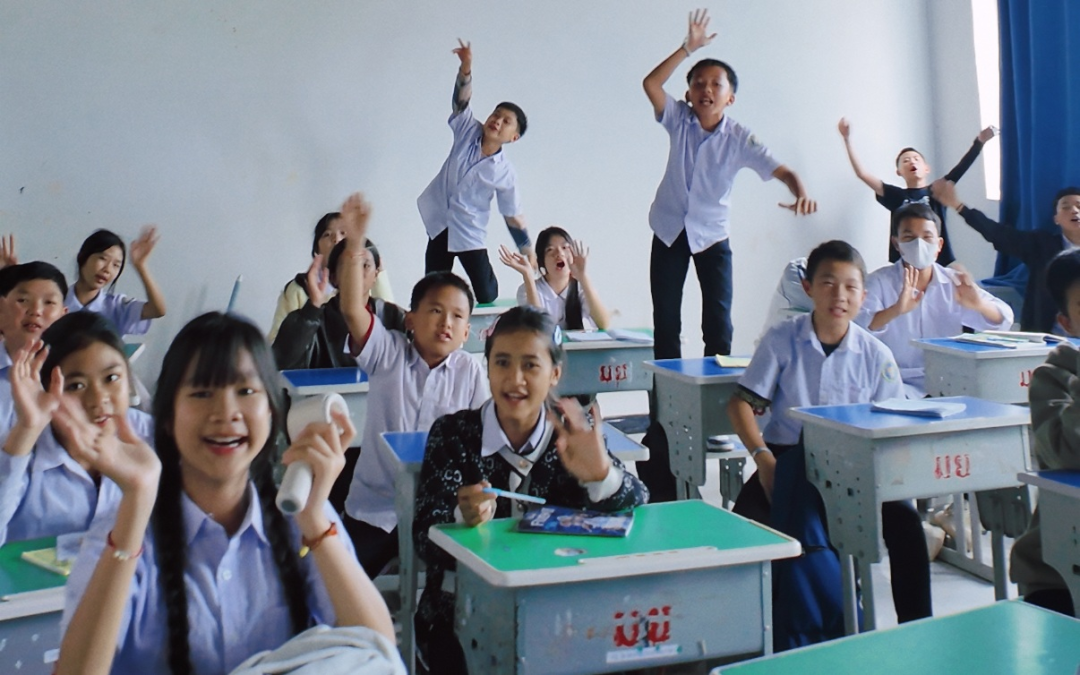
Lao pupils show their zest at a Chinese class.
Chinese facilitate activities in digital economy
Since operation of the China-Laos Railway, the cold-chain logistics have made Lao agricultural products such as bananas, mangosteens, and cassava to enter the Chinese market faster, creating new opportunities for cross-border trade. Local logistics, customs clearance, and e-commerce talents proficient in Chinese are rapidly becoming highly sought-after. In this trend, Chinese language skills helped Lao youth increase their income.
Educational cooperation and skills training are providing solid support for language-empowered trade. Xishuangbanna Vocational and Technical College, the Chinese higher vocational institution closest to Laos, has engaged in deep collaboration with Lao provincial education and sports departments and multiple universities for many years, fostering bilingual talent in both Chinese and Lao.
Since beginning to enroll international students in 2004, the college has trained nearly 3,000 Lao students, including nearly 1,000 specializing in "Chinese + Commerce" and "Chinese + Tourism." Graduates have become key pillars in Lao industries such as commerce and tourism.
The Chinese language is leaving its mark on Laos's industrial landscape and building a bridge of communication between the peoples of the two countries. As China and Laos mark the 65th anniversary of the establishment of diplomatic relations, the year 2026 is designated as the "China-Laos Friendship Year." International education on the Chinese language will continue to serve the industrial development of Laos.
(The author Song Minying is Deputy Dean of the School of Continuing Education, Kunming University of Science and Technology.)
