


Myanmar leader's visit to India: Shared interests cannot mask divides, rifts


Myanmar's President Min Aung Hlaing has just concluded a state visit to India. This visit represents a convergence of Myanmar's efforts to break out of diplomatic isolation and India's push to advance its "Act East Policy." Shared interests in security, connectivity, energy and economy are the main reasons behind the handshake between India and Myanmar.
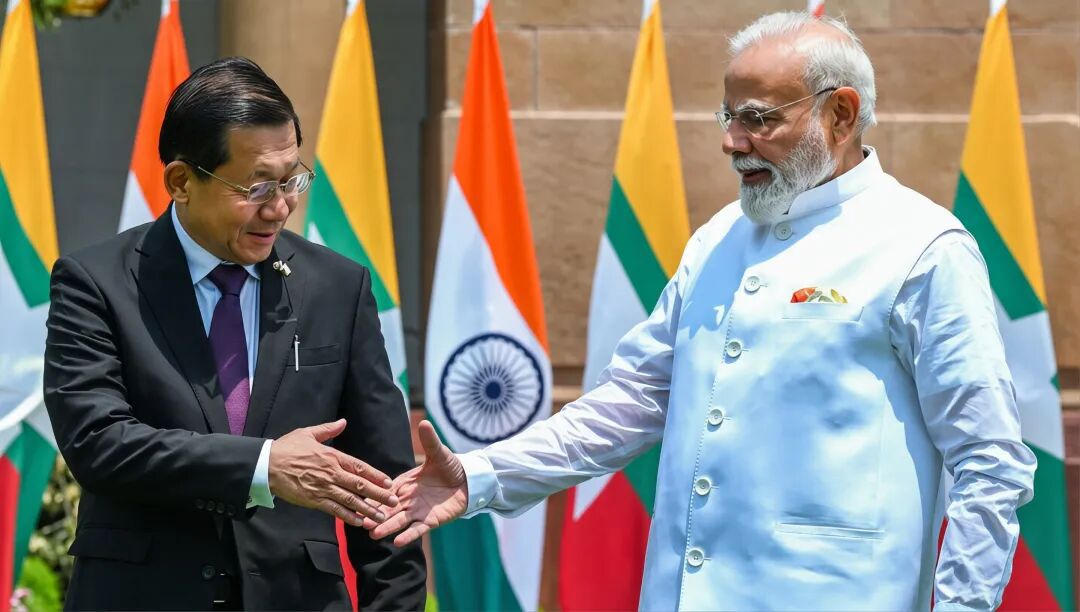
Myanmar's President Min Aung Hlaing and Indian Prime Minister Narendra Modi
Border security is the most immediate common interest between Myanmar and India. The large number of refugees caused by the civil unrest in Myanmar has flowed into India's border areas, increasing the burden on India's local governance. Cross-border armed groups moving between the two countries also complicate the Myanmar government's military operations. Faced with common security pressures, regular joint patrols and intelligence sharing between Myanmar and India have become the fundamental needs for bilateral cooperation.
Connectivity and energy cooperation are critical to whether India's "Act East Policy" can be truly implemented and whether Myanmar can improve its development conditions through external cooperation. The two countries continue to advance cross-border infrastructure projects such as roads, border gates and bridges, facilitating the flow of people and goods and paving the way for Indian production capacity to enter the Southeast Asian market.
Economic, trade, and supply chain cooperation highlight the natural complementarity between the two sides. Myanmar's economy is dominated by agriculture and primary processing industries, with a weak industrial base and heavy reliance on imports for daily goods. India, with its comprehensive light industry and manufacturing systems, is eager to export its production capacity and explore emerging markets.
Although shared interests bring Myanmar and India closer, deep-seated divides persist. Differences in political stances, geopolitical rivalries, unresolved historical disputes, and external pressures are difficult to reconcile in the short term and are fundamental reasons why the bilateral relationship struggles to deepen.
The perception of Myanmar's political landscape and the legitimacy of its government represent the most fundamental political divide between the two countries. The West has imposed comprehensive sanctions on Myanmar on the grounds of democracy and human rights, while India's political orientation has always leaned toward the Western camp, with India continuously calling for Myanmar to advance "democratic transition." This directly conflicts with the Myanmar regime's urgent need for international recognition, making it difficult to establish solid political mutual trust.
Regional power rivalry is an unavoidable geopolitical difference for Myanmar and India. China and Myanmar have long maintained friendly neighborly relations, with cooperation spanning infrastructure, economy, trade, livelihoods, and other areas. India is wary of this, concerned that China-Myanmar cooperation could squeeze its own geopolitical space. Consequently, when developing ties with Myanmar, India displays a clear balancing intent. Myanmar, however, adheres to a neutral and independent foreign policy and does not wish to be drawn into great power disputes. India seeks balance, while Myanmar seeks autonomy—a geopolitical contradiction unlikely to be resolved anytime soon.
Myanmar's ethnic armed groups and human rights issues further weaken the stability of bilateral cooperation. The West continues to pressure Myanmar’s neighboring countries on these issues, demanding the isolation of Myanmar. India needs to maintain cooperation with Myanmar to ensure border security, but it cannot completely ignore the positions of its Western allies. As a result, India oscillates between engagement and distance. Myanmar insists that ethnic and human rights issues are internal matters and opposes external interference. The ideational clash will amplify differences between Myanmar and India.
Border history and ethnic issues constitute a hidden rift in bilateral relations. There are still unresolved border demarcation disputes between Myanmar and India, with occasional frictions in ambiguous zones. Several cross-border ethnic groups sharing the same origins live along the border, and population mobility as well as local administration can easily lead to conflicts. These issues are intricate and complex, unlikely to be fully resolved through a single high-level visit.
In summary, this high-level interaction has restored long-broken communication at the top and preserved space for continued progress on practical issues such as border security, connectivity, and economic cooperation. However, the deeply rooted structural contradictions and mutual suspicions between the two countries will not be eliminated by one meeting. The Myanmar-India relations will maintain a state where cooperation proceeds on its own terms and differences remain as they are. Limited cooperation and ongoing divide may well be the norm for Myanmar-India ties.
(The authors Xiang Jie and Ye Weijie are research assistants at the Center for China’s Neighbor Diplomacy Studies, Yunnan University.)
