


Can India's IT industry withstand the onslaught of AI waves?


Since the year 2025, India's once-proud IT industry has suffered two consecutive blows to its confidence. The first came when Chinese open-source large language model "DeepSeek" burst onto the global stage, sending shockwaves through India's tech sector and prompting soul-searching questions as to why DeepSeek emerged from China rather than India, a nation renowned worldwide for its IT services. The second blow arrived when Tata Consultancy Services (TCS), India's largest IT services firm, announced the largest layoff in its corporate history. By cutting 12,000 mid- to senior-level management positions, TCS sent a chill through the industry and raised fears of an impending systemic decline.
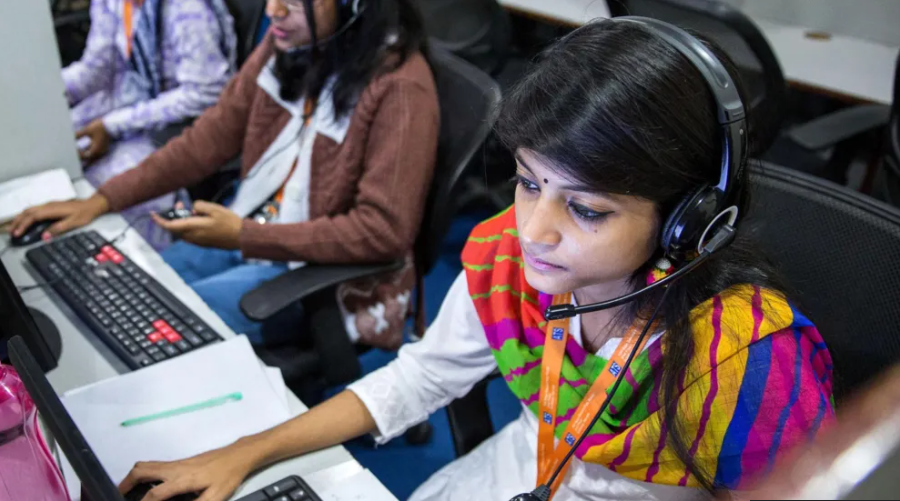
Graduates work at an Indian IT company.
In fact, the service industries like IT are inherently dependent on industrial manufacturing. However, because India has failed to build a coherent industrial manufacturing base, it cannot form an indigenous foundation for information technology. Whether in databases, AI large models for manufacturing, or enterprise resource planning (ERP) systems, India has barely developed any core capabilities of its own. This was sustainable during the early stages of global informatization, as India could maintain growth through low-cost IT outsourcing. Around 2015, the global ascent of AI was already unstoppable, yet most Indian IT firms remained indifferent. They failed to recognize the transformative potential of AI, were unwilling to abandon their established arbitrage model, and clung to the belief that they could continue the traditional division of labor—"America eats meat, India drinks soup."
But when the AI wave truly hit, the complacent dreams of Indian policymakers were shattered. India's IT industry failed to secure a strong core business to anchor itself. After all, India's longstanding strength has never been technological innovation, market expansion, or earning excess profits, but rather "hiring Indian programmers at salaries lower than those of Starbucks baristas in San Francisco." In other words, before the widespread deployment of AI tools like Claude, ChatGPT, and Gemini, the vast majority of Indian programmers were essentially engaged in tasks at which current AI tools excel—using English, following instructions strictly, and performing routine, repetitive work at extremely low wages, functioning in effect as "human AI" for Silicon Valley's tech elites.
Once lower-cost, more efficient AI tools gain widespread adoption, they will drastically compress the labor cost differential between the U.S. and India, undermining the arbitrage foundation on which Indian IT firms have long relied. Recently, TCS announced "the largest layoff in its history" involving 12,000 positions. Although it did not explicitly cite AI's impact, the connection is already clear. In the foreseeable future, a large portion of Indian IT giants' business will be replaced by AI. While IT jobs will not disappear entirely, the industry landscape has already undergone a seismic shift: Human labor remains critical in handling complex, innovative and challenging tasks, but demand for repetitive, mechanical work will drop sharply. If India fails to break out of its established model, it may face an unprecedented "talent mismatch" predicament in the AI era.
At the same time, the stellar performance of China's open-source foundational model DeepSeek has shattered India's illusions about its own IT industry's leading position, prompting Indian policymakers to confront the risk of falling behind in AI and to take remedial measures. That India's IT lags behind the U.S. has been the norm for decades, but falling behind China is far less acceptable to India. The shock to India's government and IT sector has been so profound that one industry expert said: "DeepSeek may be the best thing that has happened to India. It has given us a 'wake-up call' to stop talking and start acting."
Just ten days after the release of DeepSeek-R1, India's Ministry of Electronics and Information Technology (MeitY) initiated a call for proposals for indigenous large-scale AI foundational models capable of handling multiple tasks. MeitY issued an open tender inviting private cloud service and data center companies to reserve GPU computing power for government-led AI research. Reliance Jio, Yotta Data Services, and the Tata Group have all responded. Under this arrangement, MeitY will deploy nearly 19,000 GPUs at subsidized rates, sourced from private sector infrastructure and allocated to foundational AI projects. This has sparked a surge in corporate proposals, with companies eager to leverage government-subsidized computing power to develop their own models. AI-related initiatives are now advancing at record speed, reflecting a potent mix of ambition and anxiety that has galvanized strong political will.
To make things worse, India's IT industry is also facing unprecedented policy pressure from the Trump administration. The Halting Incoming Relocations of Employment Act (HIRE Act) introduced by the U.S. Senate's proposed a 25% tariff on all outsourced work, and it is aimed at encouraging corporations to create more jobs for the U.S. domestic labor market rather than shipping work overseas. India is one of the largest sources of U.S. service imports, and the U.S. market accounts for a significant share of Indian IT giants' revenues, making India's IT industry a likely major casualty of the Act. Notably, the services trade differs from goods trade in that its supply chains are much shorter, making it difficult for India to offset punitive tariffs through diversified cross-border deployment or to hedge risks by finding alternative markets.
For India, the worst-case scenario would be a convergence of AI shocks and geo-economic pressures—and this possibility is already looming on the horizon. Whether in manufacturing or services, the Trump administration aims to keep as many jobs as possible on U.S. soil. Given that AI's penetration and disruption of the services sector are currently far more pronounced than in manufacturing, the U.S. is now more likely to leverage its existing AI advantages to drive "services reshoring", and the U.S. tariffs may reclaim the service jobs previously outsourced to India and other countries. This includes not only traditional mid- to low-end IT services but also more diverse business services.
In summary, India's IT industry once achieved a prominent position in the global division of labor through its unique comparative advantages and has long been regarded as a symbol of India's economic core competitiveness and national soft power. However, against the backdrop of the AI wave, global industrial chain restructuring, and geopolitical friction, this "human-resource-driven" development model is showing signs of strain. India's traditional strengths, such as IT outsourcing, are now facing an existential crisis. They may be further marginalized in the race for technological innovation and industrial upgrading, and they will potentially expose the macroeconomy to systemic risks due to the damage to export pillars. The Indian government needs to break free from conventional thinking and adopt a new strategic posture; otherwise, India could very well become the country hardest hit by the global AI waves.
(The author Mao Keji is an Assistant Researcher at the International Cooperation Center, the National Development and Reform Commission of China.)
