


Tibetan guide leads campaign against trash on Yunnan pilgrimage route


Mountain guardian cleans up the climb
Starting from Yongzhi village in Dechen county, they were accompanied by 22 horses and mules to help collect garbage along the mountain trail.
While cleaning a mountain pass over 4,000 meters above sea level on June 23, A Qingbu's phone unexpectedly picked up a signal. He received a message from the Yunling township government, summoning him, a member of the township Party committee, to an important meeting in Dechen on June 25.
A Qingbu decided to transport the garbage they had already collected to a lower campsite. On June 24, he and several team members used their animals to carry dozens of large bags of waste out of the mountains.
After attending the meeting, A Qingbu rejoined his team on June 27, committed to continuing the cleaning campaign.
"Before I left, we had already cleared about 40 to 50 kilometers of the trail," he told China Daily. "We still need more than 10 days to complete the entire 240-km outer circuit."
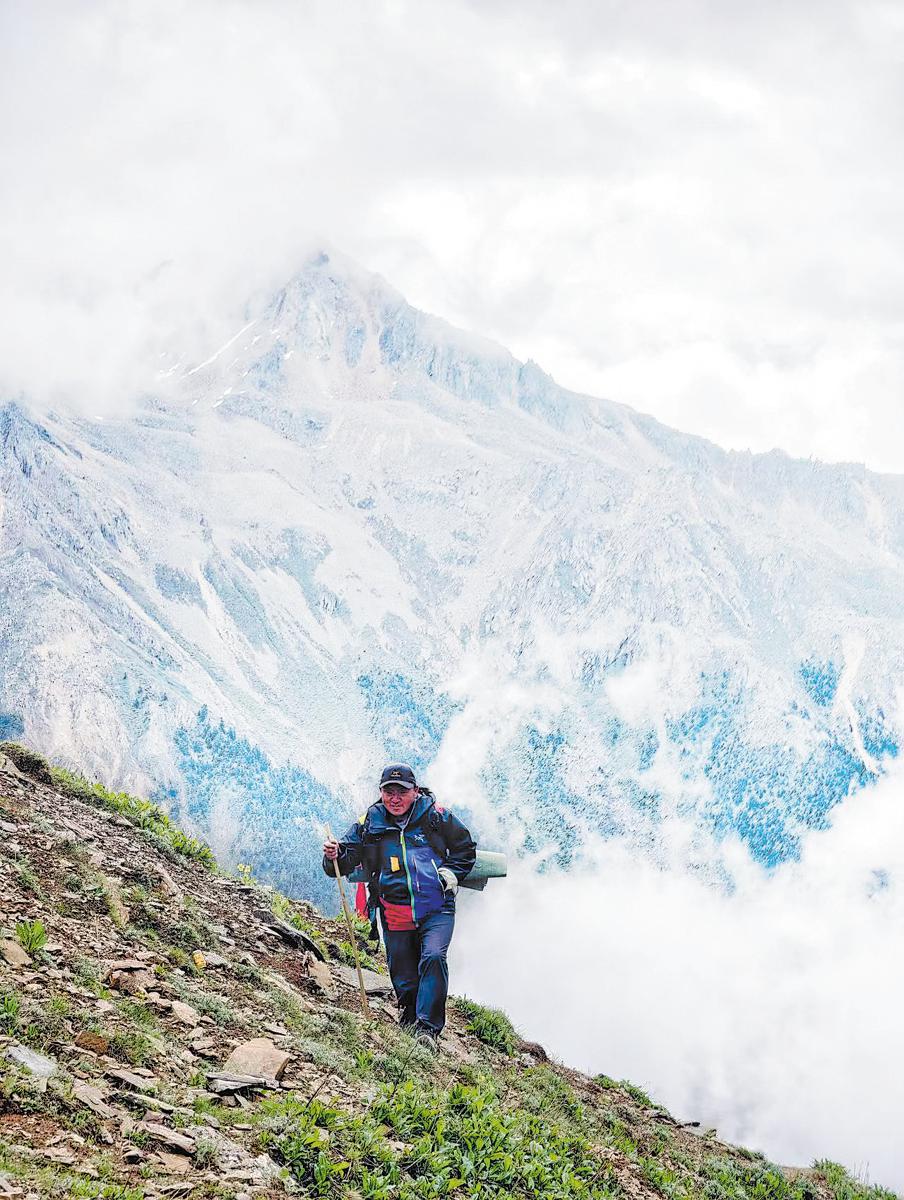
A Qingbu scales a slope on his way to collect garbage along the trail around the mountains on June 21. XUAN TIAN/FOR CHINA DAILY
Source of garbage
The first time A Qingbu noticed the garbage was in 2003 — a Water Sheep year for Mount Kawagebo, the highest peak in the Meili Snow Mountains, which straddles Yunnan and the Xizang autonomous region.
In Tibetan Buddhism, the Year of the Sheep is the sacred birth year of Kawagebo, making it a highly auspicious time for pilgrimage. Tibetan pilgrims arrived in unprecedented numbers to perform the kora, a ritual circumambulation of the mountains that can take eight to 10 days.
"At a campsite by a spring, I saw oil from plastic food bags floating on the water. It was disgusting," he said. "Even while sleeping, the stench from the garbage was unbearable."
A Qingbu, then 30 years old, had been guiding pilgrims since he was 17. He knew the outer circuit better than most. Born in 1972 in Chalitong village of Yunling township, he lost his mother at 13 and had to leave school after sixth grade to return home and farm.
Chalitong is near the main road from Dechen to Gongshan county in Yunnan and the entrance of the outer circuit around Mount Kawagebo.
Guiding pilgrims has long been a traditional occupation for local men, and it soon became A Qingbu's primary livelihood. Initially, he earned a modest 400 yuan for completing the outer circuit.
However, the 1991 Kawagebo mountaineering tragedy, which claimed 17 lives, brought international attention to the sacred peak, the surrounding mountains and the kora route. As a result, A Qingbu and his friends began guiding larger groups of pilgrims and trekkers.
"To hire a horse or mule, you now need to pay 400 to 500 yuan ($59 to 74) per day," he said. "A team of four or five guides, with five to eight animals, can serve a group of seven or eight customers and earn between 20,000 and 30,000 yuan per trip."
In the early days, the route was virtually free of litter. Tibetan pilgrims carried traditional foods like barley flour, yak butter and dried yak meat. They brewed tea from loose leaves, discarding the wet leaves beside the trail. With no packaged goods, there was little waste to dispose of, A Qingbu recalled.
Over time, however, packaged foods, canned drinks and bottled water started to fill pilgrims' bags. Seasonal grocery stands began to appear along the kora route, catering to the increasing number of visitors. A Qingbu noticed plastic bottles, instant noodle cups and snack wrappers accumulating along the path.
"In 2003, I realized this was going to become a significant problem," he said.
Birth of a campaign
In that year, A Qingbu first proposed a cleanup. But it was not until 2006 that he formally led one. Twenty-three people joined him, all carrying their own food and bedding for the journey. They had no way to haul the garbage out of the mountains. So, they did what they could, gathering the trash along the route and burying it in open places without vegetation.
"At that time, we didn't have the conditions to transport it down," A Qingbu said. "We just buried it. Simple burial."
Local Tibetans began to join him. "We shared the same faith. Mount Kawagebo is not just a mountain to us — it is a deity, a protector and a sacred presence. We cannot turn a blind eye to the trash issue," A Qingbu said.
In 2009, a breakthrough came. Trekkers from other parts of the country, learning of A Qingbu's efforts, donated money to buy bamboo baskets. A Qingbu placed them along the kora route as makeshift trash bins. The baskets were held up by bamboo poles, but they rotted quickly — lasting two years at most.
Then A Qingbu saw something in Dali city in Yunnan — small baskets made from recycled steel wire from tires. He had an idea. He commissioned larger, heavier baskets made of iron frames. "They cost more, but they lasted," he said. "Without damage from avalanches or falling trees, they could survive seven or eight years."
A Qingbu placed 500 iron baskets along the trail. With donations from his customers, he also put up bilingual signs in Mandarin and Tibetan, urging pilgrims to protect the mountains and the environment.
A Qingbu usually launches his cleanup campaign twice a year. The spring campaign is from late May to early June, before the summer vegetation grows thick. "The garbage is easier to find when the plants haven't grown yet," he said.
The second is in October, after the autumn frost kills the grass and leaves. "When the vegetation dries, the trash stands out."
A standard cleanup takes eight or nine days — the same time as a kora. A thorough one takes 20 days.
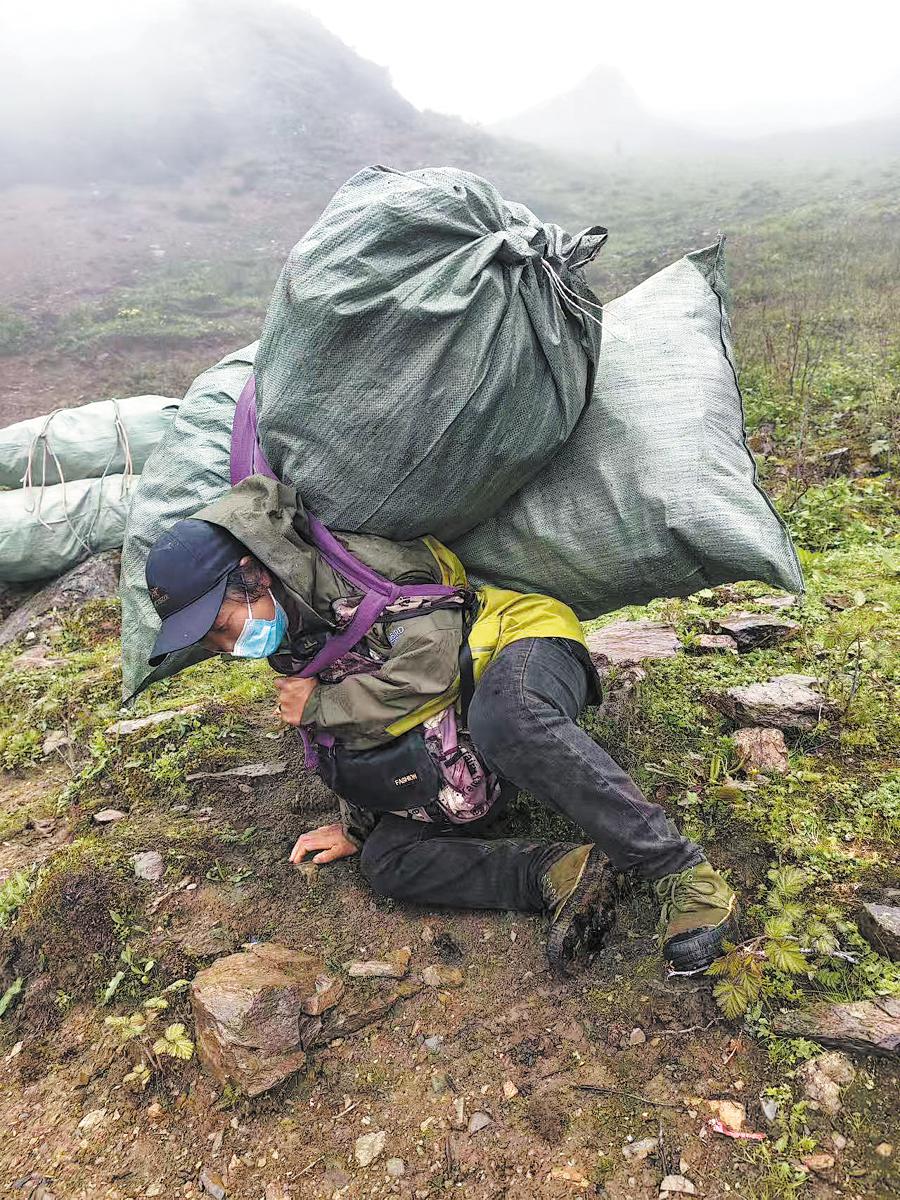
A member of the ReBird Crew carries bags of trash she collected down a slope on June 22. XUAN TIAN/FOR CHINA DAILY
The ReBird Crew
Until 2023, A Qingbu's cleanup campaign was entirely voluntary, funded by his own income and donations from his customers. In 2023, however, a significant opportunity arose when Arc'teryx, a Canadian outdoor apparel and equipment company, discovered his efforts.
The company had launched a limited-edition collection named after Kawagebo and held an event in Shangri-La, a city four hours from Dechen.
Arc'teryx decided to sponsor A Qingbu's cleanup campaign, turning it into his fulltime occupation. The company provided him with eight mules, built a shed for them and supplied feed.
It also purchased trash bins for each of his cleanup projects, providing 250 for the recent campaign. It named A Qingbu's team the ReBird Crew, providing them with Gore-Tex jackets as uniforms.
"The jackets belong to the team," A Qingbu said. "After a campaign, they can be returned to the company for maintenance and provided to our participants in the next cleanup."
According to A Qingbu, mules are more resilient than horses in the mountains, making them better suited for the project.
Initially, he considered using large plastic bins like those in cities, but they proved impractical. "A single mule could carry only four on its back," he said. "So we opted for iron-framed baskets — smaller, lighter and easier to transport."
With funding from Arc'teryx, A Qingbu could pay his crew members 150 to 200 yuan per day. However, he described it as a symbolic wage. "If we hired outsiders, we'd have to pay 300 or 400 yuan a day, and even then, they might not come because of the hard work at high altitude. But our crew members are committed. We work to protect our sacred mountains, so the wage is more like a subsidy."
A Qingbu carefully selected his team members, often choosing from nearby villages. "I chose members from families facing economic difficulties, those with children in school or elderly parents to care for," he said. "I wanted people who would value the work opportunity."
The work is grueling, with garbage often exposed to the elements for months or years, leading to rot and unpleasant odors. Although few crew members suffered from high-altitude sickness, some experienced symptoms like vomiting, nausea, headaches and stomach pain. A Qingbu typically spends 2,000 to 3,000 yuan on medicine for each campaign, including anti-nausea drugs, cold medicine, painkillers and diarrhea medication.
The results achieved by A Qingbu and his team have been remarkable over the past three years, with each campaign transporting an average of 4 to 5 metric tons of garbage from the Meili Snow Mountains to a county garbage treatment plant.
New challenge
The Year of the Sheep for Kawagebo occurs again in 2027 and A Qingbu is preparing for a surge of pilgrims. Along the kora route, more than 20 local families are constructing wooden huts and shelters to sell food and supplies to pilgrims next year. Each new grocery stand will inevitably generate more trash.
A Qingbu provides each builder with garbage bags and asks them to leave their trash near the construction site. "That way, when we come to collect, it's easier," he said. Next year, he plans to add a third cleanup in July. "If the garbage is still too much, we might add another," he said.
With the new funding from Arc'teryx, A Qingbu also plans to construct four wooden huts at various campsites along the kora route to provide free shelter for pilgrims. One hut is already nearing completion, with only the roofing left to finish. "Currently, we're using plastic as a temporary solution for the roof," he said. "We're still searching for more reliable and environmentally friendly materials to use for the roofing."
In 2023, he left his guiding work to focus entirely on the cleanup efforts. As long as pilgrims walk the kora and the mountain stands, he said, he will continue collecting and carrying the trash down.
