


If India wants to be a power, it's best to turn to China


If India's ultimate goal is to become an economic powerhouse, its best bet may be to cooperate with China. When the world's two most populous nations both achieve industrialization, they will not only benefit their own peoples, but also contribute to global prosperity.
The current global geopolitical landscape is undergoing profound reshaping. The sharp shift in U.S. policy toward India during Donald Trump's second term stems from a structural realignment of U.S. strategic priorities—where anxiety over its own relative decline now outweighs concerns about external threats. Washington's expectations of its allies and partners have shifted from "containment pawns" to "relief lifelines."
India has long enjoyed the benefits of U.S. "strategic altruism," but lacks the leverage to make major concessions to America in return. Under Trump's new "balancing-the-books" mentality, India has thus gone from a "stock with potential" to a "liability." My inference is that if China becomes the world's largest economy, the U.S. and India may eventually find themselves locked in a contest for the "silver medal"—a battle for second place.
However, we must soberly recognize that India's industrialization remains the single biggest variable in global geopolitics over the coming decades. The integration of a mega-economy with a billion-plus population into the global industrial chain is not merely an economic event—it carries profound political and historical significance. China can not underestimate India's potential simply because of U.S.-India fluctuations.
Sino-Indian relations showed signs of thawing in 2025. The "ice-breaking" meeting between the two countries' leaders in 2024 helped ease border tensions. On India's rise, I agree with the perspective that goes beyond the “zero-sum game” mentality. China and India can jointly usher in the Asian century.
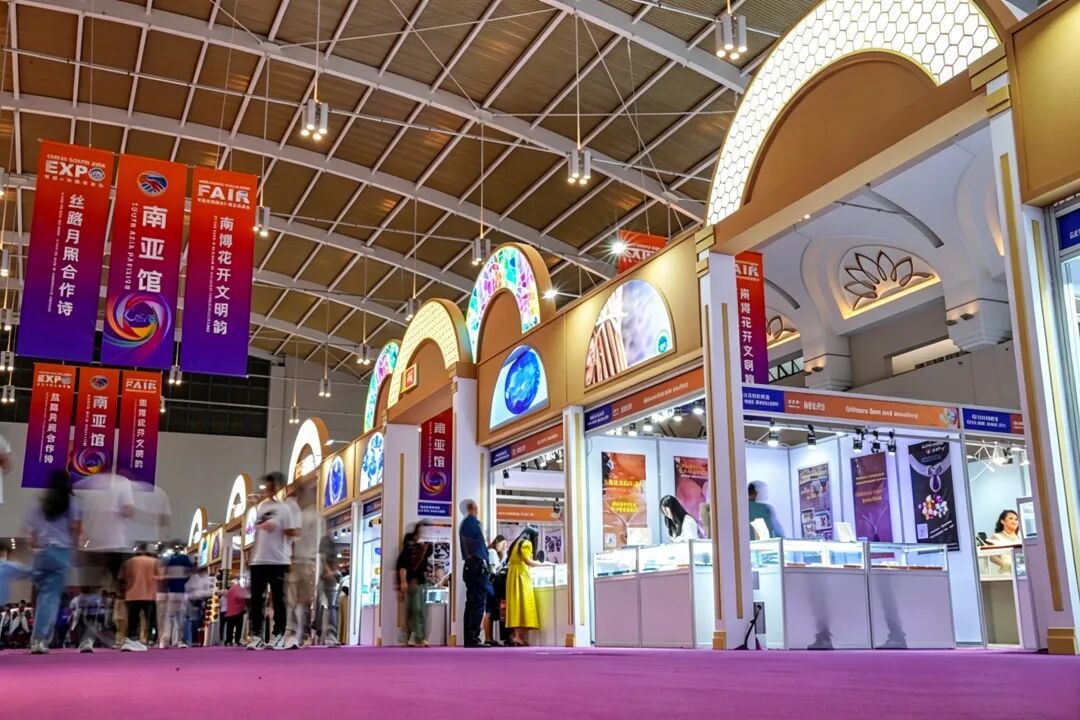
India displays its goods at the 10th China-South Asia Expo in Yunnan province.
As China's opening hub toward South and Southeast Asia, Yunnan is playing a key role in China's relations with South Asia, leveraging its geographic advantages. The 10th China-South Asia Expo, which concluded just this June, provided nearly 800 free exhibition booths for South Asian countries and set up a procurement business matching center. This "promoting trade through exhibitions" model is a vivid manifestation of Yunnan's role as a regional business hub.
As one of China's provinces closest to South Asia, Yunnan should further strengthen its role as “a pivot of Chinese opening-up.” In this way, the province will allow South Asian businesspeople and tourists to learn about China and fall in love with the country through its flowers, coffee, tea, and more.
(The author Mao Keji is an associate researcher at the Center of International Cooperation under the National Development and Reform Commission of China.)
