


Why Bangladesh upgrades its ties with China despite pressure


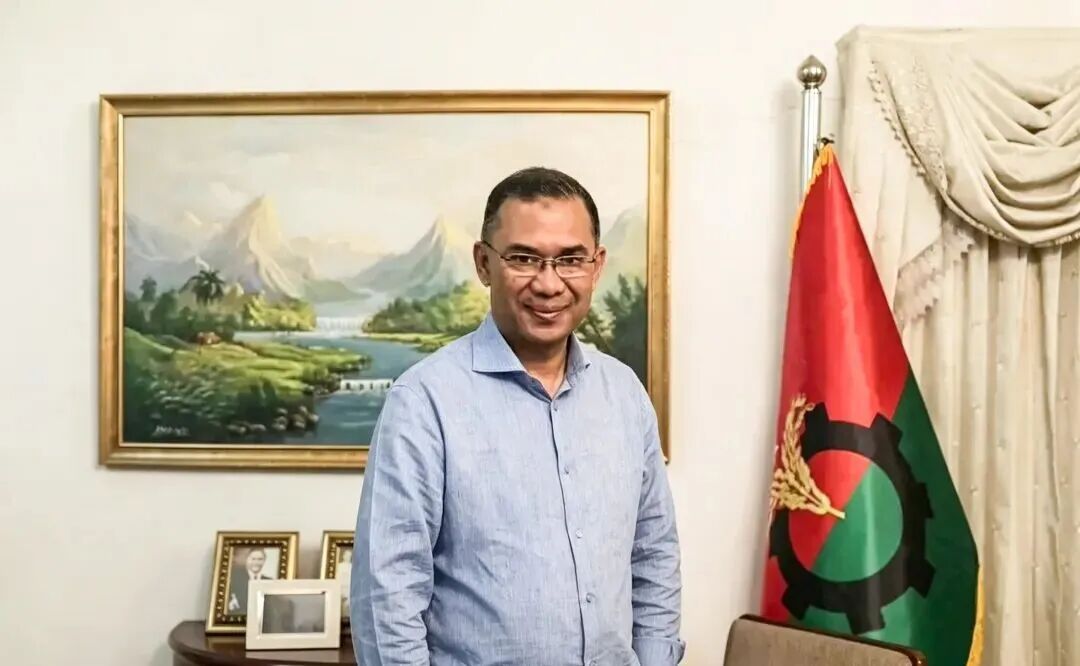
Tariq Rahman
Bangladeshi Prime Minister Tariq Rahman paid an official visit to China from June 22 to 26. Tariq's visit to China was his first overseas trip since taking office as Prime Minister.
Although China was the second stop on his itinerary, it was the first major country he visited as Prime Minister, the symbolic significance speaks for itself. Following the visit, the two countries issued the Joint Communiqué between the People's Republic of China and the People's Republic of Bangladesh.
Through this visit, the China-Bangladesh comprehensive strategic cooperative partnership was elevated to the level of building a China-Bangladesh community with a shared future in the new era. This marks the second "community with a shared future" that China establishes with a country in South Asia, following the China-Pakistan community with a shared future.
How do Bangladeshis assess this visit?
Since China proposed the Belt and Road Initiative (BRI) in 2013, South Asian countries have adopted three models in their participation in BRI cooperation: the China-Pakistan community model, the "balanced cooperation" model of countries such as Bangladesh, Sri Lanka, and Nepal, and the "resistance and hedging" model of another country.
Now that China-Bangladesh BRI cooperation has also developed into a China-Bangladesh community with a shared future, it demonstrates that the BRI is welcomed in South Asia. Some Bangladeshi scholars even believe that the conditions for building the China-Bangladesh community are more favorable than those for the China-Pakistan community, given Bangladesh's domestic stability.
Other Bangladeshi scholars are satisfied with the outcomes from Prime Minister Tariq's visit to China. Apert from the consensus on building a China-Bangladesh community with a shared future in the new era, the two sides agreed to explore the establishment of a foreign affairs and defense "2+2" dialogue mechanism, indicating that bilateral political mutual trust and strategic cooperation have reached an unprecedented level.
China will provide strong support to Bangladesh's industrialization, regional connectivity, direct Bangladesh-China links, integrated water resource management, management of the Teesta River, and people-to-people exchanges. Bangladesh hopes to further strengthen security and defense cooperation with China, and China has expressed firm support for Bangladesh in safeguarding its national independence, sovereignty, and territorial integrity.
The joint communiqué is an important document since the establishment of diplomatic relations between the two countries—a document of mutual respect and mutual commitment, and a result of win-win cooperation.
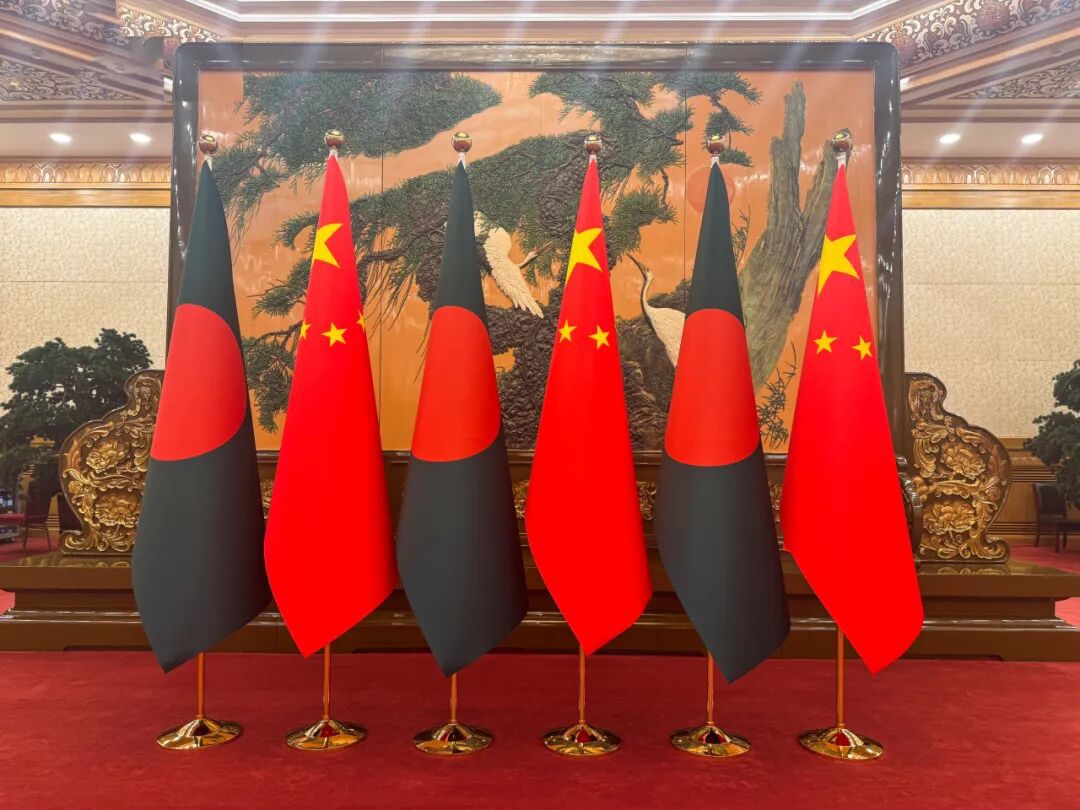
National flags of Bangladesh and China
Can Bangladesh develop by relying on China?
Bangladesh may have faced pressure from other major powers as a result its PM's visit to China, and such voices have already appeared in some international media over the past couple of days. Yet the very fact that Bangladesh is willing to bear such pressure to build a China-Bangladesh community with a shared future in the new era shows that the Bangladeshi Nationalist Party government, led by Prime Minister Tariq Rahman, is truly determined to implement the "Bangladesh First Policy."
Because they understand that only with China's help can Bangladesh achieve industrialization and modernization. This also reflects the patriotic fervor of Bangladesh's intellectual elite and their keen awareness of global developments—they fully recognize the inspirational and referential value of China's path to modernization for Bangladesh and other Global South countries.
However, Bangladeshis also need to realize that relying solely on China's commitments and assistance is not enough.
China is a populous country that achieved industrialization after World War II and currently has the most complete industrial categories in the world. China's industrialization was firstly the result of developing major heavy industries with Soviet assistance. After reform and opening-up, China actively integrated into the US-led globalization process, undertaking transfer of the global industrial and supply chains.
The Soviet Union and reform and opening-up played important roles in China's industrialization, but neither the Soviet Union nor the United States was the decisive factor. For a country to achieve industrialization, external forces are merely catalysts; its own efforts are the most critical factor.
Prime Minister Tariq also visited the Museum of the Communist Party of China during this trip.
The long-term governance of the Communist Party of China has ensured sustained social stability and policy continuity. China's five-year plans have been carried forward over more than 70 years, with successive governments working toward the same blueprint. In the West, however, policies change with each new government, lacking continuity.
As long as the Bangladeshi government resolves to complete major strategic projects vital to the national economy and people's livelihoods, China will do its utmost to support them. However, Bangladeshis must also recognize that modern industrialization should not focus only on advanced industries or technologies, and domestic realities cannot be disregarded. Bangladesh's most pressing need at present is to solve the employment problem for the majority of its youth.
Concluding remarks
Prime Minister Tariq's first overseas trip indicated that China is a priority in Bangladesh's diplomacy.
Regional economic integration in South Asia has long been stagnant, so Bangladesh will pursue a "Look East Policy" to achieve its economic development goals. By strengthening cooperation with China and Myanmar, the China-Myanmar-Bangladesh economic corridor will be built up, and Bangladesh will achieve more direct connectivity with China.
At the same time, Bangladesh aims to strengthen cooperation with ASEAN and become a member of RCEP, thereby joining the Asian production and supply chain system centered on China. Additionally, Bangladesh seeks to become a member of BRICS. This series of diplomatic moves demonstrates that Bangladesh's intellectual elite urgently hope to realize the dream of a "Golden Bangladesh" under the leadership of Prime Minister Tariq and the Bangladeshi Nationalist Party.
(The author Liu Zongyi is a research fellow at the Shanghai Institute for International Studies and the director of the Institute’s Center for South Asian Studies.)
