


Why Thailand rolls out the red carpet for Min Aung Hlaing


Myanmar's President Min Aung Hlaing paid a state visit to Thailand on August 6 to 7. Thai Prime Minister Anutin Charnvirakul received him with high-profile honors and publicly expressed support for Myanmar's return to ASEAN. Earlier, Thai Foreign Minister Sihasak Phuangketkeow had already made it clear that Thailand's fundamental policy objective is to promote Myanmar's return to ASEAN, on the grounds that "intense competition among major regional powers has made Myanmar's return vital to ASEAN unity." Thailand has become the most proactive ASEAN member state in supporting Myanmar's "return." But is Thailand truly acting for the collective good of ASEAN, or does it have its own agenda?
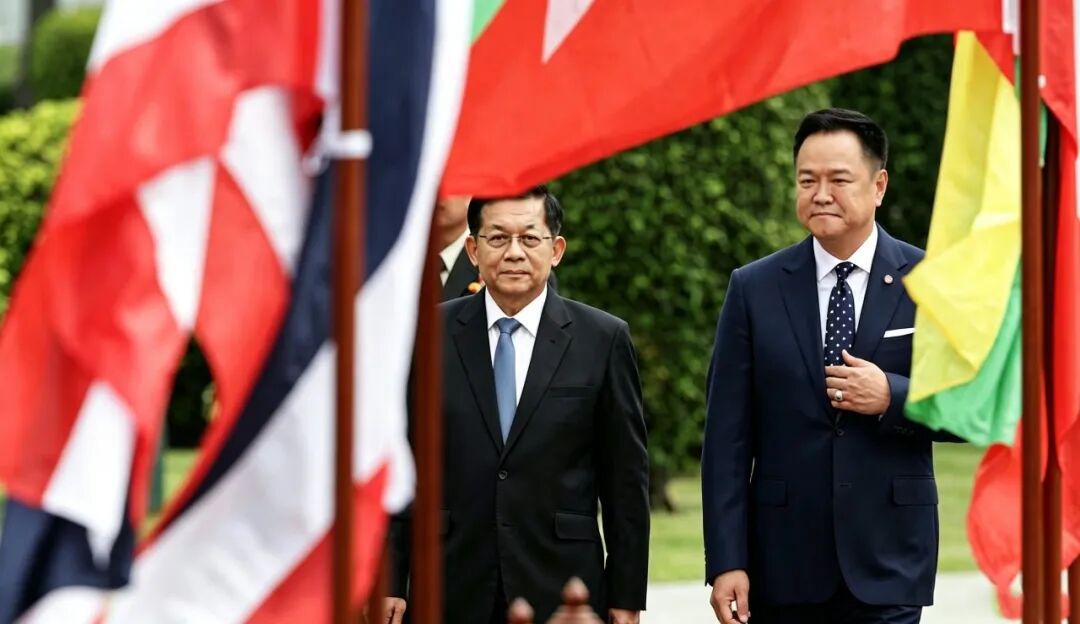
Myanmar President Min Aung Hlaing (left) visits Thailand on August 6.
Strategic Calculations Under the Banner of Unity
Thailand's justification for supporting Myanmar's return to ASEAN appears entirely reasonable. Myanmar has been absent from ASEAN for more than five years, and ASEAN's "Five-Point Consensus" has remained effectively unimplemented. So Thailand advocates for a calibrated re-engagement approach: Since isolation has failed, it is worth trying engagement.
This logic does have its merits. ASEAN's strategy of "limited isolation" toward Myanmar's military government since 2021 has yielded little results. Not only has Myanmar's military not compromised, but in early 2026 it completed a transition from "military junta" to "democratic government" through an election widely questioned by the international community. The conflict has claimed an estimated 100,000 lives and displaced 3.6 million people, while cross-border problems such as telecom fraud, drug trafficking, and refugee flows continue to worsen. Under these circumstances, continuing to "keep Myanmar out" seems unsustainable.
A deeper reason lies in geopolitics. Thai Foreign Minister Sihasak spoke bluntly about "increasingly intense competition among major regional powers." Against the backdrop of the escalating strategic rivalry between China and the United States, ASEAN's greatest fear is to be torn apart and marginalized. Myanmar sits at the crossroads of Southeast Asia, South Asia and China, occupying an extremely strategic position. A Myanmar that remains outside the ASEAN framework means a vacuum of ASEAN influence in the country, which could provide an opportunity for major powers to step in. Thailand's push for Myanmar's return does indeed take into account the need to preserve ASEAN's integrity and regional influence.
However, the rhetoric of "for ASEAN" cannot mask Thailand's own shrewd calculations of self-interest.
Thailand Thoughtful over Its National Interest
The land border between Thailand and Myanmar stretches over 2,400 kilometers. For Thailand, the turmoil in Myanmar has never been "someone else's problem." Refugee inflows, cross-border crime, border conflicts, haze pollution, and competition for rare earth resources — each of these issues directly impacts Thailand's national security and economic interests.
The refugee issue comes first. As of 2024, approximately 4.1 million Myanmar refugees had been registered in Thailand. Continued instability in Myanmar means even more refugees will pour in, placing a heavy financial burden on Thai society and creating security risks. Likewise, telecom fraud syndicates operating along the Thai-Myanmar border have severely damaged Thailand's international image and dealt a heavy blow to its tourism industry, a pillar of its economy. Thailand urgently needs to cooperate with Myanmar to combat these cross-border crimes.
The economic incentives are even more direct. Thailand is one of Myanmar's most important trading partners and sources of investment. Thailand has long imported natural gas from Myanmar, and PTT Public Company Limited operates the Yadana and Zawtika offshore gas fields in Myanmar. During Min Aung Hlaing's visit to Thailand, the two sides set a bilateral trade target of $12 billion and signed cooperation documents in areas such as labor, energy, and transportation. Thailand has extensive commercial interests in Myanmar, and promoting Myanmar's "return" to ASEAN is largely about creating a stable political environment for bilateral economic and trade cooperation.
The economic and trade ties between Thailand and Myanmar are not only historically deep but also driven by strong practical needs. Due to the crackdown on cross-border online gambling and telecom fraud, the Thai border towns such as Mae Sot and Mae Sai have continued to languish in economy. This has not only kept bilateral trade declining but has also visibly affected the livelihoods of people on both sides of the border. For Thailand, bringing Myanmar back into ASEAN means paving the way for normalizing bilateral economic relations. This is a tangible economic interest, and it also demonstrates Thailand's active support for its neighbor.
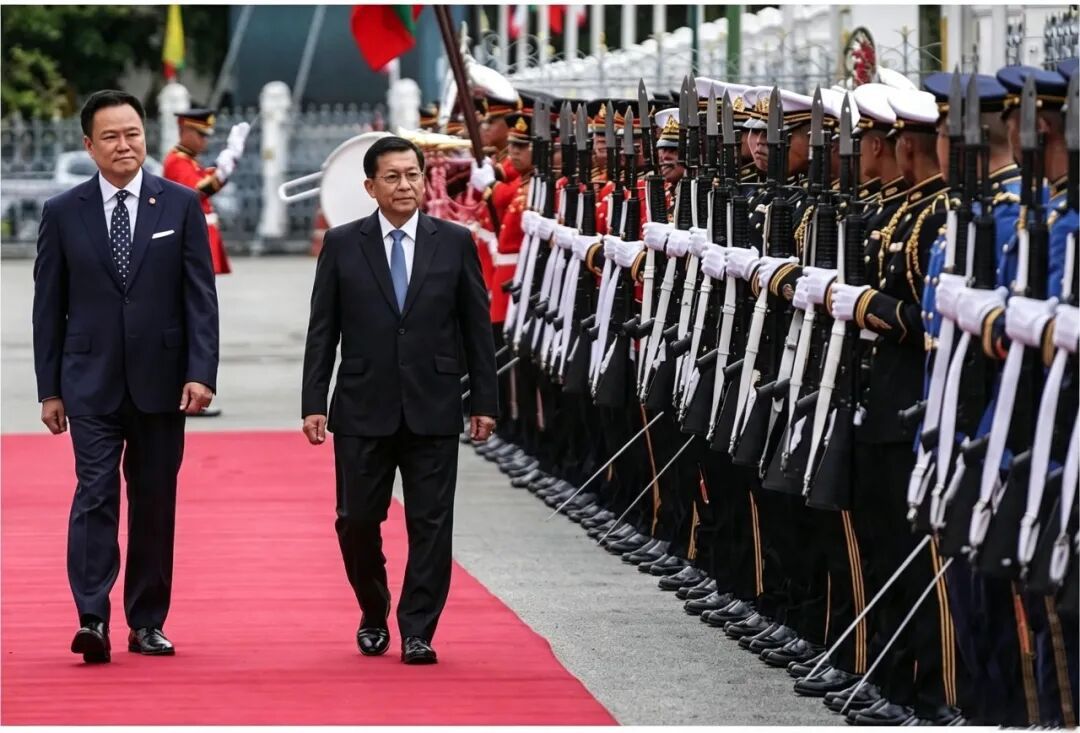
Myanmar President Min Aung Hlaing visits Thailand.
Time-tested Ties between Thai and Myanmar Militaries
Thailand and Myanmar's military establishments share a special relationship that goes far beyond that of ordinary neighbors. The two countries' armed forces have long maintained close institutionalized ties. The political friendship between Thailand and Min Aung Hlaing is essentially an extension of the long-standing institutionalized interactions between the two militaries.
Since becoming Commander-in-Chief of Myanmar's armed forces in 2011, Min Aung Hlaing has established close communication channels with Thailand's military and senior government officials. In 2016, at the invitation of Thailand's Armed Forces Commander, Min Aung Hlaing visited Thailand, and the two sides reached defense cooperation agreements on sharing military intelligence and holding joint military exercises. In September 2019, Min Aung Hlaing visited Bangkok again, meeting with then-Prime Minister and Defense Minister Prayut Chan-o-cha. The two sides agreed to jointly address border issues and strengthen cooperation in combating drugs and maritime security. Min Aung Hlaing also co-chaired the 7th Senior Officials Meeting of the Thai-Myanmar Military Committee with Thailand's Supreme Commander.
After the political changes in Myanmar in 2021, Thailand maintained a "back-channel for communication" with Min Aung Hlaing. In 2023, on the 75th anniversary of diplomatic relations, Prayut, who had by then stepped down as prime minister, still exchanged letters with Min Aung Hlaing. In April 2026, Thai Foreign Minister Sihasak became the first ASEAN foreign minister to visit Myanmar after the new government was established. In August, Min Aung Hlaing made his first official visit to Thailand as a civilian president and received a high-profile reception. Clearly, the political ties between Thailand and Myanmar are not a recent development but are rooted in decades of interaction and mutual trust between the two countries' militaries.
The time-tested military ties profoundly have shaped Thailand's policy orientation toward Myanmar. While most ASEAN member states remain reserved toward Myanmar's military government, Thailand chose to receive Min Aung Hlaing with full honors — the deputy prime minister greeted him at the airport, and a guard of honor lined up at the government building. This was not merely a courtesy to a neighboring leader but a political signal: Thailand recognizes Min Aung Hlaing's status as a "civilian president."
Within Thailand, the military still wields enormous political influence. The Anutin government's policy of engagement with Myanmar was essentially formulated only after receiving affirmation from the military. Supporting Myanmar's military, to some extent, also means safeguarding the Thai military's own voice and interest networks in regional affairs.
Controversies, Risks behind the High-Profile Reception
Thailand's adventurous push for Myanmar's return to ASEAN also faces significant controversies and risks.
First, Myanmar's leadership still refuses to accept ASEAN's "Five-Point Consensus." Min Aung Hlaing, on one hand, wants to be seen as a responsible ASEAN member, but on the other hand, he completely rejects the Five-Point Consensus — this in itself is a contradiction. Pushing for Myanmar's return to ASEAN without its substantive commitment to the Five-Point Consensus would be tantamount to giving up the most important leverage for pressuring Myanmar.
Second, there is far from a consensus within ASEAN on this issue. Malaysia, Indonesia and Singapore believe that Myanmar is not yet ready to reclaim its seat, as "atrocities against its own citizens are still taking place." Philippine Foreign Secretary Enrique Manalo said that Myanmar's return to formal ASEAN meetings is "still far off." Thailand's unilateral approach may exacerbate internal divisions within ASEAN, undermining the very "ASEAN unity" it claims to uphold.
There is also the concerning risk of "legitimacy endorsement." Rights groups such as Justice for Myanmar have already criticized Thailand's overtures to Min Aung Hlaing, arguing that "Min must be held accountable for his crimes, and to grant him legitimacy is false." It is evident that the Thai government is walking a tightrope, with the moral standing very much in question.
Thailand: Regional Responsibility or Refined Self-Interest?
Thailand's support for Myanmar's return to ASEAN is driven both by considerations for ASEAN's collective interests — preserving regional integration amid intensifying major-power competition — and by carefully calculated self-interests related to border security, economic and trade benefits, and military ties. These two motivations are not diametrically opposed but intertwined. Thailand believes that stabilizing Myanmar serves its own interests, which also happens to align with ASEAN's long-term goals.
The problem lies in the means and the pace. Pushing for engagement is not itself wrong. But if it comes at the expense of ASEAN's fundamental principles and collective consensus, and if Myanmar is allowed to "return" without fulfilling the Five-Point Consensus, then Thailand's role as a "bridge" may increase the "rifts" within ASEAN.
Breaking the ice does not equal acceptance. Thailand needs to reconsider how to promote Myanmar's return to ASEAN. How can Thailand, as a neighboring country, play a constructive role and help reach a compromise acceptable to all parties as soon as possible, so as to ease the tension in Myanmar? And how can it better use the balancing tactics to safeguard its national interests without completely breaking with ASEAN's collective principles? These questions will truly test the Thai diplomatic wisdom.
(The author Yu Haiqiu is Director and Research Fellow at the Thai Studies Institute, Yunnan Academy of Social Sciences.)
