


Who is useless: the SCO or India?


India will soon mark the tenth anniversary of its accession to the Shanghai Cooperation Organization (SCO) in 2027. Yet before the anniversary, the narrative that "the SCO is useless" has already been rampant in India's strategic community.
Proponents of this view argue that the strategic assumptions India held when "joining the club" are now disconnected from its real interests: China is increasingly occupying a dominant position, India-Pakistan tensions remain unresolved, and transit restrictions still stand between India and the Central Asian countries. Moreover, the SCO member states cannot replace Western countries in providing India with capital, technology, and markets. Following this logic, the SCO's greatest function is to ensure that India is not voiceless in China-Russia-Pakistan interactions, not absent from Central Asian affairs, and not missing from the shaping of regional order.
On the eve of the 2026 SCO Bishkek Summit, prominent Indian columnist C. Raja Mohan published two articles, "India Is Sticking with America—for Now" and "The SCO's Diminishing Usefulness for India." The articles attempt to prove to the US and the West that India's participation in the SCO does not mean it endorses a China and Russia-centered regional order with an anti-Western character.
The Indian argument of "the SCO is useless" is built on a highly self-centered set of criteria. But if the Indian motivation for participation is to preserve the right to be present, the right to engage and the right to veto, and if India finds it difficult to fully identify with other SOC members and to actively shape the organization's common vision and cooperation agenda, then what truly needs to be asked is not only what utility the SCO has for India, but also what use India actually has for the SCO.
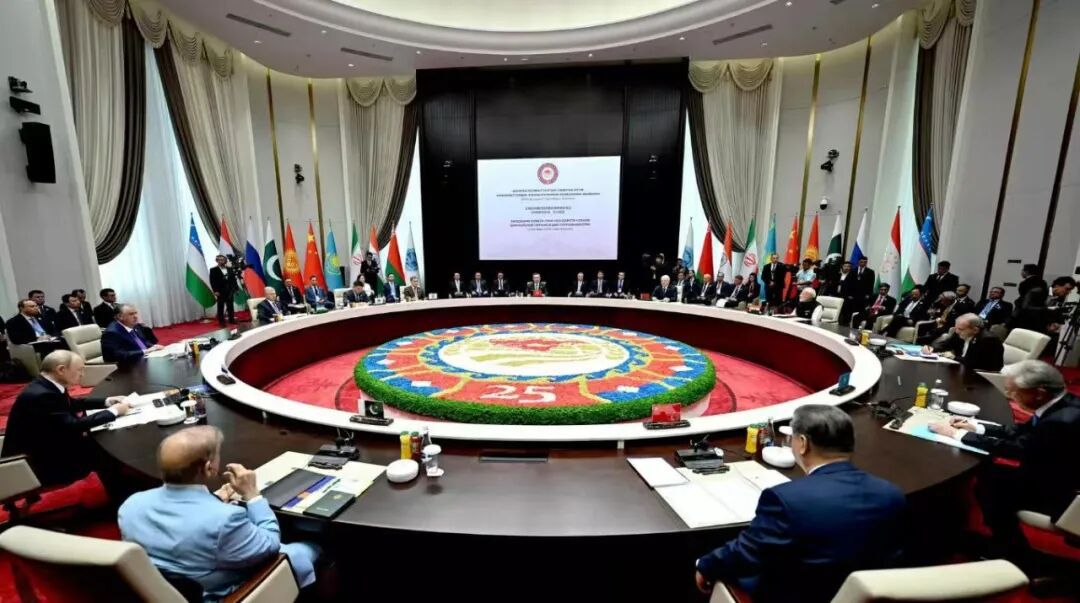
An SCO summit
Cautious Entry, Limited Presence
India's attitude toward joining the SCO underwent a transition from cold observation to cautious entry.
At the wake of the Cold War, India placed greater emphasis on managing its relationship with the United States and it was keen on the "Greater Central Asia" strategic concept proposed by the US around Afghanistan and Central Asia. After becoming an SCO observer in 2005, India mostly attended relevant meetings through ministerial-level representatives, at an administrative level lower than that of other observer states.
Four motivations drove India's accession.
First, the US decision to withdraw troops from Afghanistan and Central Asia raised the risk of regional extremist forces spilling over into South Asia. India hoped to use the SCO platform to strengthen regional security cooperation and enhance its capacity to respond to security pressures and domestic counterterrorism challenges.
Second, India sought to counterbalance China's influence for geopolitical considerations and prevent China from becoming "the sole dominant power" in Central Asia, while getting closer to Russia in security cooperation and guarding against Pakistan's growing strength.
Third, the SCO serves the Indian "Connect Central Asia Policy," develops relations with Central Asian countries and raises the level of regional connectivity, especially by advancing arrangements with Iran around infrastructure such as the Chabahar Port and the International North-South Transport Corridor.
Fourth, the SCO serves India's quest for strategic autonomy and reinforce its identity as a force shaping the international order and a rising global power. After obtaining the full-member status in 2017, India not only participated in cooperation and joint exercises related to the SCO Regional Anti-Terrorist Structure (RATS), but also expanded agenda-setting and institution-building in entrepreneurship and innovation, scientific and technological talent, traditional medicine, digital development, and people-to-people exchanges.
However, India showed reservations when it came to the SCO core agendas such as security and trade.
On the one hand, the positioning of India-SCO relations continues to weaken India's investment in the SCO multilateral cooperation.
The India-Pakistan tensions have long affected India's counterterrorism cooperation within the SCO. During India's hosting of the SCO Foreign Ministers' Meeting in 2023, S. Jaishankar strongly rebutted the Pakistani Foreign Minister's accusations against India, calling him a "spokesperson for the terrorism industry." At the leaders' summit the same year, Modi also made veiled criticism of Pakistan by saying that "some countries use cross-border terrorism as a tool of their policy and provide shelter to terrorists." In 2025, India again refused to sign the SCO defense ministers' joint statement because it did not mention the latest round of India-Pakistan clashes.
The China-India tensions and the fluctuations in relations between SCO member states and Western countries are also contributing factors. Amid the COVID-19 pandemic and China-India border tensions in 2020, India withdrew from the "Kavkaz-2020" joint military exercises, which included the SCO member states. Three years later, India assumed the rotating SCO chairmanship for the first time, but it held the leaders' summit by video, compressing a two-day agenda into an online meeting of about three hours. The following year, India sent its foreign minister to attend the SCO Astana Summit on its behalf, intending to avoid direct interaction with China and Russia at the leader’s level.
On the other hand, India also finds it difficult to form consensus with other member states on trade and connectivity issues.
India hopes to use the SCO platform to expand economic and trade ties with Central Asian countries, but it has never supported the Belt and Road Initiative and strongly opposes the China-Pakistan Economic Corridor passing through the disputed Kashmir region. In 2023, India also declined to sign the SCO Economic Development Strategy 2030 on the grounds that it was filled with too many Chinese-style diplomatic expressions.
Overall, India judged the SCO from the outset with a cautious eye, observing long before "joining," and it participated only in a limited way even after its entry, maintaining a posture of limited "presence."
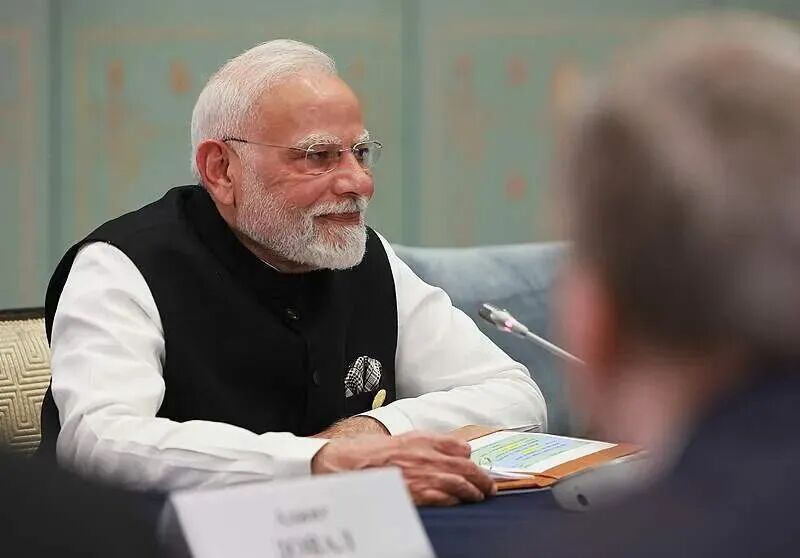
Modi is present at an SCO summit.
Body in the South, Heart in the North
A further observation shows India's role in the SCO has been in contradictions.
The first is the contradiction between identity and position.
The SCO is rooted in and committed to the Global South, and it is a pillar of South-South cooperation. India has long portrayed itself as a leader and partner of the Global South, yet it remains constantly wary that the SCO might one day slide toward becoming an "anti-Western club," fearing that China may join with Russia, Iran, and others to form an "axis" and shape an alternative international order.
In response, India strives to prove that the very existence of a "democratic India" is the best evidence that the SCO is "non-Western" rather than "anti-Western," and it also repeatedly emphasizes that "presence" does not equal position—that is, India can reach consensus with China on advancing reform of international organizations, while also resisting a new international architecture led by China.
The second is the misalignment of its role positioning.
India has not yet become a shaper of the SCO agenda, nor has it found a stable and clear role within the organization, yet it has already become an internal "spoiler." Under the principle of "consensus," India can influence the advancement of the SCO agenda through opposition or reservations. As US-India relations have grown increasingly close since the early 21st century, India has facilitated the US involvement in and containment of the SCO.
Even though US-India relations have taken a sharp turn for the worse since Trump's second term, with the US expectation of India becoming that of a "blood bag to sustain its own life" and with the US continuously applying pressure through punitive tariffs and other means, India's strategic community still finds it difficult to awake from its old dream about relations with the US.
Mohan is precisely exploiting this role, attempting to define the boundaries of the resilience of US-India relations, and his articles warn that if the US continues to apply pressure, the Modi government may be forced to make concessions to China, ceasing to play a balancing and moderating role within the SCO. When confronted with India's divisiveness and self-contradiction in the SCO, Indian scholars argue that this is a "slightly detached member" status that India deliberately maintains—participating, yet not truly integrating.
Former Indian diplomat M. K. Bhadrakumar sharply mocked this, saying that Modi "seems to know nothing about the Shanghai Spirit," and the PM instead attacks Pakistan and China through innuendo. Such remarks may cater to domestic anti-Muslim and anti-China forces, but they weaken the SCO's cohesion and facilitate the US Indo-Pacific Strategy.
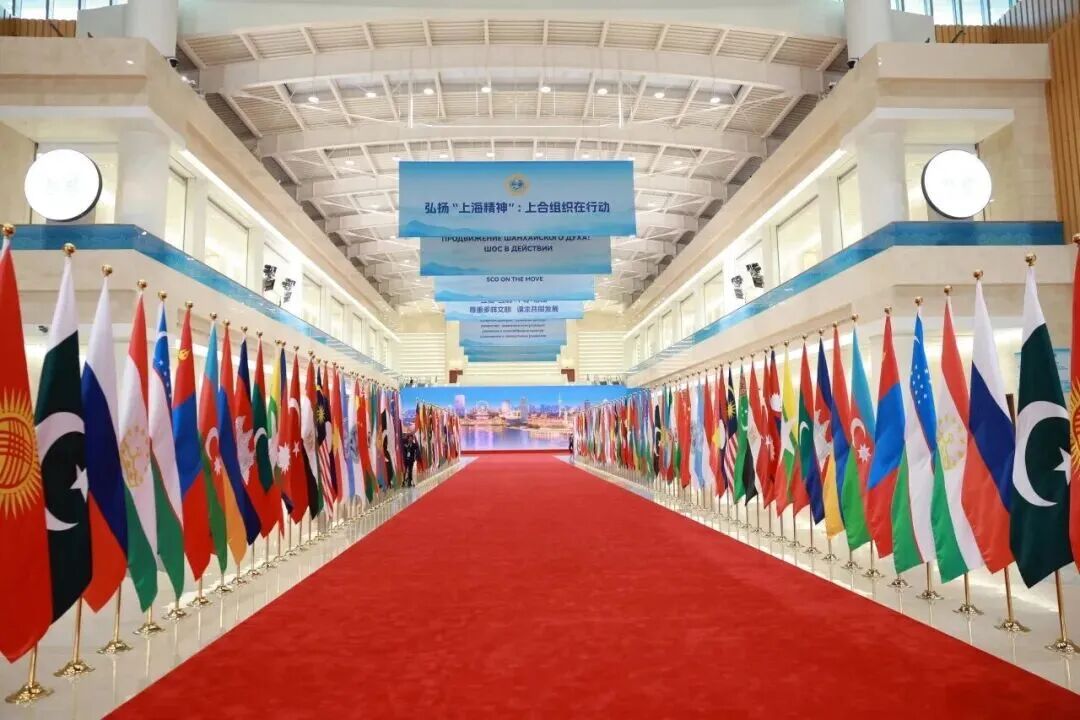
National flags of the SCO member states
Concluding remarks
Although the narrative of "the SCO is useless" continues to grow louder in India's strategic community, and some voices even call for "starting a new stove" and building an Indian version of the SCO, the mainstream view does not support direct withdrawal. Instead, it calls on India to continue using the SCO platform to expand its multilateral diplomatic space.
In 2025, Modi visited China again after seven years to attend the SCO Tianjin Summit. Images of him interacting and chatting amiably with Chinese and Russian leaders became an international hotspot. In 2026, India also participated in adopting the Bishkek Declaration, which included wording condemning military strikes on Iranian territory. Essentially, these are still aiming to maintain India's "presence." At the discursive level, India is willing to provide the SCO with a normative narrative of inclusiveness, civilizational pluralism, and Global South solidarity. At the practical level, the Indian degree of participation often depends on changes in its relations with China, Pakistan, and the US.
India explains this selective participation as "an effort to strike a balance between idealism and realism," and the country seeks to portray itself as a neutral core courted by both the East and the West. However, when it comes to the questions of what resources it can invest in the SCO, what coordination it can accept, or what common benefits it can provide, India has failed to form a consistent answer.
Ultimately, India has never truly placed the SCO at the center of its diplomatic priorities, and therefore it has not yet found within the organization a role commensurate with its great-power ambitions. Rather than constantly asking "what can the SCO do for India," India's strategic community should answer "what is India going to do for the SCO."
If a great power that claims to be rising and seeking global leadership just regards the SCO as a tool for preserving presence, balancing competitors, and managing third-party relations, and if India is unwilling to bear the corresponding costs for common security and regional development, then what may be declining is not necessarily the SCO's usefulness to India, but more likely it is India's usefulness to the SCO as a member state.
Writing by Mao Yaxin (member of the South Asia Research Group on WeChat and PhD candidate at Renmin University of China); Trans-editing by Wang Shixue and Liu Ziyu
