


Will Myanmar finally accept ASEAN’s Five-Point Consensus?


The ASEAN Foreign Ministers' Informal Meeting was held in Bangkok, Thailand, on July 12. Myanmar Foreign Minister Tin Maung Swe attended the meeting and briefed on the Myanmar situation. This marked the first face-to-face meeting between Myanmar's foreign minister and his ASEAN counterparts since the military took over power in 2021, breaking a five-year diplomatic stalemate between the two sides.
Since Min Aung Hlaing assumed office as Myanmar's President on April 10, Myanmar has embarked on intensive heads-of-state diplomacy, with the president visiting India, China, and Laos in succession. In addition, several ASEAN foreign ministers have also visited Myanmar and begun engaging with the new government.
However, differences between ASEAN and Myanmar over the "Five-Point Consensus" persist. On July 9, Myanmar's parliament passed a motion rejecting ASEAN's Five-Point Consensus. Three days later, at the informal ASEAN Foreign Ministers' Meeting in Bangkok, ASEAN foreign ministers unanimously reaffirmed that the Five-Point Consensus remains irreplaceable. On July 21, ASEAN foreign ministers agreed to develop benchmarks for measuring progress in Myanmar's situation, aiming to facilitate the implementation of the long-stalled "Five-Point Consensus" peace plan.
Has the Five-Point Consensus become the major obstacle for Myanmar's return to ASEAN? Is Myanmar's recent diplomatic breakthrough a genuine beginning of regional integration, or merely a temporary thaw in its relations with ASEAN?
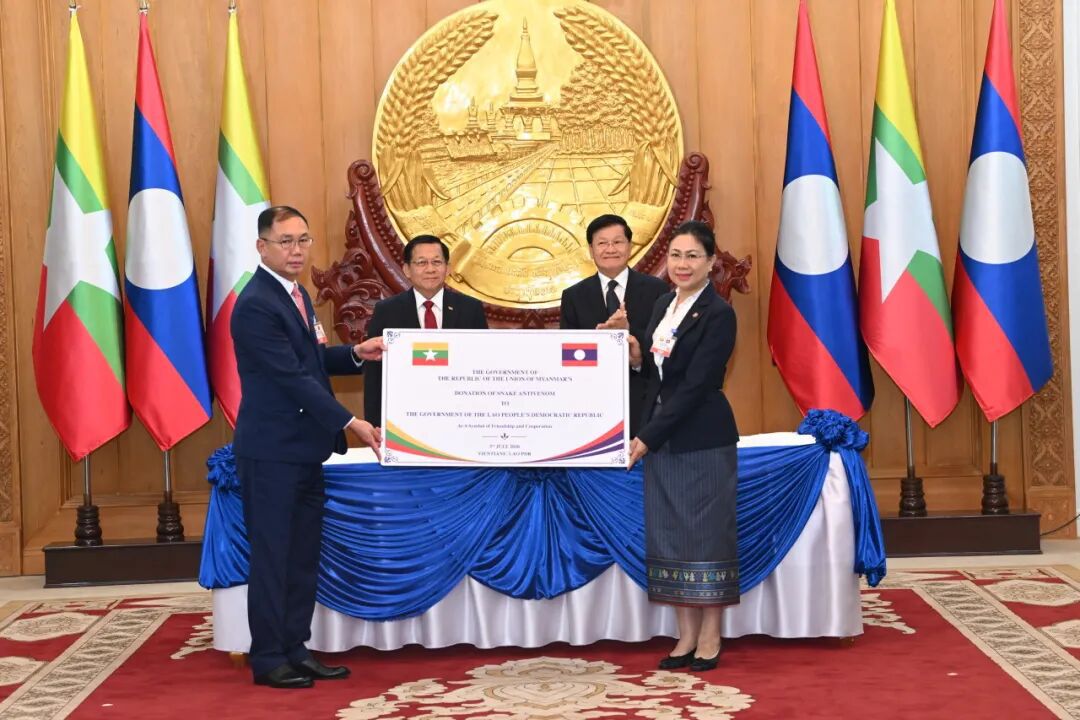
Myanmar president visits Laos.
Pragmatic engagement or principled stance
For a long time, the Indochinese ASEAN countries—represented by Laos, Thailand, Cambodia, and Vietnam—have generally held that long-term isolation of Myanmar cannot resolve its domestic issues; rather, it may create a vacuum in regional governance that could be exploited by external forces. Consequently, these countries advocate a pragmatic engagement and development-first approach toward Myanmar.
In contrast, countries such as Indonesia and Singapore adhere to the principled bottom line, insisting that implementation of the Five-Point Consensus is a prerequisite for Myanmar's return to ASEAN mechanisms. Former Indonesian President Joko Widodo said in June that Myanmar has not made significant progress in implementing the Five-Point Consensus.
At the 48th ASEAN Summit held in Cebu, Philippines, in May, leaders agreed that Myanmar should first demonstrate substantial progress on the Five-Point Consensus before its senior officials could be considered for re-engagement in ASEAN processes. Overall, while ASEAN does have strategic differences on how to resume engagement with Myanmar, the bloc's collective stance on upholding the Five-Point Consensus as the primary framework for resolving the Myanmar issue has not fundamentally shifted.
According to The Straits Times, ASEAN foreign ministers agreed to develop benchmarks for measuring progress in Myanmar's situation on July 21, including permanent cessation of violence, release of all political prisoners, and safe and unhindered delivery of humanitarian aid within Myanmar. The ministers also initiated discussions on appointing a long-term special envoy to replace the existing annual rotating mechanism, aiming to advance the implementation of ASEAN's long-stalled "Five-Point Consensus" peace plan.
However, Myanmar's Federal Parliament passed a motion in early July formally rejecting the Five-Point Consensus. The motion argued that ASEAN should reassess its stance toward Myanmar in light of political developments and the formation of a new elected government. This indicates not only a significant gap between Myanmar and ASEAN's positions but also the complex power dynamics at play in Myanmar.
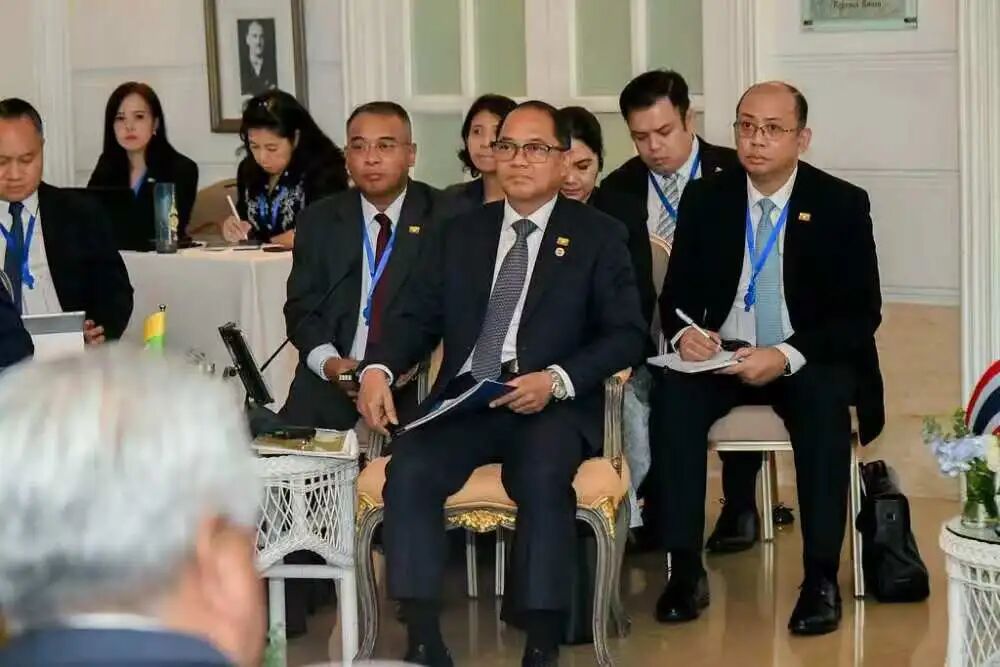
Myanmar Foreign Minister Tin Maung Swe attends the ASEAN Foreign Ministers' Informal Meeting in Bangkok, Thailand, on July 12.
How long can the diplomatic thaw last?
Myanmar's intensive diplomatic efforts have contributed to a phased breakthrough at the diplomatic level. However, whether these positive diplomatic developments can translate into structural breakthroughs remains subject to multiple constraints. The sustainability of this short-term diplomatic thaw is still uncertain.
First, progress in Myanmar's domestic peace process remains limited. According to data from the conflict monitoring group "Armed Conflict Location & Event Data Project" (ACLED) and the United Nations, ongoing conflict since the 2021 power takeover has resulted in significant casualties and population outflows. Social unrest and economic recession have become internal weaknesses constraining Myanmar's development, and they are also key reasons for the international community's cautious wait-and-see approach.
Second, ASEAN's "Five-Point Consensus" framework remains valid, and the principled bottom line by hardline member states have not softened. Myanmar continues to be excluded from ASEAN's high-level mechanisms, and its regional legitimate status has not yet been restored. At the same time, Western sanctions remain in place, with financial blockades, investment bans and technology embargoes placing considerable pressure on Myanmar's economic recovery. Cross-border cooperation projects face certain constraints in their implementation.
Furthermore, Myanmar's diplomatic model—which relies on great-power balancing and sub-regional cooperation—has certain limitations: External political endorsements and economic cooperation dividends can help optimize the external development environment, but they cannot substitute for fundamental governance processes such as domestic ceasefire, cessation of violence, and political reconciliation.
The partial Myanmar-ASEAN thaw at the diplomatic level is still far from equating to an all-encompassing strategic breakthrough. Whether Myanmar can ultimately break free from its diplomatic predicament and return to ASEAN's mainstream cooperation system may depend less on the frequency and fanfare of high-level visits, and more on substantive progress in the domestic peace process and "concrete and demonstrable progress" with respect to ASEAN.
Given that the political landscape and security situation in Myanmar have not undergone fundamental improvement, the current Myanmar-ASEAN diplomatic warming may merely represent a partial easing—essentially tactical, informal, and highly reversible. A full Myanmar return to the ASEAN will still take time.
(The author Huang Shanshan is a Ph.D. candidate at the School of International Relations, Yunnan University.)
