


US-India relations: A ‘broken mirror’ hard to mend


U.S. Secretary of State Marco Rubio paid a visit to India from May 23 to 26. Since Donald Trump returned to the White House, U.S.-India relations have remained tense. Can the two sides now mend their broken ties?
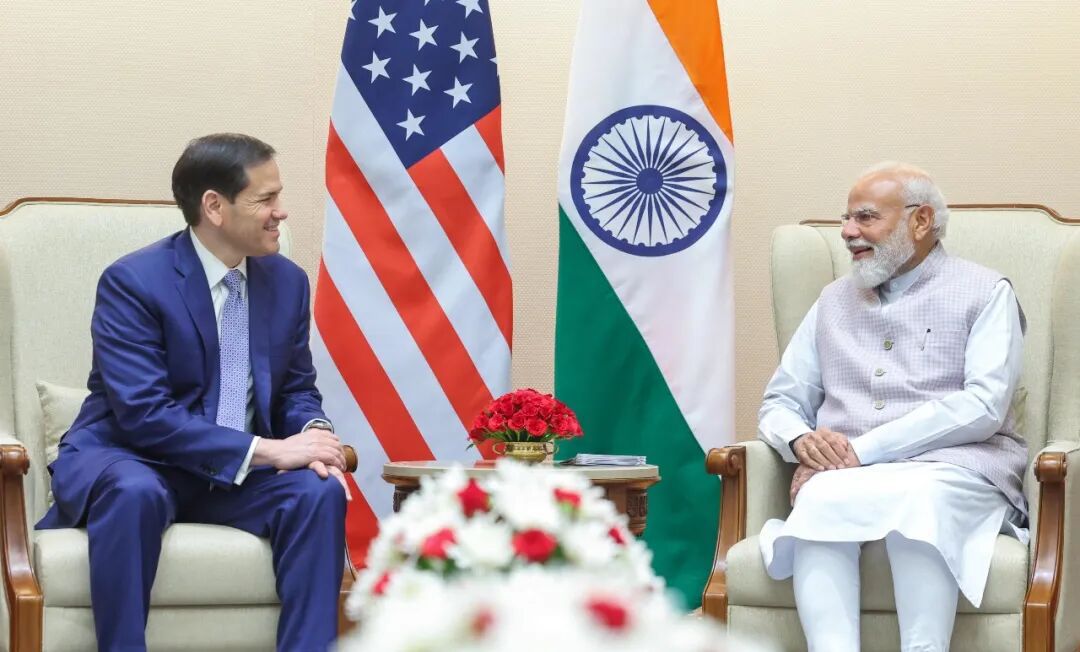
U.S. Secretary of State Marco Rubio talks to Indian PM Modi during the visit.
The U.S.-India relations have experienced nearly a year of continued downturn and strained difficulties. The Trump administration has not only imposed high punitive tariffs on India, bus also tightened U.S. visas for Indians, especially H-1B visas.
What is even harder for Indian elites to accept is that senior U.S. officials frequently resort to verbal "pressure" and "humiliation" against India. This has severely damaged the self-esteem and confidence of India's pro-U.S. elites, while also stirring up anti-U.S. memories and resentment within the country.
Clearly, Rubio's visit aims to inject new vitality into bilateral relations that are on the verge of derailment. The two countries signed a "Framework Agreement on Securing Supply Chains for Critical Minerals and Rare Earth Mining and Processing," aimed at deepening cooperation in mining, processing, recycling, and investment to build resilient supply chains for emerging technologies.
However, there were also many discordant notes and performances during the visit. At a press conference, Indian Foreign Minister Subrahmanyam Jaishankar bluntly stated that the U.S. has always openly pursued an "America First" policy, and that New Delhi also follows an "India First" approach.
An Indian journalist raised a question about racially charged remarks against Indians in the U.S., alluding to Trump's previous endorsement of describing India as a "hellhole." Rubio responded candidly, saying that the U.S., like anywhere else, has some foolish people who make such remarks.
US-India flags
In fact, the deeper discord lies at the level of strategic interests. India's greatest disappointment and concern is that the U.S. has completely changed its attitude toward India's rise.
Since the George W. Bush era, U.S. leaders have repeatedly declared that helping India rise is in America's strategic interest. However, Trump 2.0 believes that India's continued rise will pose a strategic "threat" to the U.S. in the future.
U.S. Deputy Secretary of State Richard R. Verma stated at the Raisina Dialogue on March 5, 2026: "India should understand that we will not repeat on India the mistakes we made on China 20 years ago."
The implication is that although the U.S. needs India to balance China, it will never allow India to grow into a truly major world power. In other words, U.S. policy toward India is: cooperation with conditions, a ceiling on India's rise, a division of labor in industries — all serving the maintenance of U.S. hegemony. Therefore, Rubio's visit to India can hardly mend the broken bilateral relations.
(The author Lin Minwang is a researcher at the Institute of International Studies, Fudan University)
