From exile to leadership: Who is Bangladesh's new PM?
Tarique Rahman, Chairman of the Bangladesh Nationalist Party (BNP), was sworn in February 17 as the 11th Prime Minister (PM) of Bangladesh and formed a new cabinet.
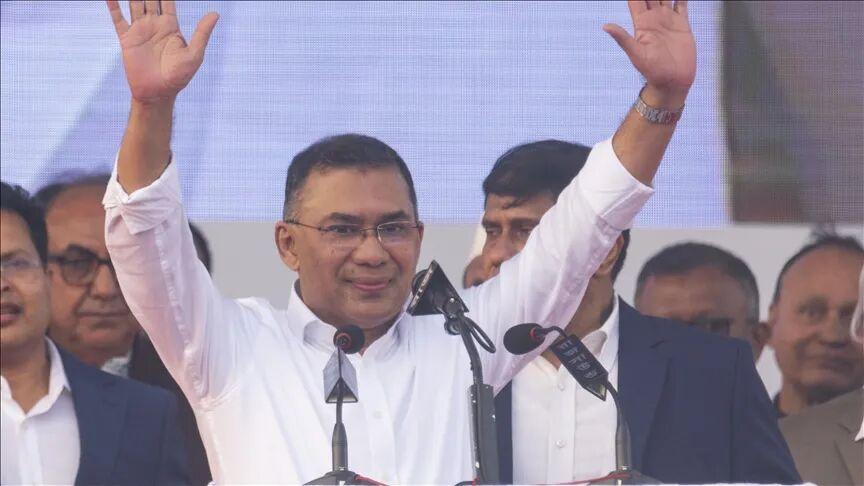
Prime Minister Tarique Rahman
His father, Ziaur Rahman, was a former President of Bangladesh and one of the key leaders of the country's independence, who was assassinated in a military coup in 1981. His mother, Khaleda Zia, served three terms as Prime Minister following his father's death, becoming the first female Prime Minister in the country's history. It can be said that Tarique was born at the core of power, and this political lineage laid a solid foundation for his subsequent rise within the party.
Tarique Rahman was born in November 1968 in Dhaka. His early years were somewhat controversial and he was once viewed by outsiders as a playboy. He first studied at BAF Shaheen College, St. Joseph Higher Secondary School, and later completed his secondary education from Dhaka Residential Model College and HSC from Adamjee Cantonment College. Between 1985 and 1986, Tarique initially enrolled in the Faculty of Law at the University of Dhaka, before transferring to the Department of International Relations. However, during his second year of university, he dropped out to pursue business, venturing into the textile and shipping industries.
He subsequently devoted himself to the political cause of the Bangladesh Nationalist Party. In 1988, Tarique gradually began engaging in political work. That year, he served as a key member of the local Upazila branch of the BNP in Gabtali, Bogura, his father's ancestral home, and started participating in local politics. During the 1991 national elections, Tarique actively participated in campaign work, canvassing for votes for his mother, Khaleda Zia.
After the BNP's election victory, he remained active in party affairs in the Bogura district. During the Awami League's tenure in government from 1996 to 2001, Tarique was active in opposition politics, continuing to coordinate work for the BNP. In the 2001 national elections, the BNP regained power. However, in 2004, a grenade attack occurred in Dhaka, targeting, among others, opposition leader Sheikh Hasina, resulting in multiple deaths and hundreds injured. Tarique was later convicted in connection with this case and sentenced to life imprisonment.
He subsequently became a political prisoner under Sheikh Hasina's regime. In 2007, a military-backed caretaker government launched an anti-corruption drive. Tarique was arrested on corruption charges, imprisoned, and allegedly subjected to torture, though he denied all accusations. After his release on September 11, 2008, Tarique traveled to London for medical treatment and subsequently went into self-imposed exile in the UK, citing security concerns. During his exile, he did not withdraw from politics; instead, he gradually moved towards the core leadership of the Bangladesh Nationalist Party. In 2018, he was appointed acting chairman of the party, becoming its de facto leader from abroad.
Following the July Revolution of 2024, the Hasina government fell, and the nation's politics entered a critical turning point. The subsequent interim government dropped many of the charges against Tarique, clearing the path for him to restore his political standing and return to Bangladeshi politics. On December 25, 2025, Tarique returned to Bangladesh with his wife and daughter, ending 17 years of exile. Subsequently, in February 2026, Tarique was sworn in as the Prime Minister of Bangladesh. The 25 ministers and 24 ministers of state in Tarique's cabinet were also sworn in, administered by President Mohammad Shahabuddin. This victory was not merely a political one; it symbolized a major realignment following a long period of political confrontation.
From a political dark horse to an exile overseas, and finally to the premiership, Tarique's path to the pinnacle of power has been exceptionally arduous. It showcases not only his personal political will but also the profound influence of family and factional forces within Bangladesh's political structure. Tarique's ascension is both a product of historical forces and a reflection of political cycles.
Tarique Rahman's electoral victory carries the profound expectations of the Bangladeshi people for the new government to build a democratized and modernized society. Whether his domestic governance can meet public expectations will directly impact the long-term stability of his administration. Ensuring the transparency and administrative efficiency of his government will be crucial measures to prevent the resurgence of governance controversies and win societal trust.
(The author Liu Chunying is a PhD Candidate at the Institute of International Studies, Yunnan University.)