Japan emerges as imminent, real threat to China
Armed with a knife, a Japan Ground Self-Defense Force member, Second Lieutenant Kodai Murata (23), forcibly entered the Chinese Embassy in Japan on March 24, threatening to kill Chinese diplomats in the name of "God." The day before, the Japanese government’s draft of the 2026 Diplomatic Blue Book formally downgraded the Sino-Japanese relations.
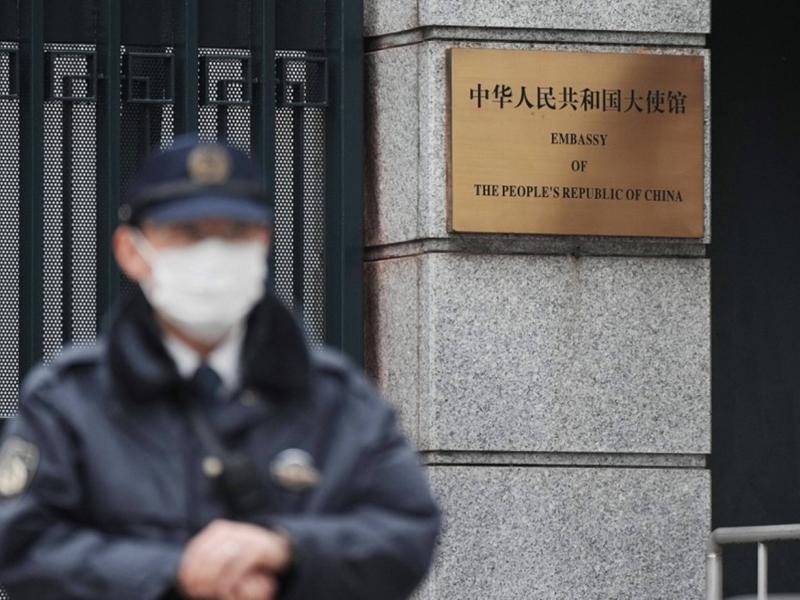
A policeman stands guard outside the Chinese embassy in Tokyo after Japanese authorities promised to beef up security. Photo: AFP
These two incidents—one overt, one covert; one military, one political—mark a fundamental reversal in Japan’s policy toward China. A Japan that stands in total opposition to China across all fronts, from civil society to officialdom, from public opinion to the military, and harbors extreme animosity toward China is no longer a latent threat but an imminent and tangible danger.
What warrants even greater vigilance is the resurgence of Japanese militarism. On March 23, Japan launched its largest postwar restructuring of the Self-Defense Forces, explicitly designating China as an "unprecedented and greatest strategic challenge," completely abandoning its principle of "exclusive defense" and pivoting toward "proactive deterrence" and "stand-off counterstrike capabilities." The escort fleet, which had been maintained for 70 years, was disbanded and reorganized into a naval fleet.
Japan plans to rename the Air Self-Defense Force the "Aerospace Self-Defense Force" by the end of 2026, upgrade its space operations units, and deploy Type 12 surface-to-ship missiles—capable of covering the Miyako Strait and the Diaoyu Islands—on Miyako and Ishigaki Islands. It is also consolidating amphibious assault groups in Sasebo, Kyushu, and acquiring U.S.-made Tomahawk cruise missiles. These moves clearly indicate that Japan is sharpening its claws, seeking to establish a complete kill chain targeting China.
Opinion polls are even more alarming. By March 2026, Japanese public favor toward China has fallen to an all-time low, with the unfavorable rate exceeding 87%. Following the reappointment of the Sanae Takaichi cabinet, her far-right hardline stance toward China has won the approval of nearly 90% of the public. The Liberal Democratic Party holds 316 seats in the House of Representatives—well above the two-thirds threshold needed to amend the constitution. This means that Japan now faces no obstacles in revising its pacifist constitution and fully removing the postwar shackles on its military.
The fact is clear: Japan has fully shifted toward the far-right wing. The specter of militarism lingers on in the country, and in alignment with U.S. hegemony, Japan aims to contain China, and even prepare for a strategic showdown. If Japan were to launch a strategic confrontation with China, China would have no room to retreat and would inevitably deal Japan a devastating blow.