What are Indian stakes and responses in the Iran crisis?
The conflict is not a distant war for India; it is an economic, diplomatic, and strategic test
India is watching the Iran crisis with deep concern and responding on two tracks: immediate crisis management and a longer-term strategic review. India has major direct interests in West Asia—oil, gas, shipping routes, trade flows, and the safety, employment, and remittances of around 10 million Indians living and working in the GCC countries.
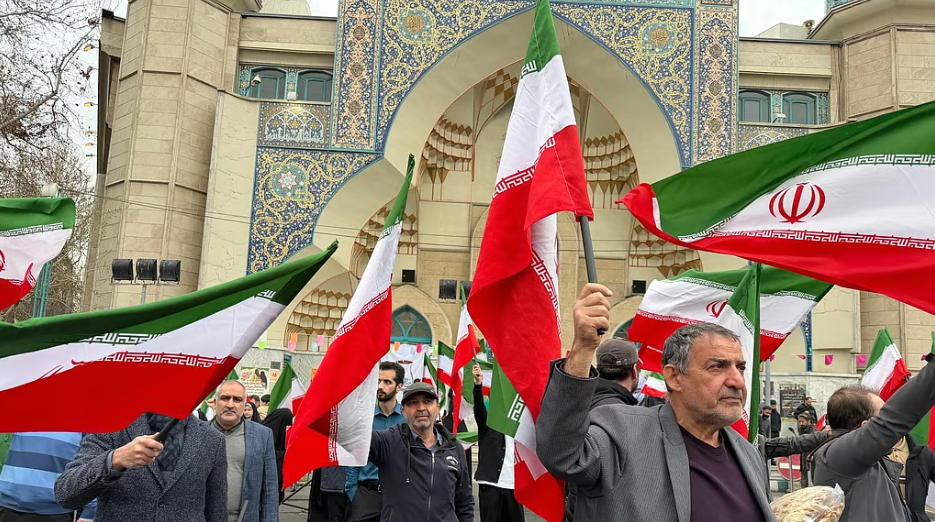
A group of men wave Iranian flags as they attend a demonstration in support of the government and against U.S. and Israeli strikes in Tehran. Photo/AP
The scale of India’s economic exposure can be understood through a few basic numbers. India imports roughly 5 million barrels of crude oil a day, meeting about 90% of its requirement. It also imports around 60,000 tonnes of LPG daily, equal to about two-thirds of its total need of roughly 90,000 tonnes a day. LNG imports are about 70,000 tonnes a day, accounting for around 45% of total demand of nearly 150,000 tonnes. In fertilizers, India imports about 50,000 tonnes a day, or roughly one-fourth of its daily requirement of around 200,000 tonnes. Even in the nitrogen fertilizers produced domestically, natural gas typically accounts for around 70–80% of production cost. The Gulf connection is equally important on the income side: Indians working in the GCC countries sent back about $45 billion in remittances, out of the roughly $130 billion India received globally last year.
The effect of the crisis does not stop at petrol and diesel. It spreads through the wider economy. Higher crude prices raise transport costs. Strain in gas-linked supplies pushes up fertilizer costs, affecting agriculture and eventually food prices. Higher freight rates make imports and exports more expensive. Any disruption in LPG supply is felt directly in households and commercial kitchens. At that point, the Iran crisis is no longer only a foreign policy issue; it becomes a domestic economic and administrative challenge.
There is another economic dimension as well. If the war persists, Gulf countries may have to divert more capital toward defense, domestic stabilization, and eventual reconstruction. That could slow, reduce, or defer the flow of sovereign funds into major investment projects in India. Publicly stated investment intentions from Saudi Arabia, the UAE, and Qatar together amount to roughly $185 billion—about $100 billion from Saudi Arabia, $75 billion from the UAE, and $10 billion from Qatar. A prolonged conflict could place part of this investment pipeline under pressure as Gulf capitals reprioritize spending.
Beyond prices and supplies, the conflict also creates geopolitical and diplomatic challenges for India. India’s difficulty is straightforward: it has to manage important relationships on several sides at once. Israel matters for defense, technology, and intelligence cooperation. The Arab Gulf matters for energy, remittances, trade, and the livelihoods of millions of Indians working there. At the same time, India must also manage its strategic relationship with the United States—a major strategic, trade, defense, technology, and investment partner—which is itself directly involved in the conflict.
The crisis also puts India’s wider connectivity strategy under strain. Chabahar was one of the few routes available to India that bypassed Pakistan and provided a practical gateway to Afghanistan and Central Asia. That route now faces uncertainty. This corridor, meant to extend India’s strategic reach can become unreliable in a prolonged crisis, affecting a larger geopolitical objective. The conflict could also hurt another major connectivity initiative with both strategic and economic value for India: the India-Middle East-Europe Corridor, or IMEC. If the crisis persists, IMEC could face delay, disruption, or reduced viability, weakening an important part of India’s broader Middle East and Europe strategy.
Indian public opinion on the Iran crisis is not uniform. One section tends to view the conflict through the Israel lens and supports tough military action, especially in the context of terrorism and security. Another sees the crisis through distrust of American power, Western double standards, and the politics of sanctions and control over oil flows. A third is not emotionally aligned with either side, but is concerned about war, instability, and the economic impact on ordinary people. All three responses are present in India. Overall, however, questions are growing in India about the American-Israeli case for the war, and criticism is increasing. Support for the American-Israeli action appears to be weakening as the conflict drags on, its stated justifications come under closer scrutiny, and the economic costs become more visible.
India’s response has moved on several fronts at once. It has prioritized household LPG and other essential sectors, pushed refiners to raise domestic production, sought alternative supplies from the United States, Russia, and other producers, opened new fertilizer-sourcing lines, and stepped up efforts to secure safe passage for India-bound ships through Hormuz. It has also increased maritime vigilance, kept its missions in the region on round-the-clock watch, and maintained a diplomatic line centered on de-escalation and the protection of energy infrastructure. Consumers have been asked to avoid panic bookings, shift to piped natural gas wherever possible, and ports have been directed to give priority to LPG carriers. New Delhi has also rolled out a targeted relief scheme for exporters hit by freight, insurance, and logistics disruption.
If the crisis drags on, India is likely to go further in rationing scarce gas, protecting fertilizer supplies, diversifying fuel sourcing, and preparing evacuation or assisted-movement plans for Indians in the region. At the strategic level, there is also renewed interest in the long-discussed undersea natural gas pipeline from Oman to India, since such a route would bypass Hormuz and reduce one element of India’s present vulnerability.
If the crisis deepens further, India will face not only higher energy costs, but also wider economic, diplomatic, and strategic consequences across its western flank. The challenge before New Delhi is not simply to manage a temporary disruption. It is to protect India’s economic stability, retain diplomatic balance, and reduce long-term vulnerability to shocks emanating from West Asia.
(The writer Robinder Sachdev is president of The Imagindia Institute. He wrote the book "Trumpotopia: A Guidebook to Decode Donald Trump and the Culture and Politics of America—With Tips for World Leaders and CEOs to Tackle Trumpotopia.")