Caught in the Crossfire: Sri Lanka and the IRIS Dena Incident Amid the US–Israel–Iran Geopolitical Clash
Caught in the Crossfire: Sri Lanka and the IRIS Dena Incident Amid the US–Israel–Iran Geopolitical Clash
--- Iranian Military Ship Sinking Close to the Southern Coast of Sri Lanka: A Case Analysis
By Dr. Manoj Jinadasa (PhD in Digital Critical Media Studies, Newcastle, UK), Senior Lecturer and Head of the Department of Mass Communication, University of Kelaniya, Sri Lanka
Abstract
This paper examines the sinking of the Iranian naval ship IRIS Dena near the southern coast of Sri Lanka as a microcosm of contemporary global geopolitical tensions. Drawing on Critical Geopolitics, Complex Interdependence Theory, Regional Security Complex Theory, and Weaponized Interdependence, the study situates this localized incident within broader patterns of power projection by the United States, Israel, and Iran. The incident highlights the vulnerabilities of small states in an interconnected global system, where distant military actions can generate localized strategic, economic, and psychological consequences. Analysis of the Sri Lankan public’s response, media coverage, and government positioning underscores the challenges of maintaining diplomatic neutrality while navigating complex regional and global power dynamics. The paper concludes that the IRIS Dena incident exemplifies how modern military capabilities, geopolitical networks, and media narratives converge to produce multi-layered impacts on smaller, strategically located states in the twenty-first century.
Keywords: Complex Interdependence; Weaponized Interdependence; Regional Security Complex; Geopolitical Vulnerability; Naval Power Projection
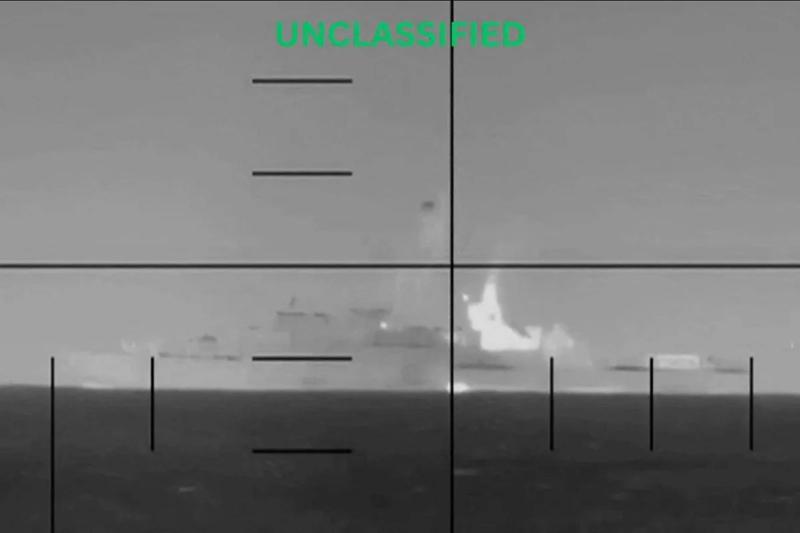
Periscope footage of the sinking. Photo/AFP
Introduction
The day before yesterday, Sri Lankan national media initially reported that an Iranian ship had sunk close to the southern coast near Galle. Later reports confirmed that the Iranian warship IRIS Dena sank in the Indian Ocean off the southern coast of Sri Lanka, near Galle. The incident occurred about 40 nautical miles (approximately 70–75 km) south of Galle. The location was outside Sri Lanka’s territorial waters but within its Exclusive Economic Zone (EEZ).
At the time of the incident, the ship reportedly had around 180 crew members on board. Following the sinking, the Sri Lankan Navy conducted rescue operations, rescuing 32 sailors and recovering 87 bodies. The rescued sailors were later taken to Karapitiya Teaching Hospital for medical treatment.
However, later reports from international media indicated that the ship had been attacked and destroyed by a torpedo strike from a submarine, allegedly carried out by the United States and Israel as part of the ongoing conflict with Iran. Some reports suggested that such an attack on a naval vessel in this region is extremely rare and has not occurred on this scale since the period following World War II.
The news created concern among many Sri Lankans, as the Middle Eastern conflict appears to be extending closer to the Indian Ocean region and the Sri Lankan maritime boundary. Initially, the national media did not report the full details of the incident. However, when international media revealed the alleged military attack by the United States and Israel, opposition politicians criticized the government and state media, accusing them of withholding the real story and providing incomplete information to the public.
In response, the government later stated that the initial reports were based on the limited information available at the time. According to officials, once the actual circumstances of the attack became clearer, national media began continuously reporting updates about the incident.
Theoretical Framework
To understand the IRIS Dena incident as more than an isolated naval event, it is important to situate it within contemporary international relations theory. Classic liberal institutionalist scholarship introduced the idea of complex interdependence, where multiple channels of interaction (economic, political, and institutional) connect states and non-state actors in ways that transcend narrow zones of military confrontation. Robert Keohane and Joseph Nye (1977) explain that complex interdependence “consists of multiple channels of contact,” and that there is “no hierarchy of issues” which privileges military security above economic and diplomatic interactions, making states mutually vulnerable to actions far from their borders (as cited in Power and Interdependence, pp. 24–25).
At the same time, regional security complex theory (RSCT) suggests that international security dynamics are not best analyzed solely at the global level but also through geographically clustered patterns of interaction where threats and insecurities are constructed socially and contextually (Buzan & Wæver, 2003). RSCT posits that “security relations between states tend to be geographically clustered such that threats are more intense within a region than beyond it,” which helps explain why an external conflict in the Middle East can generate localized anxieties in the Sri Lanka context.
More recent scholarship has updated interdependence theory to account for power asymmetries inherent in complex global networks. The weaponized interdependence framework argues that states controlling central nodes in global economic and political networks can leverage these to coerce others, demonstrating that “global economic networks…can be repurposed as tools of state coercion” rather than merely fostering cooperation (Farrell & Newman, 2019, p. 45 as summarized). This helps situate how great powers project influence across distant theaters, affecting weaker states indirectly through market, information, and military domains.
Taken together, these theories provide a conceptual lens for analyzing the IRIS Dena incident not simply as an isolated attack but as an event embedded within interconnected global power dynamics, where military actions by major powers resonate across economic, political, and security networks, producing strategic vulnerabilities for smaller states such as Sri Lanka.

The Shahid Bagheri, an Iranian drone carrier, off the coast of Bandar Abbas, Iran on February 1. Photo/Reuters
Analysis of the Broader Implications of the Incident
This context and the incident are now creating a psychologically vulnerable situation in the minds of the Sri Lankan public. Questions are being raised about how an Iranian naval ship carrying nearly 180 crew members was navigating through the Indian Ocean close to Sri Lanka. Initial reports suggested that the ship was en route to India for naval training. However, according to international maritime reports, the ship may have been unable to return to Iran due to the escalating military tensions in the Middle Eastern maritime region.
Sri Lankan society is now somewhat shocked, and rumours are spreading regarding whether the present government could have anticipated or scrutinized such a situation earlier. Many people are questioning how a military action allegedly involving the United States and Israel could occur in international waters so close to Sri Lanka and the Indian Ocean region. The major concern among the public is whether Sri Lanka could face security threats as a result of the ongoing confrontation between the United States, Israel, and Iran.
Another important issue relates to Sri Lanka’s foreign policy. Sri Lanka has historically attempted to maintain a balanced or middle-path foreign policy, maintaining relations with multiple global actors. The question now being raised is whether Sri Lanka will be pressured to align with one side in the conflict—either the United States and Israel or Iran. Historically, Sri Lanka has maintained cooperative relations with both sides. For example, during the presidency of Mahinda Rajapaksa, the Iranian leadership, including Mahmoud Ahmadinejad, visited Sri Lanka and supported major national development projects such as energy and power infrastructure. At the same time, many Sri Lankans currently work in Israel, and a significant number of Sri Lankan professionals are employed in the United States as well.
A third concern relates to the broader geopolitical situation. If major regional powers such as China, India, or Russia become involved in the conflict—either directly or indirectly—the strategic position of Sri Lanka could become more complex. In such a scenario, Sri Lanka may face difficult diplomatic decisions about which political or strategic position to adopt in the emerging global alignment.
Historically, global conflicts have affected Sri Lanka before. During World Wars I and II, the city of Colombo experienced aerial attacks, demonstrating how global wars can extend into the Indian Ocean region. Therefore, this current naval incident may symbolize a broader geopolitical shift in which conflicts that began in the Gaza Strip and Jerusalem region later expanded toward Iran, Iraq, and now appear to have implications for the Indian Ocean geopolitical space.
Some analysts interpret the situation as part of a wider global power struggle between Western and Eastern geopolitical blocs. They argue that the confrontation involving the United States and Israel may influence other regions and draw in additional global powers. In this context, the sinking of a naval vessel close to Sri Lanka metaphorically reflects how modern military power can operate over long distances and how local regions may become indirectly involved in broader global conflicts.
Thus, this incident in the Indian Ocean raises important questions about regional security, Sri Lanka’s diplomatic neutrality, and the evolving geopolitical competition among global powers in the twenty-first century.
Conclusion
The IRIS Dena incident demonstrates the complex interplay between global power projection and local strategic vulnerability. While the attack occurred in international waters near Sri Lanka, its implications extend far beyond the immediate loss of life and naval assets. The case illustrates how small states can be drawn into larger geopolitical struggles despite attempts to maintain neutral or balanced foreign policies. Drawing on Complex Interdependence and Weaponized Interdependence frameworks, the incident shows that global military actions are no longer confined to traditional battlefields; instead, they intersect with economic networks, media narratives, and diplomatic pressures, creating cascading effects for regional actors.
For Sri Lanka, the event raises urgent questions regarding national security, foreign policy alignment, and crisis communication, emphasizing the need for proactive monitoring of global conflict zones and stronger mechanisms for risk assessment. The public’s perception of vulnerability, fueled by partial media reporting and international revelations, underscores the importance of transparency and timely governmental communication in maintaining societal trust.
Ultimately, the IRIS Dena sinking serves as a strategic case study of how modern warfare and power asymmetries operate across globalized networks, highlighting the ongoing relevance of international relations theories in interpreting the security, political, and societal dimensions of twenty-first-century conflicts. Sri Lanka’s experience offers broader lessons for small or middle powers navigating the increasingly entangled landscape of international geopolitics.
References
• Farrell, H., & Newman, A. (2019). Weaponized Interdependence: How Global Economic Networks Shape State Coercion (pp. 44–47).
• Keohane, R. O., & Nye, J. S. (1977). Power and Interdependence: World Politics in Transition (pp. 24–25). Little, Brown & Co.
• Buzan, B., & Wæver, O. (2003). Regions and Powers: The Structure of International Security. Cambridge University Press.