Should China consider joining 'Board of Peace' and its 1st leaders' meeting?
The "Board of Peace" initiated by U.S. President Trump is scheduled to hold its first leaders’ meeting in Washington on February 19. Should China consider joining Trump's "Board of Peace" and participate in this inaugural leader-level meeting?
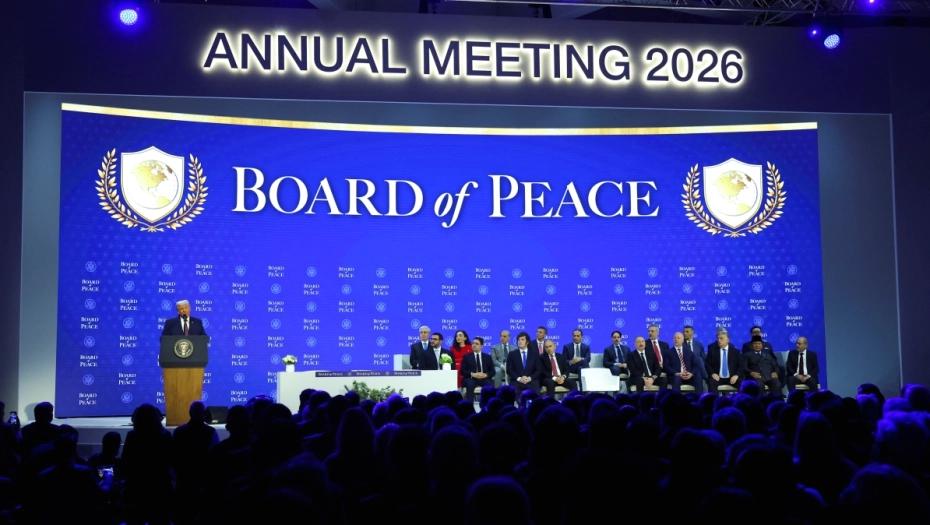
U.S. President Donald Trump attends a Board of Peace charter announcement during the World Economic Forum in Davos on January 22.
From China's perspective, China should not consider joining the "Board of Peace" or participating in the Washington meeting. This stance is based on the nature of the mechanism, the general response from the international community, and China's core diplomatic principle.
The "Board of Peace" promoted by Trump is not simply established to address the Gaza issue. Its true objective is to create a "parallel institution" led by the United States that would bypass the functions of the UN Security Council. The board's charter grants Trump the position of "Lifetime Chairman" with the "veto power."
The founding executive members of the board are mostly Americans (such as Secretary of State Rubio and Trump’s son-in-law Kushner), which completely violates the fundamental principle of sovereign equality in international relations.
Furthermore, the mechanism stipulates that payment of one billion dollars grants permanent membership, commodifying international peace affairs. This stands in stark contrast to the legitimacy of the UN Security Council, which is based on authorization under international law.
Countries like Italy, Spain, Norway, and New Zealand have stated they "have no intention to join" or "cannot join." Italian Foreign Minister Tajani pointed out that his country's constitution does not permit joining an institution dominated by a single leader.
None of the other permanent members of the UN Security Council (China, Russia, the UK, and France) has formally joined. Although Russia received an invitation, it has only stated it is "studying the matter" and has not confirmed participation.
China upholds that the United Nations is the core mechanism for international peace and security affairs. Any action aimed at weakening or replacing the United Nations does not align with China's diplomatic policy of safeguarding the post-WWII international order.
China will insist on a just resolution to the Gaza issue within the framework of the United Nations and through the channels of the Security Council, rather than participating in a "private club" that lacks international consensus and challenges the principle of multilateralism.