US-Israel strike on Iran marks open, hot war in the Middle East
The United States and Israel launched strikes on Iran Feb. 28, with explosions and flashes of light visible across Tehran. Multiple missiles hit the University Street and Jomhouri areas of the capital, with plumes of smoke rising over the city.
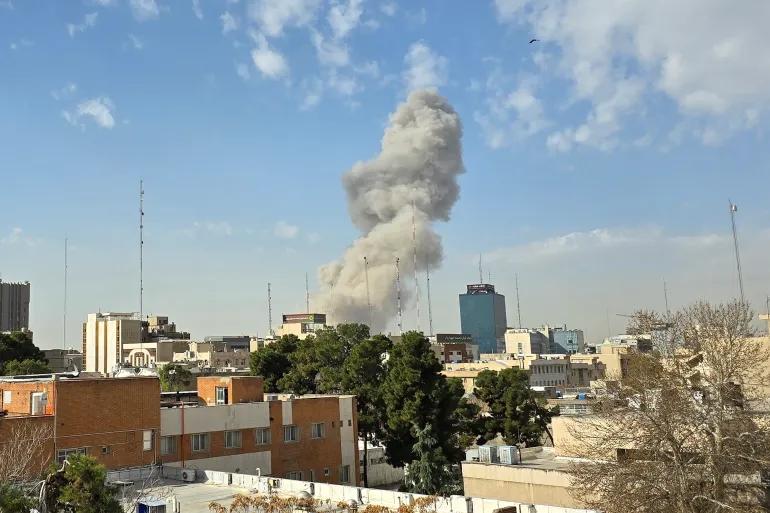
A plume of smoke rises after an explosion in Tehran.
This joint military action did not target border military installations but directly struck the political and security heart of the Iranian capital, marking a formal escalation of the decades-long "shadow war" in the Middle East into direct, open war between states.
University Street houses the offices of Iran's Supreme Leader, the presidential palace, and the National Security Council – the nerve center of the Iranian regime. Striking this area aims to paralyze its command structure.
Jomhuri Square is home to the Ministry of Intelligence and Security (MOIS), the Islamic Revolutionary Guard Corps (IRGC) headquarters, and the Ministry of Defense. Attacks here target Iran's security decision-making and counter-intelligence capabilities.
Israeli Defense Minister Israel Katz announced that "the strikes were launched," breaking with the traditional policy of "neither confirming nor denying" such operations. The explosions and smoke visible across Tehran occurred on Saturday (a working day in Iran), intended to create maximum social and psychological shock.
The attack is the inevitable consequence of the complete failure of the 2025-2026 US-Iran nuclear negotiations. According to details previously revealed from the third round of talks in Geneva, Switzerland, the US demanded that Iran dismantle its Fordow and Natanz nuclear facilities and ship out all enriched uranium, a demand Iran flatly rejected.
The day before the strike, US President Donald Trump claimed he "hadn't decided on military action." However, the US military had amassed its largest fleet in the Middle East since the 2003 Iraq War, including the USS Ford and USS Lincoln carrier strike groups. The military option was activated when diplomatic pressure failed to force Iranian compliance.
For Israel, tolerating an Iran with nuclear weapons potential is viewed as a "strategic suicide." Against the backdrop of a shaky coalition government, launching a war framed as "defending national survival" serves as an ultimate tool to divert domestic political pressure.
The world has crossed a Cold War red line. This attack a decapitation strike aimed at changing the nature of the Iranian regime. The smoke over Tehran signifies the definitive end of the Middle East's "30-year peace" (1991-2021), pushing the world towards the brink of an unpredictable hot war.