Eric's Insight: What should we remember about China-Myanmar ties?
A reception marking the 75th anniversary of China-Myanmar diplomatic relations was held on June 9 in central Yunnan’s Kunming city. Representatives from both countries shared ideas on strengthening the China-Myanmar community with a shared future.
As China and Myanmar celebrate more than seven decades of diplomatic ties, the rhetoric of "Pauk-Phaw"—the cherished "fraternal" bond—is often invoked in official statements and commemorative events. But beyond the ceremonial handshakes and nostalgic narratives, what is it that we should truly remember about this relationship?
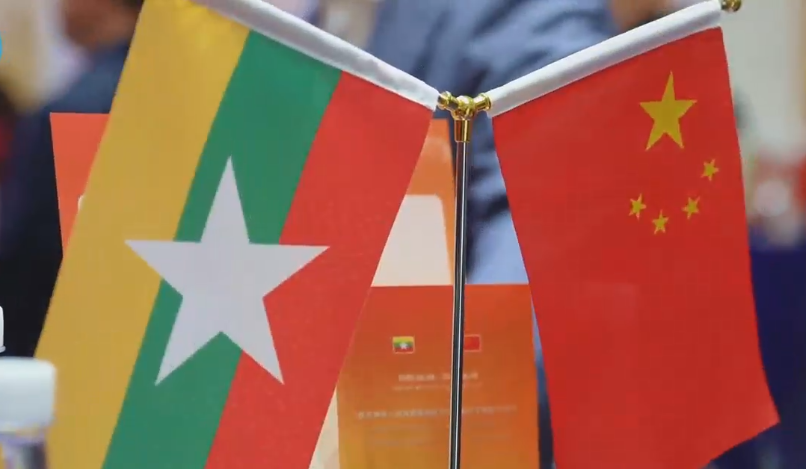
The China-Myanmar national flags
First, a peace-loving brotherhood. Shortly after the founding of the People’s Republic of China, Myanmar was among the first neighboring countries to establish diplomatic relations with China. The two nations then joined hands as peace-loving pioneers on the international stage.
At the invitation of Myanmar’s Premier U Nu, Chinese Premier Zhou Enlai made an official visit to Myanmar in June 1954. During this historic visit, both sides issued a joint statement affirming that the Five Principles of Peaceful Coexistence would serve as the guiding principles for their bilateral relations. Later, these principles were expanded into ten tenets for managing international relations at the Asian-African Conference in Bandung, Indonesia.
Embracing the spirit of peaceful coexistence, China and Myanmar signed a boundary agreement in Beijing in October 1960. This agreement officially completed the demarcation of the more than 2,000-kilometer borderline between the two countries. It also marked the first boundary agreement China signed with an Asian neighbor, setting an example for the peaceful resolution of border issues. In addition, it opened a new chapter in China's neighborhood diplomacy.

A traditional Myanmar puppet play is staged at the reception marking the 75th anniversary of China-Myanmar diplomatic relations.
Second, a heart-warming brotherhood. The term "Pauk-Phaw" evokes a deep warmth, symbolizing an unshakable kinship. The 75-year milestone serves as a reminder to both nations that true brotherhood is not only about a shared history of peace. It is also about facing challenges together with kindness and mutual support.
When China was first severely affected by the COVID-19 pandemic in early 2020, the Myanmar Federal Political Negotiation and Consultative Committee (FPNCC) coordinated a joint effort among its seven member organizations. Together, they procured more than 480,000 disposable medical masks from Thailand and Myanmar, which were then donated free of charge to China. This generous donation holds special significance given the urgency of the situation and the prevailing Western attitudes toward China at the time.
The kindness shown by Myanmar has been deeply appreciated by the Chinese side. After a magnitude 7.9 earthquake struck Myanmar in late March this year, a 37-member Chinese medical team set out from central Yunnan’s Kunming Changshui International Airport the next day, heading to Yangon to provide post-quake relief. This act clearly demonstrates the strong "Pauk-Phaw" friendship between the two nations in standing together through thick and thin and helping each other in times of need.
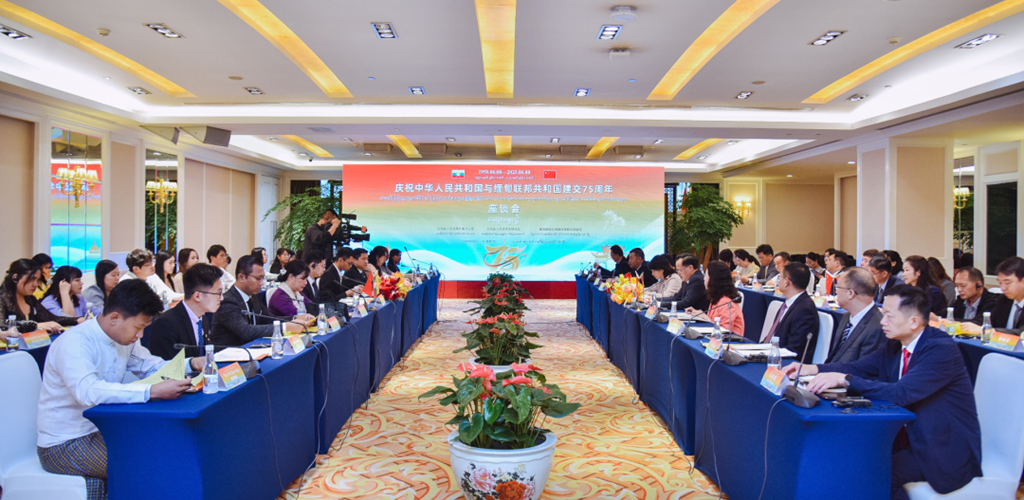
A reception marking the 75th anniversary of China-Myanmar diplomatic relations is held on June 9 in central Yunnan’s Kunming city.
Currently, China is Myanmar’s largest trading partner and a key investor, with initiatives like the China-Myanmar Economic Corridor (CMEC) addressing the needs in infrastructural improvement. In addition, historic ties such as the ancient Tea-Horse Road and other cultural connections remind us that the relationship goes beyond government affairs. As long as the people of both countries continue to embrace peace and support each other sincerely, the China-Myanmar community will have a bright future.
Written by Wang Shixue; Proofreading by Zu Hongbing and Wang Huan (YICC); English polishing by Franklin (CICG)