


Decades of diligence fuel development in deepest Yunnan province


On a clear morning in late September, a group of border police officers departed from the Dulongjiang station in Yunnan province to complete a five-day patrol of a border marker at 4,100 meters above sea level. The route, spanning nearly 80 kilometers through dense forest and unstable slopes, is emblematic of the daily challenges in this remote township in southwestern China.
The group set off with food for several days, spare clothing, emergency gear and a satellite phone. There was also something else, written the night before and left behind: letters to their families.
"We all knew what kind of road we were about to walk," said Zhang Qilei, head of the Dulongjiang township border police station in Gongshan county. "Out there, if something happens, help can take hours just to reach the foot of the mountain. After that, it would depend on whether they could find us in time in the forest."
For almost a week, the team trekked, hauling 20 kilograms of supplies each, crossing rivers by hand, probing mud with bamboo poles, and climbing slopes so steep they relied on ropes to pull one another up. At night, they slept in damp air. There was no signal, only a brief daily check-in by satellite phone to report their location.
When they reached the marker, the tension finally broke.
"It's hard to explain that feeling," Zhang said. "Pride. Relief. You've been holding it in the whole way."
Hours later, as they made their way back, the weather turned. Rain came down hard enough to collapse their tents.
They were fortunate, Zhang said. "If it had rained earlier, we might not have made it."
For decades, journeys like this have defined life in Dulongjiang, a remote township tucked between steep mountains and the Dulong River valley near the border with Myanmar. The region, home to just over 4,000 people — most of them from the Derung ethnic group — was once among the most isolated places in China.
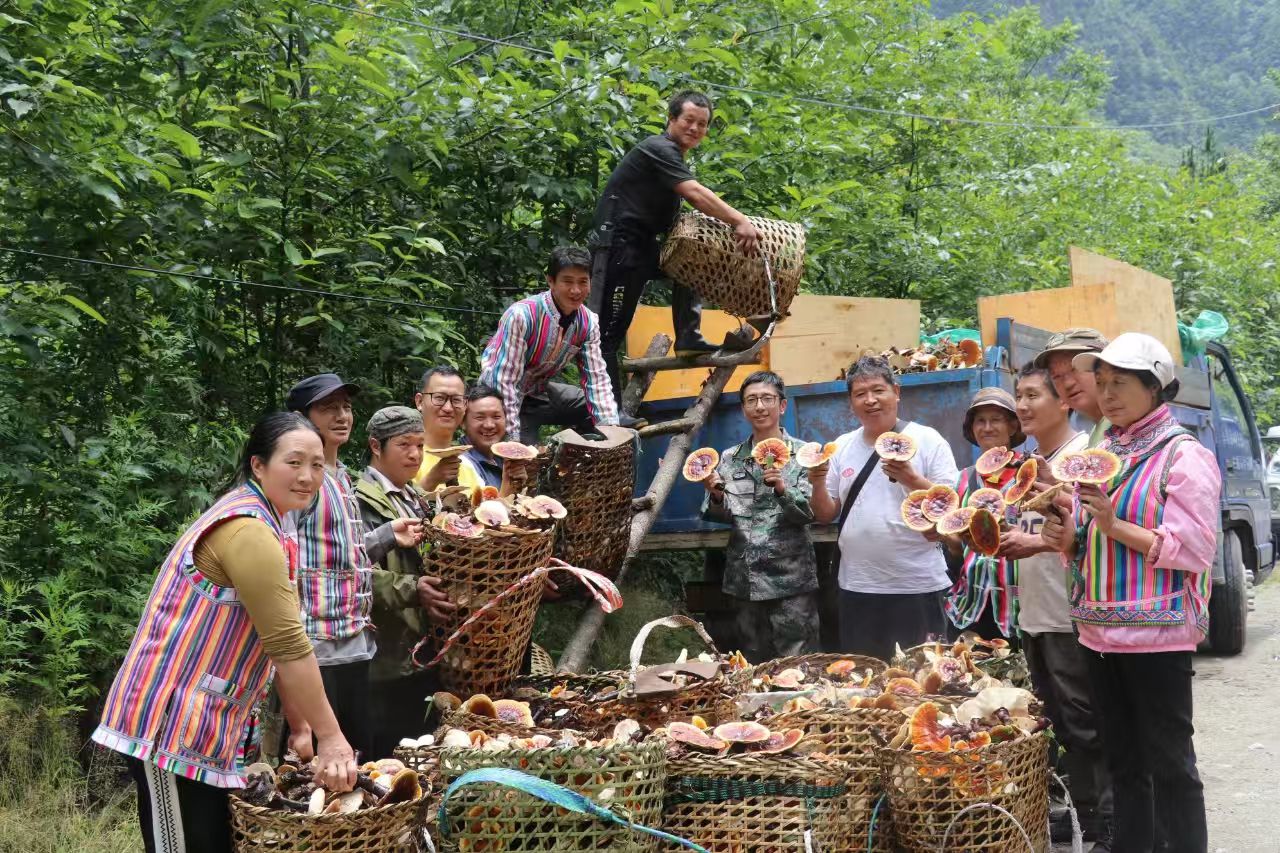
The Derung people harvest ganoderma lucidum in the Dulongjiang township of Gongshan county. They earn extra income by planting ganoderma lucidum. Photo/Yunnan Daily
Until the late 20th century, there was no road connecting it to the outside world. Travel meant days of walking over mountain passes. Each winter, heavy snow sealed the valley off for months. Supplies came in on foot or by mule. The border police station here was established in 1964, though a military presence dates back to 1952. For much of its history, the role of the station's staff was as basic as it was demanding: patrol the border, maintain order and help people survive in a place where geography shaped every aspect of life. Over 74 years, eight officers have died in the line of duty. The work, though, has never been limited to security. "We've always been doing more than guarding the border," said Li Xiaojun, a former station chief who served from 2016 to 2021. "We were part of building this place — step by step." The changes came slowly at first. In 1999, a rough road finally reached Dulongjiang township, ending the region's complete isolation. But it remained unreliable, often cut off by landslides or snow. It was not until 2014, when a tunnel through the Gaoligong Mountains opened, that the valley became accessible year-round. "The difference is hard to describe," Li said. "Before, everything had to be carried in. Now, people can drive out in a few hours." With access came opportunity. Tourists began to arrive. Local products — especially tsaoko, Chinese black cardamom, also known as caoguo, a spice grown in the region — found markets beyond the valley. Motorcycles and, later, private cars became common. Income rose. In 2018, the Derung people, once among the poorest groups in China, were officially lifted out of extreme poverty. In 2019, the township's Party committee wrote a letter to President Xi Jinping to share the good news. In a reply dated April 10, 2019, Xi congratulated them and stated that poverty alleviation is just the first step, with better days yet to come. He expressed hope that the villagers would continue their efforts, work hard, and unite to build their hometown well and guard the border well, striving to create a brighter future. For Li, the message captured something they had long understood. "Protecting the border and developing the community are not separate things," he said. "They happen together." In Dulongjiang, that principle is visible in small, daily interactions. In addition to their primary duties such as processing documents, maintaining public order and patrolling the borders, the police also provide free services to the villagers, such as traveling to remote villages to take photographs for official paperwork, giving haircuts and helping with some farming tasks, saving people the cost and time of long trips. They mediate disputes — often between relatives in tightly knit communities — preferring conversation over strict legal enforcement. "In a place like this, you can't just apply rules in a dogmatic manner," said Gou Guowei, a former instructor at the station. "You have to understand local residents' lives." He recalled introducing what officers call "hearthside mediation", where mediators, police officers and involved parties sit around the fire to resolve conflicts in a more familiar setting. He said, "That's where people feel at ease, and that's where you can really talk." The relationship runs both ways. Residents, in turn, rely on the police not only for safety, but for help in emergencies. During one winter, when snow blocked the road, Li led a team to transport a student with appendicitis to a hospital, clearing ice along the way. What would normally take an hour stretched into several.
In another instance, officers waded through floodwaters to rescue a worker trapped by a mudslide, tying a rope around one of their own before entering the current.
"These are not decisions you think about for long," Li said. "You just go."
Many of those now working alongside the police grew up in the same villages they serve. Some are border wardens, responsible for monitoring stretches of terrain that remain inaccessible by road.
Wang Shirong, 49, has been patrolling border markers for more than 30 years. The routes he follows run through dense forest, where paths disappear quickly and landmarks shift with the seasons.
"There's no fixed road," he said. "If you don't go for a few months, everything is covered by plants again."
The work is dangerous — falling rocks, deep mud, leeches and the constant risk of getting lost. The pay is modest — just 500 yuan ($73.5) a month. But Wang said that was never the point.
"When you see the word 'China' on the marker, you forget how tired you are," he said.
He plans to continue until he no longer has the strength, then pass the responsibility to younger members of his team.
For those who left and returned, the changes are even more striking.
Jiang Bin, now a deputy Party chief of the township, remembers a childhood of dirt roads, dim houses and limited supplies. "Back then, we lived very simply," he said. "Mostly on what we grew ourselves."
Today, incomes have risen, housing has improved and younger generations are more connected — to education, to markets, to the outside world.
"The biggest change is not just material," Jiang said. "It's people's mindset. In the past, geographical isolation made villagers shy around outsiders. Now, many run small businesses, showcasing local specialties to tourists."
Yet challenges remain. The region is prone to landslides and floods. Its terrain limits large-scale development. Maintaining stability, officials said, is still the foundation for everything else.
"The police station has always been part of that foundation," Jiang said. "Without stability, none of this would be possible."
Back at the station, Zhang sees his role as part of a much longer chain.
The uniforms have changed over the years — from border troops to immigration police — but the expectation has not. Zhang said, people working in the township carry both the weight of the journey behind them and the distance still to go.
"People before us built the road, the schools and the way of working," he said. "We not only need to continue their achievements but also think ahead of the people and provide more service."
That continuity is not always visible in dramatic moments like a five-day patrol. More often, as the officers mentioned, it is found in routine: a visit to remote villages, a document processed, a quiet conversation at someone's doorstep.
