


What challenges does Myanmar under Min Aung Hlaing face?


From late 2025 to early 2026, Myanmar completed a new round of general elections for the Federal Parliament. The military-backed Union Solidarity and Development Party (USDP) secured a majority of seats, and Min Aung Hlaing was elected president, completing the power transition. This development marked Myanmar’s departure from an interim government status and its entry into a new governing cycle.
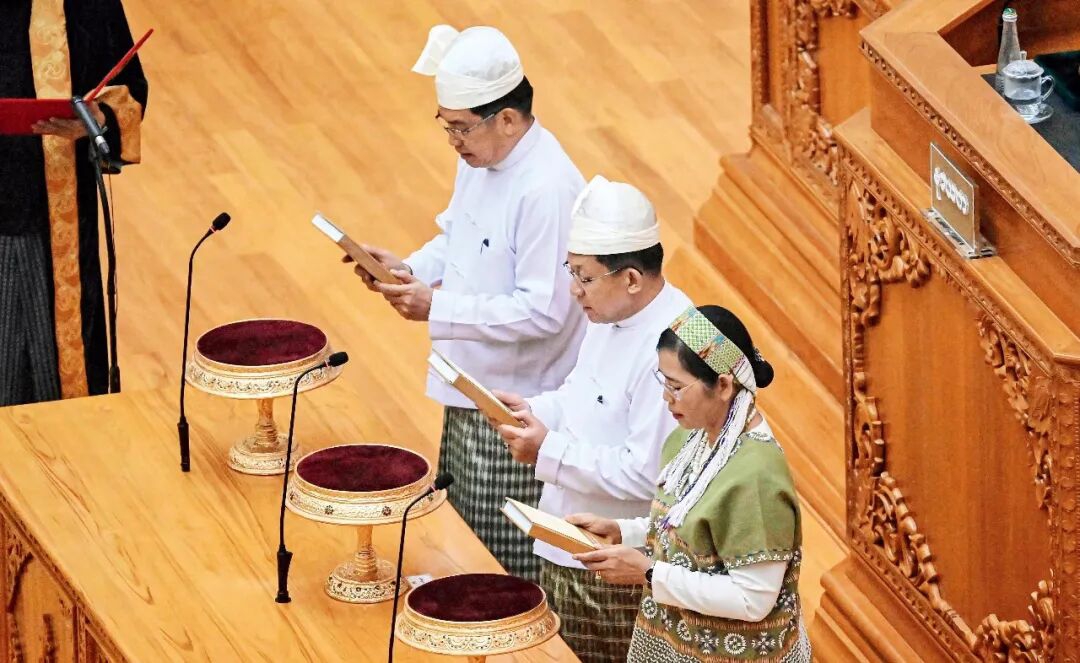
Myanmar's new President Min Aung Hlaing (central), along with the newly-elected vice presidents, took their oaths of office on April 10.
These elections have not only reshaped Myanmar’s domestic political landscape but also set the basic framework for the direction of its domestic and foreign policies in the coming years. However, the deep-seated challenges — including ethnic divisions, armed conflicts, economic vulnerability, and external constraints — cannot be resolved in the short term and will continue to test the governance capacity of the new administration.
First, ethnic reconciliation remains highly uncertain. Myanmar’s ethnic issues involve deep-seated conflicts over power-sharing, resource allocation, and cultural identity between the central government and ethnic minority regions. The trust deficit built up over years of prolonged conflict has resulted in a significant gap between the demand of hardline armed organizations and the stance of Myanmar central government. It remains difficult to transform periodic ceasefire into lasting peace. In the coming years, security in northern Rakhine State and northern Myanmar may remain volatile, thereby affecting the stability of economic reconstruction and cross-border cooperation.
Second, economic recovery faces multiple constraints. The continuation of Western sanctions, insecurity in some regions, aging infrastructure, insufficient foreign exchange reserves, and slow recovery of external investment confidence are the factors that hinder Myanmar’s economic recovery. Myanmar’s current economic policies are largely reactive, and it will be difficult to change the country’s single-sector economy that is heavily dependent on the export of primary products. If the economic growth continues to fall short of expectations, unemployment and poverty could challenge the new government’s ability to maintain stability.
Third, expanding diplomatic space will still take time. Some Western countries hold a negative attitude toward Myanmar’s new government, and the likelihood of sanctions being lifted in the short term is low. Sanctions in the financial and foreign trade sectors will continue to restrict the new government. Within ASEAN, views on Myanmar are not consistent, and reintegrating Myanmar into the mainstream of regional cooperation will require sustained diplomatic efforts.
Finally, while a relatively centralized administrative system helps improve decision-making efficiency, it has inherent shortcomings in incorporating diverse opinions and reflecting the demands of different groups. How to balance social stability and public expression, and avoid the long-term accumulation of potential contradictions, is a challenge the new government must face in its governance.
(About the authors: Xia Zhikuan is a research assistant and Ph.D. student at the Center for China’s Neighbor Diplomacy Studies, Yunnan University; Luo Shengrong is a researcher and Ph.D. supervisor at the Institute of International Relations, Yunnan University.)
