


Philippine clan politics: An elite dilemma out of Western-democracy transplant


The Philippine Senate initiated impeachment proceedings against Vice President Sara Duterte on May 18. Inside the session hall, 23 senators were sworn in as judges of the impeachment court; outside, thousands of riot police stood ready, with steel barricades and checkpoints pushing tensions in Metro Manila to a breaking point.
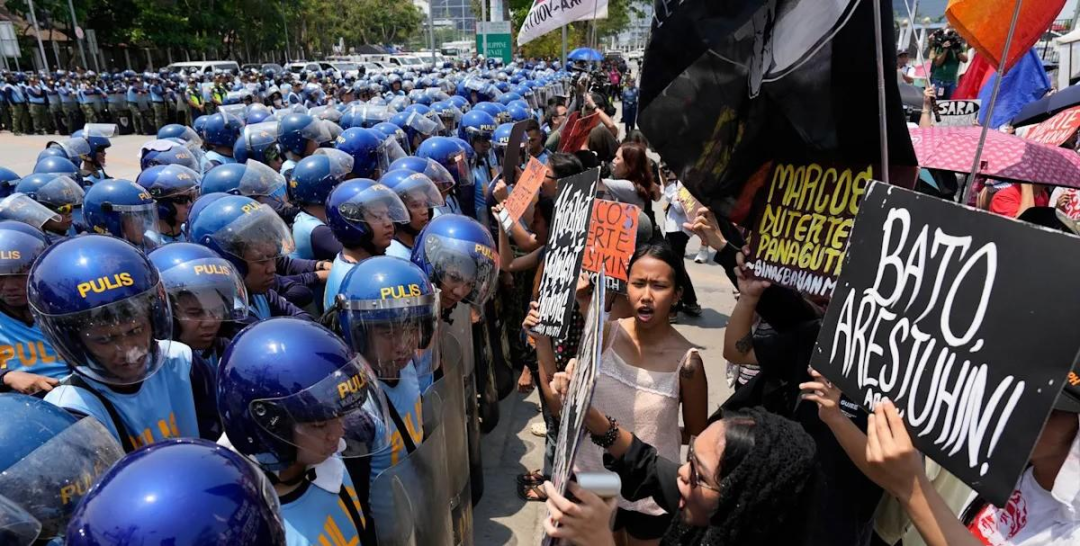
Riot police stand in Manila on May 18.
This fractured scene is a microcosm of Philippine clan politics — when family interests dominate national governance, democracy inevitably deviates from its original design. To better understand why such fierce confrontations have become the norm in Philippine politics, one must go back to 1565, when Spain formally colonized the Philippines, laying the groundwork for dynastic politics.
The 300-plus years of Spanish colonial rule established the foundation of the Philippine oligarchic system. Through the encomienda system, the colonizers nurtured local elites loyal to them, co-opting them into the colonial apparatus and gradually shaping the prototype of Philippine family-based politics.
The American colonial period introduced Western-style electoral politics, but only traditional oligarchic families could run for office, leading to the heredity of political power among a small number of elite clans. For a long time, the central government was alternately controlled by a few major families from Central Luzon and the Visayas, who formed intricate patronage networks through intermarriage and alliances — the root of the Philippines’ modern political malaise.
The rivalries among the major families controlling Philippine dynastic politics have spanned more than half a century, with the main stream being the conflicts and bloody feuds among three blocs: the Marcoses, the Aquinos, and the Dutertes.
The Marcos and Aquino families are the most deeply influential adversaries in Philippine political history. Their story directly altered the nation’s destiny. In 1983, opposition leader Ninoy Aquino Jr. (father of Benigno Aquino III) returned from exile in the United States. Moments after stepping off the plane in Manila, he was assassinated. The public blamed then-President Ferdinand Marcos. In 1986, Ninoy’s widow, Corazon Aquino, ousted the elder Marcos from power, forcing the Marcos family into exile in Hawaii.
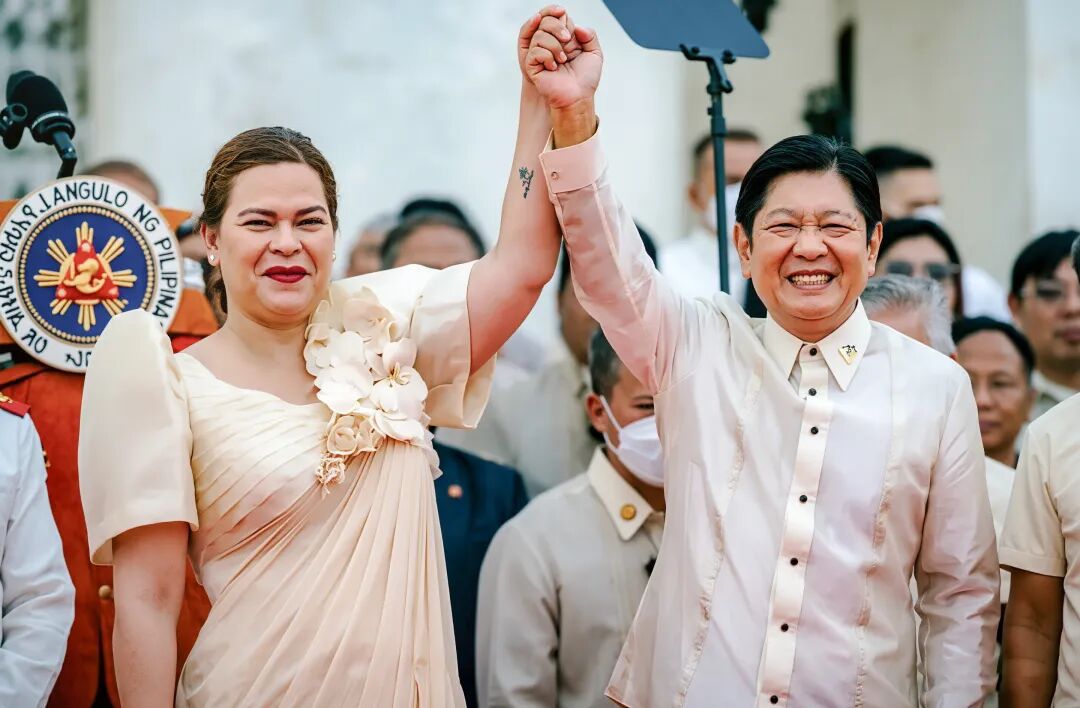
The Duterte and Marcos families have a short-lived alliance.
Meanwhile, the Duterte and Marcos families formed a short-lived alliance based on mutual interests, only to turn against each other after the partnership broke down — a relationship full of drama. Ahead of the 2022 elections, the Dutertes and Marcoses forged a powerful electoral alliance. Sara Duterte, from the Duterte family, accepted the vice presidency under Marcos.
However, to prevent the rising Duterte family from making a comeback in the 2028 elections, the Marcos administration turned around and cooperated with the International Criminal Court, arresting former President Rodrigo Duterte in 2025 and sending him to The Hague. This move provoked a public backlash. The Dutertes once again played the “victim card,” gaining popular support.
The two families also differ in their foreign policy orientations: the Marcos administration has leaned toward the United States, while the Dutertes, during their time in power, emphasized more on great-power balancing. Such divergent political paths meant their alliance could only ever be temporary; in the long run, they were bound to become adversaries, each going their own way.
Today, Philippine politics remains highly dependent on family alliances and elite bargaining. When these family interests clash with the continuity and order of national governance, it is always the governance system that is sacrificed or compromised. Unless the structure of clan politics is broken, the chaos of family interests overriding the national interest will continue to dominate the Philippine political scene.
In Philippine politics, governance is a tool for dynastic families to expand their influence. Alliances are born of interest and dissolve in conflict. When in power, families use the state apparatus to retaliate against former allies, and the state power thus shifts back and forth among the clans.
(The authors Li Siqi and Zhang Rong work at the Institute of International Relations, Yunnan University.)
