


Arctic to Indian Ocean: Mapping the strategic depth of India–Russia RELOS


The India-Russia Reciprocal Exchange of Logistics Agreement (RELOS), which came into effect in April 2026, is a significant defence pact that enables the reciprocal use of military infrastructure and resources. The agreement enlarges India's "strategic space" from the Arctic to the Pacific. RELOS is also a translation of the much-derided notion of "strategic depth" in linking two geologically distant yet historically identical powers of the Arctic and the Indian Ocean. As a result, it not only challenges bilateral defence relations but also a multipolar world.
Most simply, RELOS allows the mutual use of military bases to station 3,000 troops, vessels and aircraft in each other's countries. This is a first for India. India has executed logistics-sharing agreements with friends, allies, and partners, including the United States (the Logistics Exchange Memorandum of Agreement, or LEMOA) in 2016, but none of these has enabled the deployment of troops or assets in this manner. Here, Russia has a special place in the Indian defence ecosystem with RELOS.
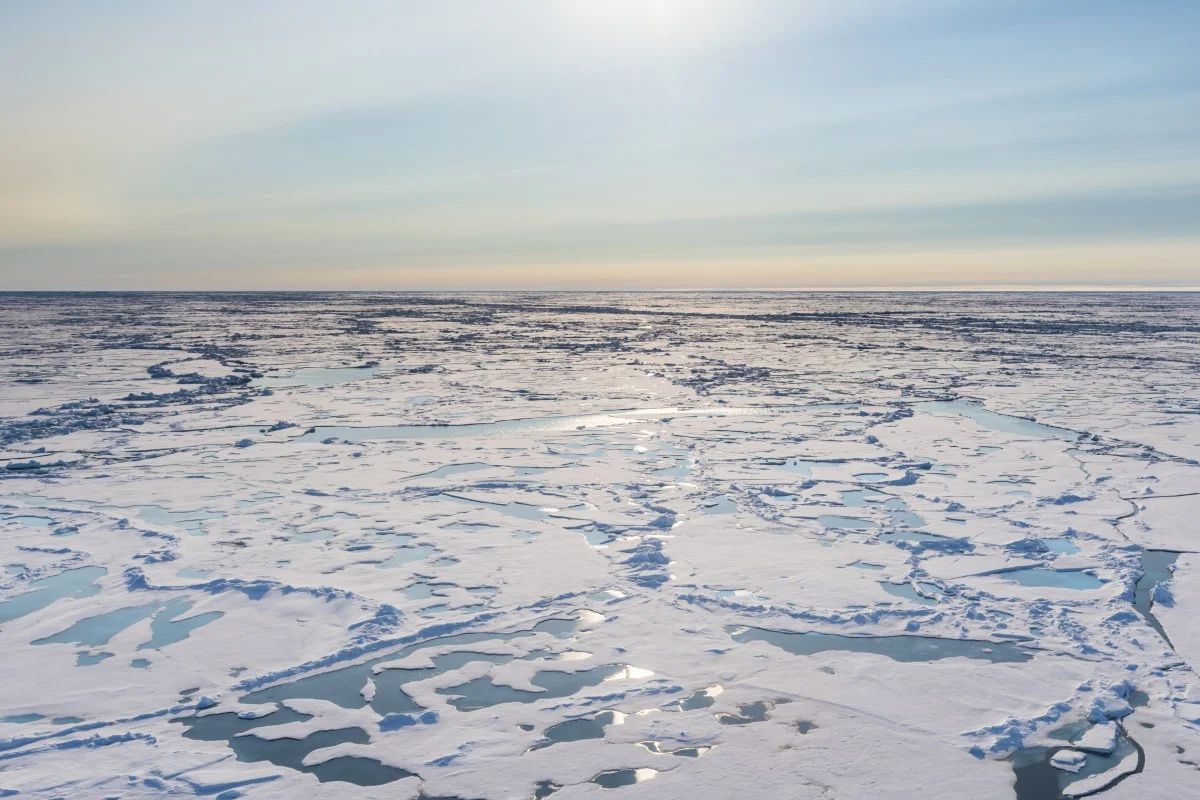
A view of the Arctic region
A contiguous maritime zone along Eurasia's rim
This accord must be seen in the broader geopolitical context of realignment following Russia's invasion of Ukraine. Amid Western sanctions on Russia, India emerged as a significant buyer of cheap Russian oil. This realpolitik energy policy was criticised by Western leaders, such as US President Donald Trump, who considered it to be supporting the Russian invasion led by President Vladimir Putin. India, however, defied Western pressure and chose economic advantage over geopolitical pressure, a policy that continues with RELOS.
In geostrategic terms, RELOS boosts India's influence. Logistical hubs in the Russian Far East (Vladivostok on the Pacific Ocean) and the Arctic (Murmansk) mean the Indian government has control from the Indo-Pacific region to the Arctic. This is no mere token. The Arctic is rapidly becoming a vital geopolitical and economic region as ice recedes and maritime transit through the Northern Sea Route opens up. This gives India, a maritime country heavily dependent on trade, more options amid global supply chain risks and greater leverage beyond traditional choke points like the Strait of Malacca.
In exchange, Russia gets to operate in the Indian Ocean region (IOR), a maritime domain long dominated by Western powers and increasingly contested by China. India's ports give Russia access to warmer waters, which are accessible year-round and not available at its Arctic port facilities. This transaction thus links two operational theatres to create a contiguous maritime zone along Eurasia's rim.
The RELOS deal also has practical advantages. The Indian military is still largely reliant on Russian equipment (60-70 per cent). This agreement enables timely repair, maintenance and stocking of these systems through base camps. This reduces downtime during operations and enhances readiness, particularly in long-duration operations. And the training and joint patrols in the agreement improve interoperability, taking bilateral military engagement beyond arms sales.
An insurance policy and a bargaining chip
But, RELOS is also about geopolitics. By extending to Russia the same, if not more, benefits as provided under LEMOA, India asserts its autonomy. It affirms New Delhi's desire not to be "one-sided", even in the context of increased Western engagement. This is particularly so in recent years, given India's relations with the US, especially since Donald Trump's return. Disputes over trade, foreign policy and military co-operations have clouded what was once a burgeoning partnership.
In this respect, RELOS is an insurance policy and a bargaining chip. It ensures that Russia continues to view India as a security partner, but also gives the US a taste of what it might lose if it does not continue to work with India. This is part of a multipolar world where middle powers such as India seek to maintain their independence by playing their partners against each other.
On the other side, China's reaction to RELOS highlights its significance. On the face of it, China has appeared to support the agreement, lauding it as good for the "Global South". Yet, there is a level of concern behind this. The Arctic is a key focus of China's "Polar Silk Road," and the Indian Ocean is a priority under its Belt and Road Initiative's sea-lanes initiative. Better coordination between India and Russia in these waters makes it difficult for China's long-term plan.
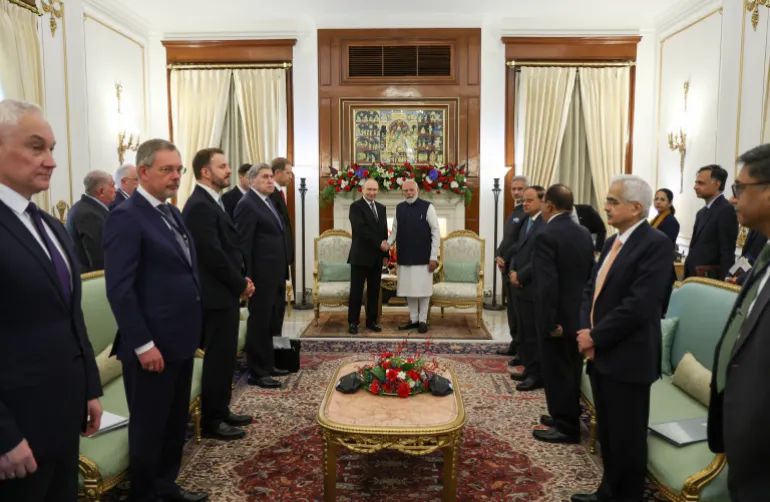
Russia’s President Vladimir Putin shakes hands with India’s Prime Minister Narendra Modi during a meeting in New Delhi, India, on December 5, 2025 [Sputnik/Alexander Kazakov via Reuters]
It is a two-way street for India. On the one hand, RELOS enhances its capabilities in the Indo-Pacific by adding a northern flank to its geostrategy. On the other hand, it could see New Delhi caught in the competition between the big powers, which may limit its options. This is where this part of the balance will be tricky, and where diplomacy will be required to ensure that engagement with Russia doesn't undermine other important relationships, particularly in technology and trade.
Another RELOS issue is maritime awareness. Importantly, combined logistics and patrols enable greater situational awareness of strategic ocean spaces, such as the Arctic and Indian Ocean. This, in turn, will help with energy security, maritime security and infrastructure. In a more dangerous world, where supply chains are increasingly vulnerable to threats such as climate change, conflict, and geopolitical rivalry, these considerations are even more important.
A bridge between the Arctic and the Indian Ocean
But there are concerns from critics. Having foreign military personnel and equipment on India's soil, in a controlled way, is a first. It raises questions of sovereignty and control, as well as the risk of escalation in a crisis. Transparency and procedures will need to be in place to manage these implications and instil confidence. In addition, the future of RELOS is dependent on Russia's standing in the world. Isolation from the West could erode its economic and technological capacity, potentially affecting long-term plans. For India, this underlines the importance of a diversified arms procurement and partnerships.
But the deal also has positive implications. RELOS gives India a deeper strategic reach, literally and figuratively, by expanding its presence in multiple directions and further establishing its position as a global player. For Russia, it offers a means of reconnecting with Asia after its attempts to exclude it from the globalised world. Ultimately, RELOS symbolises a new era of security in the 21st century. Space is no longer a constraint but an opportunity, and a connection through logistics, technology, and alliances. The Arctic and the Indian Ocean are today connected.
In a world of uncertain geopolitics, pacts like RELOS will decide the future. They are reflective of a multipolar reality, flexible, pragmatic, and self-interested, not ideological. The challenge for India will be to make the most of this strategic bounty while keeping true to its first principle: sovereignty in an interdependent world. By connecting the Arctic to the Indian Ocean, RELOS links regions and the past to the future. And how it will become a bridge to stability or a flashpoint for conflict will be determined by its cautious use in the years ahead.
So, the India-Russia RELOS is not just a logistic agreement; it is also a bridge between the Arctic and the Indian Ocean in a turbulent world. In a world beset by the Middle East crisis on energy and security, alliances are in transition and expanding. In this respect, RELOS boosts India's strategic flexibility and helps Russia move away from Europe. But it also affects the bilateral relations between China and India and between China and the US. It offers India a counterweight to China without binding alliances. For the US, it adds to alliances but strengthens Indian sovereignty. And for China, it affords a nuanced balance in Eurasia and oceans. In an evolving multipolar world, RELOS is not about conflict but about balance in a hotspot.
(The writer Dr. Sujit Kumar Datta is a professor at the Department of International Relations, University of Chittagong, Bangladesh.)
