Geography has never played a role in foreign politics of the theatre, or the theatrical world--but what are the most important geographies? Strategic waterways or chokepoints are the decisive spaces, which, on the one hand, project power, engage in struggle, and restructure power. This was the case because it occurred during the Suez Canal crisis in the mid-20th century, and it continues to hold true in the current Strait of Hormuz crisis: empires are even slower to decline. They begin to wear out after the military ambition accelerates faster than the political policy, and economic weakness undermines the political geopolitical ambitions. The reorganization of the world order is not typically abrupt; more likely, it is a slow process that can be accompanied by crises, giving evidence of the structural fragility of the dominant forces.
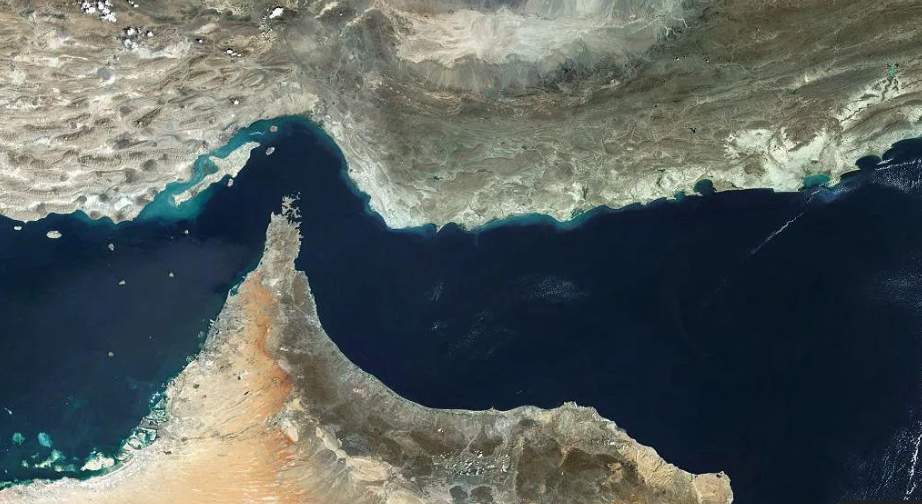
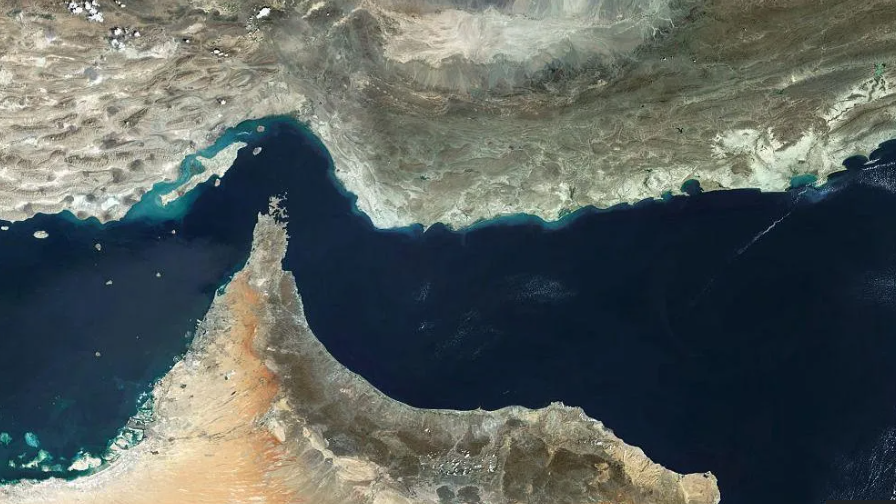
A view of the Strait of Hormuz
In nationalizing the Suez Canal in 1956, President of Egypt Gamal Abdel Nasser not only proclaimed sovereignty but also tore the very heart of the British imperial presence in the Middle East. It was not only a trade route but also a strategic canal between Britain and its surviving colonies, and the symbol of its undying imperial glory. The British response was very quick, but it was not placed in the right place. London, which was weary of the Second World War and at the same time unwilling to lose its position, intervened in the military to regain control of the canal and overthrow Nasser, with the help of France and Israel. The campaign seemed to be effective at first. Anglo-French forces were fast in their movement, and Israeli forces seized the Sinai Peninsula. But the benefits on the battlefields, as history would reveal, do not necessarily translate into political achievements.
It was not the battlefield; rather, it was the greater scheme of world power. Diplomacy was engaged in the two giants of the bipolar world, the United States and the Soviet Union. U.S. President Dwight D. Eisenhower had recognized the danger of escalation and the possibility that Britain could be sidelined as a crumbling imperialist nation. Washington was working hard to strangle finances, thus jeopardizing the stability of the pound sterling and the availability of international financial support. Britain was already a weak economic state, but it could not afford the war. This brought about the humiliating defeat that marked the end of British rule in the Middle East.
The Suez Crisis was thus a highly significant lesson, as it showed that empires cannot be sustained through the application of military force. The person must also possess the economic ability and vision. Britain was not defeated because of its failure to excel in its army; rather, it was because of the overly fluctuating nature of its resources and ambitions. This imbalance emerged during the crisis, which accelerated the shift of power in the region from London to Washington.
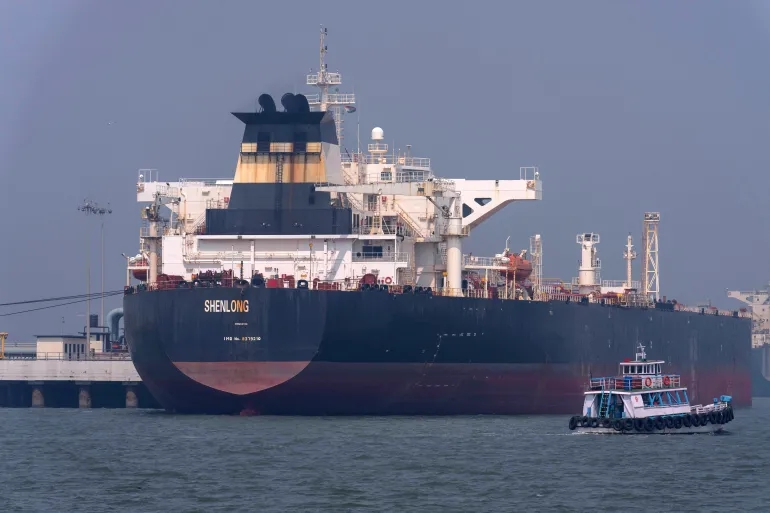
The Liberia-flagged tanker Shenlong Suezmax at the Mumbai port in India after clearing the Strait of Hormuz, on March 12, 2026 [AP Photo]
It is compelled to face another crisis at the Strait of Hormuz chokepoint, which is almost 70 years old. This narrow waterway transports around one-fifth of the world's oil and natural gas; therefore, it is a chokepoint for global energy security. Any disruption with this one directly and far-reaching affects the world economy. Nonetheless, Hormuz is not only an asset because of its energy flows, but also a battlefield on which the American power's survival in the Middle East is on trial.
The Iranian variable in this equation is important. It is a mixture of political will and an enormous army, since this was not the situation in 1956 when Egypt had to resort to diplomatic missions in the bipolar system. It possesses numerous missiles, drones, and capabilities in asymmetric warfare, enabling it to disrupt the world's sea traffic and energy markets. This power is also facilitated by geography, since Iran is closer to the Strait and can therefore exert its power on a larger scale than it did with its traditional power.
This gives an intricate quandary to America. On the one hand, the military conflict is rife with horrible perils in case it escalates. The disruption of international markets, the rise in energy prices, and the straining of alliances would be the long-term results of any disruption of Hormuz. The de-escalation process without strategic objectives, on the contrary, would demonstrate American power weaknesses. That would be a good message to the region's actors: that their endurance and resilience could even offset the greatest military advantage.
This twin crisis, in most respects, is similar to the crisis Britain faced in 1956. However, in the contemporary context, the case is likely to be more complex. The current global system is no longer bipolar but multipolar, with newly emerging superpowers such as China and Russia playing significant roles. Though these players do not literally play the role of the Cold War superpowers, they still influence the strategic calculus by furthering the non-unipolar order.
A limitation of the tactical and structural power is a critical difference in analyzing these crises. The US and its allies have crushing tactical advantages in air superiority, naval power, and advanced intelligence and technology. This tactical victory, however, does not always translate into a strategic or political victory as the Suez Crisis did. The situation in Iran, however, is a structural struggle. It is well situated geographically, but it has a regional structure of cooperation and a decentralized military policy, which weighs it down and puts it in an asymmetric position. Its yearnings are too low and local, even to itself, to survive, to struggle, and exist. This is a disproportionality of these purposes. The US is trying to bring sanity to the region, whereas Iran is trying everything to survive and gain freedom. As world history has proven, in unfair combat, the weaker party usually wins.
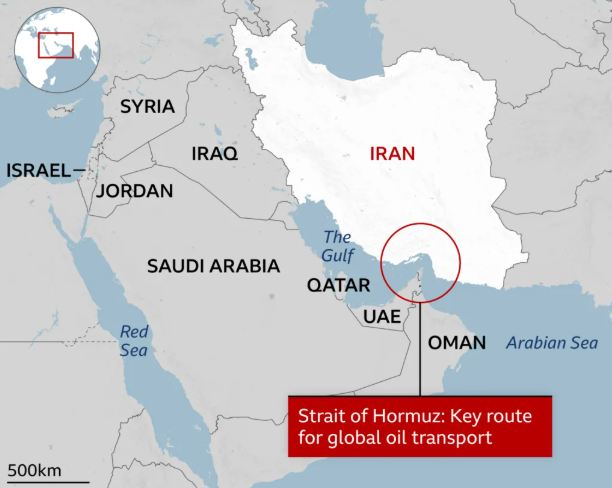
Location of the Strait of Hormuz
Such a comparison has a very loose meaning. These are the main channels of the Gulf, like the Suez and the Hormuz, where the shift in the world order may be observed. They are an amalgamation of the military, finances, and will. They show the futility of the great powers, their destiny, and that of their opponents.Above all, they disclose that hegemony erosion is a process, a slow-paced, controversial, and, in most cases, locally caused crisis. The point is that the geography between Suez and Hormuz is not historical. The military's supremacy is subject to political prudence, and when its economic foundations are sabotaged, the corrosion sets in. The present tensions in the Strait of Hormuz may not be a re-enactment of the 1956 drama; however, they already contain elements of change.
These chokepoints in the era when the world is getting acquainted with a much more volatile international system are a constant reminder that it is not only the amount of power being exercised, but also how well the person can utilise it. Here, the Suez to Hormuz passage is simply a historical analogy, a peep into the future of the world-system, in which solidity, moderation, and tact will be the elements that will determine the fates of nations.
In conclusion, it is history that not only are trade routes strategically located along waterways, but also that the crossroads of the fate of the great powers lie there. The crisis in 1956 over the Suez Canal proved the weakness of British imperial power, and its decline began. Tension in the Strait of Hormuz today is similar to that time, and it is comparable to the struggles that contain the hegemony of the United States in a world that is becoming increasingly competitive. What it is teaching us is that even the most powerful nations have to re-examine themselves when economic frailty, geopolitical revulsion, and strategic profligacy meet. Suez and Hormuz put the players of the world on their minds that there is no mastery of byways to be had.
(The writer Dr. Sujit Kumar Datta is a professor at the Department of International Relations, University of Chittagong, Bangladesh.)