


As regional powers, India and Vietnam seek mutual support


From May 5 to 7, President of Vietnam To Lam paid a state visit to India. The India-Vietnam relations was thus upgraded from the comprehensive strategic partnership established a decade ago to an Enhanced Comprehensive Strategic Partnership.
Following Donald Trump's return to office in 2025, both India and Vietnam have had to deal with a more isolationist United States. In trade and economics, both India and Vietnam have become primary targets of U.S. pressure. Strategically, the United States has shown little regard for the two countries' strategic value in containing China.
Against this backdrop, middle powers around the world have made strategic adjustments, and India and Vietnam are no exception. For regional powers, seeking mutual support has become a more realistic and reliable option.
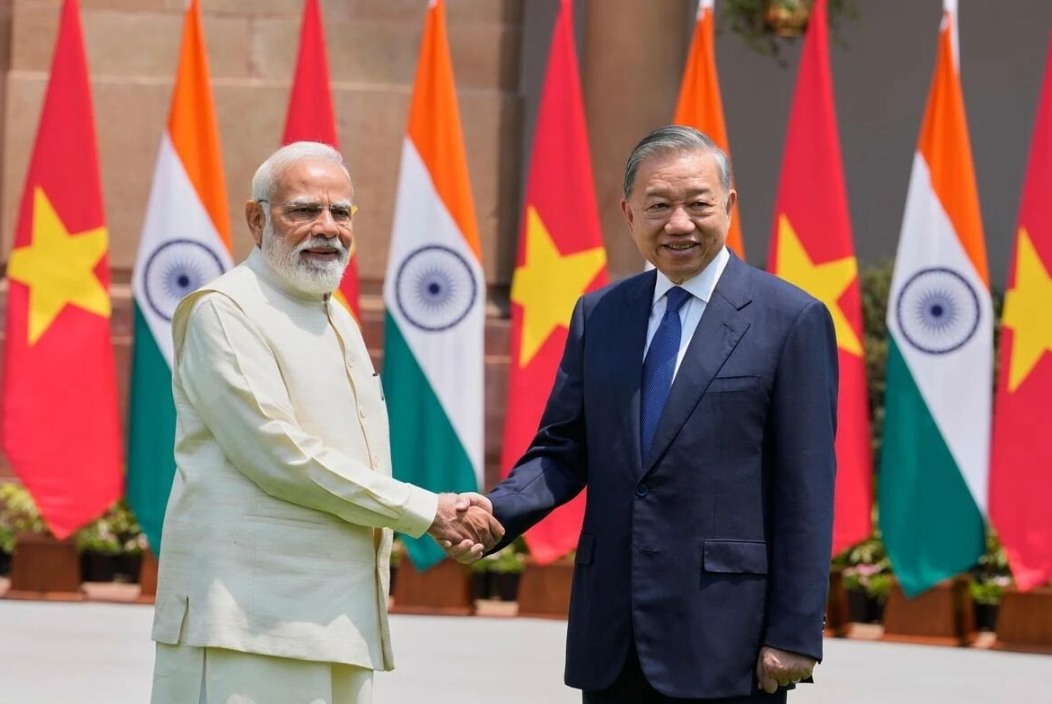
Modi and To Lam shake hands during the visit.
Cooperation highlights
In addition to continuing their dialogue mechanisms on political strategy, economy, trade, science and technology, the two sides have agreed to establish dialogue mechanisms in defense, maritime security, trade and investment, agriculture, health, information and communications technology (ICT), cybersecurity, science and technology, space, and atomic energy.
On development cooperation, India's "Vision 2047" will be aligned with Vietnam's goal of becoming a high-income country by 2045 to strengthen collaboration in economic development, trade, and investment. The two countries have also made a clear commitment to increase their current bilateral trade volume of $16 billion to $25 billion by 2030.
Defense and security cooperation remains the cornerstone of India-Vietnam relations. In June 2022, the two countries signed a general framework for defense cooperation, the "India-Vietnam Joint Vision Statement on Defense Partnership 2030," along with a landmark Mutual Logistics Support Agreement.
Subsequently, in November 2025, India and Vietnam signed a Memorandum of Understanding on Submarine Search and Rescue Support and Cooperation and a Letter of Intent on Strengthening Defense Industry Cooperation, broadening the India-Vietnam defense cooperation.
During this visit, the two countries explicitly committed to further deepening defense cooperation. Vietnam has joined India's Indo-Pacific Oceans Initiative (IPOI), and the two militaries will strengthen cooperation and exchanges in traditional and emerging defense.
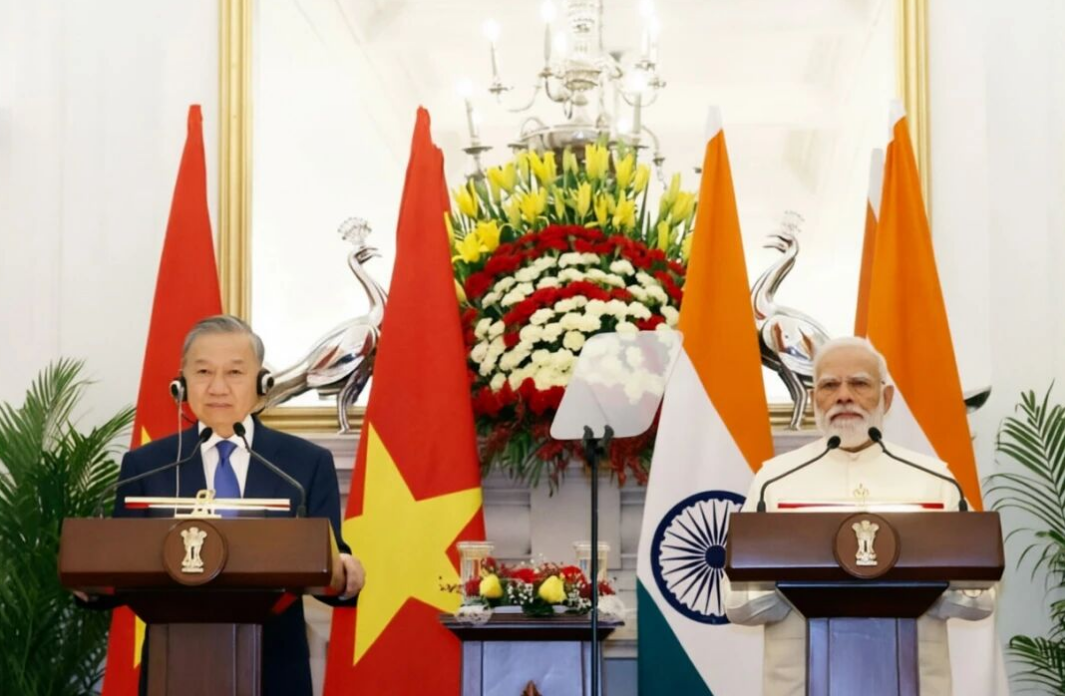
Modi and To Lam attend a joint press conference during the visit.
A partnership of historical foundation
The development of the India-Vietnam strategic partnership has a strong historical foundation. Since India's independence in 1947, India provided significant political support for Vietnam's wars against France and the United States, based on its stance against colonialism and hegemony.
After Vietnam invaded Cambodia and installed the Heng Samrin regime in 1979, India was one of the few countries to recognize that regime. Following the outbreak of the Sino-Vietnamese self-defense counterattack in 1979, India provided substantial political support and military defense assistance to Vietnam.
After the dissolution of the Soviet Union, India launched its "Look East Policy" in late 1992, aiming to strengthen economic and trade ties with Southeast Asia. Within ASEAN, Vietnam supported India's pursuit of a greater strategic presence in the region.
By early 21st century, as India and Vietnam gradually expanded economic and trade cooperation, they also began to restore and strengthen their security and defense relationship, signing a broad defense cooperation agreement covering intelligence sharing, personnel training, military equipment maintenance, and cooperative weapons production.
With the introduction and advancement of the U.S. Indo-Pacific Strategy in 2017, both India and Vietnam publicly supported a free and open Indo-Pacific, echoed and embraced the U.S. "de-risking" strategy for supply chains, joined the Indo-Pacific Economic Framework (IPEF), and reinforced the U.S.-led international narrative on the South China Sea, international law, and freedom of navigation.
(The author Lin Minwang is a researcher at the Institute of International Studies, Fudan University.)
